Kevin Coolidge
I want to grow up to be the President of the United States. Who doesn’t? The perks are great-- free housing, an experienced household staff paid for by the taxpayers, private plane, bullet-proof car, guaranteed media exposure, my own bowling alley, and all with access to nuclear weapons. Plus, when I die, I get a parade!
Sure, once I take the oath of office, someone I have never met will want me dead. Okay, probably a whole lot of somebody’s, and the population of some nations. Yes, the probability of being assassinated dramatically increases, but I get to throw out the first pitch on opening day, and I bet front-row tickets to Dancing with the Stars is totally going to happen.
In theory, there are only two qualifications to run for president of the United States. The candidate must be at least 35 years of age, and a natural-born citizen of the United States. I’ve met the minimum requirements to be elected president. There’s already been one Coolidge in the White House. Surely, it’s time for another.
Being president isn’t actually all that hard. Approval numbers aren’t a problem once you are in office. You’re guaranteed at least four years, and maybe eight if you have a good speechwriter and if you are better-looking than your opponent. If you think about it, and I certainly have, it’s pretty hard to screw up things up bad enough to be fired, or impeached, if you read history and like big words.
It’s a pretty secure* sinecure. Former presidents have started wars for no reason, had sex with interns, undermined Congressional policy, and don’t even ask about the cover-ups. If you want to be the first President to actually be impeached, you are going to have to lose Alaska in an arm wrestling match to the English Prime Minister, and you can always just quit like Nixon.
Becoming president—getting elected—is much, much harder than being president. For help with this, I read So You Want To Be President? by John Warner. It may appear that there is no real formula to winning the presidency. There have been several winning strategies, but I’m not a war hero, or a Hollywood actor.
John has thought of everything. All I have to do is work through the scenarios and exercises and be better prepared for the hard work of an actual election. This book won’t guarantee me victory, but it will guarantee fun. Now I just have to come up with my political slogan. I’m thinking, “Putting the Cool back in Political”…
*The only job more secure than being president of the United States is Supreme Court Justice. That’s a position appointed for life. That means you get to stay on the bench even if you drool in your oatmeal, or flip a coin to make decisions about the laws that govern our nation. Do these people even show up for work? Who keeps track? I’m betting there are morning Sotomayor never takes her PJs off. Hmmm…
Hail to the chief? Or the hell with this job? Email me at from_my_shelf@yahoo.com and let me know. Miss a past column? Just access the secret bunker for past columns at frommyshelf.blogspot.com. Hobo wants to be president, but he can’t decide if he’s technically nine years old, or fifty-two. He’ll just have to settle for being First Cat, and author of “Hobo Finds A Home”…
Monday, September 24, 2012


Monday, September 17, 2012
I Could Pee on This
Kevin Coolidge
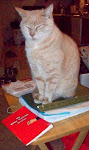
A heap of fur leaps onto my desk and plops in front of the keyboard. Of course, it’s time to write my column. Hobo, the cat, always seems to know this, and he’s here to supervise. Unfortunately, he’s not nearly as helpful as he thinks. I don’t know what to write about, and he’s not giving suggestions. He doesn’t do that. It’s my job.
It should be easy. I read every day. Sometimes, when I’m really busy, it’s just ten or fifteen minutes before bed, but I’m always reading something. Actually, I’m one of those people that are usually reading at least four books, sometimes more. He’s some of what I’m reading right now.
Monster Hunter Legion by Larry Correia: This book is the fourth in the series that started with Monster Hunter International. I discovered Larry’s book in 2007 when it was still only a self-published novel. Self-publishing doesn’t have to mean vanity publishing, because sometimes other people really do want to read it, and they aren’t saying that just to be nice.
In the Monster Hunter series, it turns out monsters exist, and there is good money to be made killing them. Enter Monster Hunter International (MHI), remarkable group of misfits that has banded together. They do more than dare to raise a candle to the darkness. They pack napalm-fed flame-throwers and lots of firepower. There’s specialized body armor, big guns with unusual ammunition, and bloodsucking fiends. You’ll also find some likable, well-developed heroes that bleed and a full-speed action that’s funny as all Hades.
In this latest installment, the staff of MHI is in Las Vegas to attend the first annual International Conference of Monster Hunting Professionals. A great opportunity to network with all the supernaturally attuned organizations and the best buffets, but a creature left over from a World War Two weapons experiment wakes up and goes on a rampage proving that what happens in Vegas, doesn’t always stay in Vegas….
Then, there’s I Could Pee on This: And Other Poems by Cats, by Francesco Marciuliano: I’m not a fan of poetry. I seldom read it. I often skip it when my favorite authors insert it into their prose, begging me to read it. Dying to prove that people still read poetry. I almost always skip it so that I can get back to the good stuff. I do, however, appreciate that some subjects are better expressed in verse form.
Cats are natural poets—quiet, focused, and a little lazy. It’s only natural that felines would express themselves through free verse rather than longer literary works. Sometimes a few words do paint a larger canvas.
If you have a cat, you’ve been woken up early for the morning feeding, or accidentally stepped on your present of dead rodent. Francesco has, and his poetry reveals the true artistic and neurotic genius that all cats possess. The science fiction writer Robert Heinlein once wrote, “Women and cats will do as they please, and men and dogs should relax and get used to the idea.” I guess you have your answer to why dogs are man’s best friend…Dogs are possessions. Cats have personnel…
The Walking Dead graphic novel series by Robert Kirkman: I just finished watching the second season of the Walking Dead on DVD. It’s not just gratuitous violence, but truly a character-driven drama that carries an undercurrent of social commentary, and yeah-- there’s zombies.
It’s an adaptation from the graphic novel series, but there are some departures, and it’s one of the few times that I think the visual medium is an improvement. Mostly because the graphic novel is used almost as a storyboard, and the actors, director, and writers are able to further develop some of the characters I both love to hate and hate to love. There are a lot of zombie movies out there, but they always end. What happens next? With the Walking Dead you get to see the morning after, and the morning after that…
I didn’t know where to begin, and now I don’t know where to end. I’m almost out of room and I didn’t tell you about the book of short stories almost finished on my nightstand, or the audio book I’ve been listening to when I’ve been lifting weights in the garage. I didn’t have time to mention the book I’m reading that claims learning to cook was the hinge on which human evolution turned. I guess I have plenty to read and write about after all…
Too much to read, or not enough time to read them all? Email me at from_my_shelf@yahoo.com and let me know!
A heap of fur leaps onto my desk and plops in front of the keyboard. Of course, it’s time to write my column. Hobo, the cat, always seems to know this, and he’s here to supervise. Unfortunately, he’s not nearly as helpful as he thinks. I don’t know what to write about, and he’s not giving suggestions. He doesn’t do that. It’s my job.
It should be easy. I read every day. Sometimes, when I’m really busy, it’s just ten or fifteen minutes before bed, but I’m always reading something. Actually, I’m one of those people that are usually reading at least four books, sometimes more. He’s some of what I’m reading right now.
Monster Hunter Legion by Larry Correia: This book is the fourth in the series that started with Monster Hunter International. I discovered Larry’s book in 2007 when it was still only a self-published novel. Self-publishing doesn’t have to mean vanity publishing, because sometimes other people really do want to read it, and they aren’t saying that just to be nice.
In the Monster Hunter series, it turns out monsters exist, and there is good money to be made killing them. Enter Monster Hunter International (MHI), remarkable group of misfits that has banded together. They do more than dare to raise a candle to the darkness. They pack napalm-fed flame-throwers and lots of firepower. There’s specialized body armor, big guns with unusual ammunition, and bloodsucking fiends. You’ll also find some likable, well-developed heroes that bleed and a full-speed action that’s funny as all Hades.
In this latest installment, the staff of MHI is in Las Vegas to attend the first annual International Conference of Monster Hunting Professionals. A great opportunity to network with all the supernaturally attuned organizations and the best buffets, but a creature left over from a World War Two weapons experiment wakes up and goes on a rampage proving that what happens in Vegas, doesn’t always stay in Vegas….
Then, there’s I Could Pee on This: And Other Poems by Cats, by Francesco Marciuliano: I’m not a fan of poetry. I seldom read it. I often skip it when my favorite authors insert it into their prose, begging me to read it. Dying to prove that people still read poetry. I almost always skip it so that I can get back to the good stuff. I do, however, appreciate that some subjects are better expressed in verse form.
Cats are natural poets—quiet, focused, and a little lazy. It’s only natural that felines would express themselves through free verse rather than longer literary works. Sometimes a few words do paint a larger canvas.
If you have a cat, you’ve been woken up early for the morning feeding, or accidentally stepped on your present of dead rodent. Francesco has, and his poetry reveals the true artistic and neurotic genius that all cats possess. The science fiction writer Robert Heinlein once wrote, “Women and cats will do as they please, and men and dogs should relax and get used to the idea.” I guess you have your answer to why dogs are man’s best friend…Dogs are possessions. Cats have personnel…
The Walking Dead graphic novel series by Robert Kirkman: I just finished watching the second season of the Walking Dead on DVD. It’s not just gratuitous violence, but truly a character-driven drama that carries an undercurrent of social commentary, and yeah-- there’s zombies.
It’s an adaptation from the graphic novel series, but there are some departures, and it’s one of the few times that I think the visual medium is an improvement. Mostly because the graphic novel is used almost as a storyboard, and the actors, director, and writers are able to further develop some of the characters I both love to hate and hate to love. There are a lot of zombie movies out there, but they always end. What happens next? With the Walking Dead you get to see the morning after, and the morning after that…
I didn’t know where to begin, and now I don’t know where to end. I’m almost out of room and I didn’t tell you about the book of short stories almost finished on my nightstand, or the audio book I’ve been listening to when I’ve been lifting weights in the garage. I didn’t have time to mention the book I’m reading that claims learning to cook was the hinge on which human evolution turned. I guess I have plenty to read and write about after all…
Too much to read, or not enough time to read them all? Email me at from_my_shelf@yahoo.com and let me know!
Sunday, September 9, 2012
Disaster Preparedness
Kevin Coolidge
They laughed. I smiled. They said this day would never come. I knew. They said I was wasting my time and money. I prepared. Yes, the world was safe when I installed a standby generator. The situation was stable when I stockpiled ammunition. People went on vacation while I bought up the canned bacon. I waited. I was right…
Why prepare at all? It’s calm. The skies are clear, and life is good. Wouldn’t your resources best be used for what you know is coming? Life is unpredictable. Fires burn, storms rage, and enemies attack. No one is ever completely safe. What do you do? Should you get ready for Armageddon or put your trust in the government when disaster strikes?
There is an alternative. You don’t have to become a hardcore survivalist, or a trusting fool. Don’t let disaster preparedness distract you from meeting life’s other needs. Don’t spend five times your salary on a water filtration system. Arthur T. Bradley’s motto is “prepare for what makes sense.”
The world probably isn’t going to end tomorrow, and if it were, that assault rifle with optional grenade launcher won’t ensure your survival. According to The Disaster Preparedness Handbook, by Arthur T. Bradley, you should prepare for challenges you might actually face—power outages, inclement weather, and being stranded on the road.
His book is designed to help your family for more common, yet still potentially deadly, disasters--hurricanes, tornadoes, earthquakes, blackouts and more. Bradley’s hopes to accomplish three things: 1. Motivate you to become better prepared 2. Illustrate how to prepare effectively and 3. Help you realize your place in a larger movement.
This isn’t book on how to live off the land, become self-sufficient. This isn’t practical for most people. It’s also not list driven with examples of tools, clothing, and food supplies to hoard. This book is designed to help identify the needs you may experience during hard times.
The book is organized around basic needs that must be met in order to survive. At the beginning of each chapter is a scenario designed to help the reader access the current level of readiness—for example, a powerful storms rolls through your community overnight, causing a loss of electrical power, or your county health department issues a boil order for all tap water.
The ends of the chapters have short summaries of the important points for future reference—for example, carbon monoxide poisoning and fire are dangers associated with backup heaters. Also a brief list of recommended supplies limited to actual needs, focusing more on general need than specific items—such as having fuel for your emergency heater.
You can’t prepare for everything. Know your capabilities, but more importantly, know your limitations. Unless all civilization breaks down, you don’t need to be self-sufficient to be prepared. Focus on your family’s needs and know that being prepared is a part of being responsible. The goal is be more confident, better-prepared and secure in an unpredictable world…
Prepared? Or Scared? Email me at from_my_shelf@yahoo.com and let me know. Miss a past column? Visit http://frommyshelf.blogspot.com and stock up now. Hobo the cat is prepared. You might call him fat; he calls it insurance, because the hardest thing about the zombie apocalypse should be the waiting…
They laughed. I smiled. They said this day would never come. I knew. They said I was wasting my time and money. I prepared. Yes, the world was safe when I installed a standby generator. The situation was stable when I stockpiled ammunition. People went on vacation while I bought up the canned bacon. I waited. I was right…
Why prepare at all? It’s calm. The skies are clear, and life is good. Wouldn’t your resources best be used for what you know is coming? Life is unpredictable. Fires burn, storms rage, and enemies attack. No one is ever completely safe. What do you do? Should you get ready for Armageddon or put your trust in the government when disaster strikes?
There is an alternative. You don’t have to become a hardcore survivalist, or a trusting fool. Don’t let disaster preparedness distract you from meeting life’s other needs. Don’t spend five times your salary on a water filtration system. Arthur T. Bradley’s motto is “prepare for what makes sense.”
The world probably isn’t going to end tomorrow, and if it were, that assault rifle with optional grenade launcher won’t ensure your survival. According to The Disaster Preparedness Handbook, by Arthur T. Bradley, you should prepare for challenges you might actually face—power outages, inclement weather, and being stranded on the road.
His book is designed to help your family for more common, yet still potentially deadly, disasters--hurricanes, tornadoes, earthquakes, blackouts and more. Bradley’s hopes to accomplish three things: 1. Motivate you to become better prepared 2. Illustrate how to prepare effectively and 3. Help you realize your place in a larger movement.
This isn’t book on how to live off the land, become self-sufficient. This isn’t practical for most people. It’s also not list driven with examples of tools, clothing, and food supplies to hoard. This book is designed to help identify the needs you may experience during hard times.
The book is organized around basic needs that must be met in order to survive. At the beginning of each chapter is a scenario designed to help the reader access the current level of readiness—for example, a powerful storms rolls through your community overnight, causing a loss of electrical power, or your county health department issues a boil order for all tap water.
The ends of the chapters have short summaries of the important points for future reference—for example, carbon monoxide poisoning and fire are dangers associated with backup heaters. Also a brief list of recommended supplies limited to actual needs, focusing more on general need than specific items—such as having fuel for your emergency heater.
You can’t prepare for everything. Know your capabilities, but more importantly, know your limitations. Unless all civilization breaks down, you don’t need to be self-sufficient to be prepared. Focus on your family’s needs and know that being prepared is a part of being responsible. The goal is be more confident, better-prepared and secure in an unpredictable world…
Prepared? Or Scared? Email me at from_my_shelf@yahoo.com and let me know. Miss a past column? Visit http://frommyshelf.blogspot.com and stock up now. Hobo the cat is prepared. You might call him fat; he calls it insurance, because the hardest thing about the zombie apocalypse should be the waiting…
Sunday, September 2, 2012
I Survived Summer Reading
Kevin Coolidge
It’s summer, and that means vacation, and summer reading. If you are looking for your third grader to survive summer reading, then check out the historical fiction series by Lauren Tarshis. History is more than a series of situations, and dates. Lauren presents historical facts woven with the experience of a boy living through a historical event. History is life lived backwards, and it doesn’t have to be boring.
The San Francisco Earthquake, 1906: Leo loves being a newsboy in San Francisco. Having a job that gives him the freedom to explore the city is an opportunity that his grandfather would want him to take. One early spring morning, everything changes. The earth rumbles, and he finds himself stranded in the middle of the city as buildings crumble and burn. Can Leo survive the devastating disaster?
The Sinking of the Titanic, 1912: George must be the luckiest kid alive. He’s sailing on the Titanic, the greatest ship ever built. There’s so much for a young boy to explore, but the impossible happens, an iceberg. George is stranded, alone and afraid. Will he survive the sinking of the ship?
The Shark Attacks of 1916: Chet is finally feeling at home in Elm Hills, New Jersey. A job, great friends, and the perfect summertime destination: cool, refreshing Matawan Creek. Shocking news interrupts his plans when a shark begins attacking swimmers along the Jersey shore. Will he come face-to-face with a bloodthirsty shark?
The Bombing of Pearl Harbor, 1941: Danny is a tough city kid from New York City. He is out of place in Hawaii, and he just wants to go home. Mom wanted a fresh start away from the crime, dark alleys, and gangs. But nothing was as dangerous as the morning the skies filled with fighter planes. Bombs and bullets pound the harbor. Can Danny survive the day that will live in infamy?
The Attacks of September 11, 2001: Lucas loves football, but his parents think it’s too dangerous. His dad’s friend Benny is a firefighter and a former football star. He’d know what to do. Lucas takes the train to the city instead of the bus to school. It’s a bright beautiful day in New York, but just as Lucas arrives at the firehouse, everything changes. Will anything ever be the same again?
Hurricane Katrina, 2005: Barry just wants to win the “Create a Superhero” contest from his local comic shop. He worked three hours just on the flames. Then his father tells him to pack up. The hurricane is getting nasty and there’s a mandatory evacuation, but Barry’s little sister is sick, and they are forced to stay home. The levees break and Barry is separated from his family. Can he survive the storm of the century…alone?
Sand, sunburn, and sharks, nothing says summer like the beach, and that’s why I’m staying close to shore. I’m staying home where I will be safe. I won’t be leaving Tioga County anytime soon, but I can take a vacation anytime I want. All I have to do is pick up a book, and open the pages. A book will take me places I’ve never been. Another adventure, another place, another time—all of it possible with a good book….
History: created by the actions of the great? Or shaped by the simple deeds of the small? Email me at from_my_shelf@yahoo.com and let me know. Miss a past column? Delve into the past at http://frommyshelf.blogspot.com Hobo isn’t planning on repeating history. He found a home and he’s keeping it. You can, however, read about his past in “Hobo Finds A Home”
It’s summer, and that means vacation, and summer reading. If you are looking for your third grader to survive summer reading, then check out the historical fiction series by Lauren Tarshis. History is more than a series of situations, and dates. Lauren presents historical facts woven with the experience of a boy living through a historical event. History is life lived backwards, and it doesn’t have to be boring.
The San Francisco Earthquake, 1906: Leo loves being a newsboy in San Francisco. Having a job that gives him the freedom to explore the city is an opportunity that his grandfather would want him to take. One early spring morning, everything changes. The earth rumbles, and he finds himself stranded in the middle of the city as buildings crumble and burn. Can Leo survive the devastating disaster?
The Sinking of the Titanic, 1912: George must be the luckiest kid alive. He’s sailing on the Titanic, the greatest ship ever built. There’s so much for a young boy to explore, but the impossible happens, an iceberg. George is stranded, alone and afraid. Will he survive the sinking of the ship?
The Shark Attacks of 1916: Chet is finally feeling at home in Elm Hills, New Jersey. A job, great friends, and the perfect summertime destination: cool, refreshing Matawan Creek. Shocking news interrupts his plans when a shark begins attacking swimmers along the Jersey shore. Will he come face-to-face with a bloodthirsty shark?
The Bombing of Pearl Harbor, 1941: Danny is a tough city kid from New York City. He is out of place in Hawaii, and he just wants to go home. Mom wanted a fresh start away from the crime, dark alleys, and gangs. But nothing was as dangerous as the morning the skies filled with fighter planes. Bombs and bullets pound the harbor. Can Danny survive the day that will live in infamy?
The Attacks of September 11, 2001: Lucas loves football, but his parents think it’s too dangerous. His dad’s friend Benny is a firefighter and a former football star. He’d know what to do. Lucas takes the train to the city instead of the bus to school. It’s a bright beautiful day in New York, but just as Lucas arrives at the firehouse, everything changes. Will anything ever be the same again?
Hurricane Katrina, 2005: Barry just wants to win the “Create a Superhero” contest from his local comic shop. He worked three hours just on the flames. Then his father tells him to pack up. The hurricane is getting nasty and there’s a mandatory evacuation, but Barry’s little sister is sick, and they are forced to stay home. The levees break and Barry is separated from his family. Can he survive the storm of the century…alone?
Sand, sunburn, and sharks, nothing says summer like the beach, and that’s why I’m staying close to shore. I’m staying home where I will be safe. I won’t be leaving Tioga County anytime soon, but I can take a vacation anytime I want. All I have to do is pick up a book, and open the pages. A book will take me places I’ve never been. Another adventure, another place, another time—all of it possible with a good book….
History: created by the actions of the great? Or shaped by the simple deeds of the small? Email me at from_my_shelf@yahoo.com and let me know. Miss a past column? Delve into the past at http://frommyshelf.blogspot.com Hobo isn’t planning on repeating history. He found a home and he’s keeping it. You can, however, read about his past in “Hobo Finds A Home”
Monday, July 30, 2012
A Bridge to the Past
Kevin Coolidge
I can hear the rush of water as the horses approach the stream. It’s a cold, wet night, perfect for dallying in the shelter of the covered bridge crossing Miller’s Creek. Perhaps, I can even steal a kiss from my sweetheart.
I love the red, rustic look of a covered bridge. It reminds me of a time when life was simple and roads were made of dirt instead of asphalt. During the 1800s, there were over 12,000 covered bridges in the United States, but due to fire, flood, neglect and modern replacement that number has dwindled to about 750.
Pennsylvania has slightly more than 200 covered bridges, more than any other state. In fact, Pennsylvania has 25% of the existing covered bridges in the United States. Pennsylvania has many waterways, and during the 1800s, Pennsylvania was almost entirely forested as well as being a major source of lumber for the United States, thus the reason for so many covered bridges.
The first covered bridge in the United States was built in Philadelphia. Timothy Palmer, a bridge builder from Massachusetts, thought if bridges were better protected from the elements, then the life of a bridge could be extended from 10 to 12 years to perhaps as many as 40 years. Today, we can see how keeping a bridge dry and properly maintained can increase its use to well over a 100 years.
Pennsylvania also had the longest covered bridge ever built. The Columbia-Wrightsville Covered Bridge was over a one mile in length, and was constructed over the Susquehanna River. Pennsylvania is indeed the “Covered Bridge Capital” of the United States, being the state with the first covered bridge, the most covered bridges, and home to the longest covered bridge. What could have been an end to a large number of our covered bridges occurred in 1958, when the state highway department began to modernize the highway system.
In Pennsylvania, the state-owned bridges were to be replaced within three years if they did not have at least a 15-ton limit capacity, at least a 14-foot clearance, or one travel lane. This would have eliminated most covered bridges. Local historical societies and a new group of concerned citizens formed the Theodore Burr Covered Bridge Society of Pennsylvania, to save these historical structures.
The influence of the society and public outcry helped create an understanding that the covered bridges would be preserved if it was feasible. The needless destruction of these bridges was slowed, and today the number of existing bridges remains fairly constant.
Fred J. Moll is a historian of the society, and his book Pennsylvania’s Covered Bridges looks at the earliest covered bridges as well as those that have survived progress. There is also a chapter on Pennsylvania’s railroad covered bridges. Very few photos or information exist on these structures. So, step back in time and imagine the days when our forefathers traveled these wooden spans to reach their daily destinations….
Bridge the gap? Or burn your bridges? Email me at from_my_shelf@yahoo.com and let me know. Miss a past column? Take a bridge to the past at http://frommmyshelf.blogspot.com and catch up. Get a glimpse into Hobo the cat’s past in “Hobo Finds A Home”, a children’s book about a cat’s adventures.
I can hear the rush of water as the horses approach the stream. It’s a cold, wet night, perfect for dallying in the shelter of the covered bridge crossing Miller’s Creek. Perhaps, I can even steal a kiss from my sweetheart.
I love the red, rustic look of a covered bridge. It reminds me of a time when life was simple and roads were made of dirt instead of asphalt. During the 1800s, there were over 12,000 covered bridges in the United States, but due to fire, flood, neglect and modern replacement that number has dwindled to about 750.
Pennsylvania has slightly more than 200 covered bridges, more than any other state. In fact, Pennsylvania has 25% of the existing covered bridges in the United States. Pennsylvania has many waterways, and during the 1800s, Pennsylvania was almost entirely forested as well as being a major source of lumber for the United States, thus the reason for so many covered bridges.
The first covered bridge in the United States was built in Philadelphia. Timothy Palmer, a bridge builder from Massachusetts, thought if bridges were better protected from the elements, then the life of a bridge could be extended from 10 to 12 years to perhaps as many as 40 years. Today, we can see how keeping a bridge dry and properly maintained can increase its use to well over a 100 years.
Pennsylvania also had the longest covered bridge ever built. The Columbia-Wrightsville Covered Bridge was over a one mile in length, and was constructed over the Susquehanna River. Pennsylvania is indeed the “Covered Bridge Capital” of the United States, being the state with the first covered bridge, the most covered bridges, and home to the longest covered bridge. What could have been an end to a large number of our covered bridges occurred in 1958, when the state highway department began to modernize the highway system.
In Pennsylvania, the state-owned bridges were to be replaced within three years if they did not have at least a 15-ton limit capacity, at least a 14-foot clearance, or one travel lane. This would have eliminated most covered bridges. Local historical societies and a new group of concerned citizens formed the Theodore Burr Covered Bridge Society of Pennsylvania, to save these historical structures.
The influence of the society and public outcry helped create an understanding that the covered bridges would be preserved if it was feasible. The needless destruction of these bridges was slowed, and today the number of existing bridges remains fairly constant.
Fred J. Moll is a historian of the society, and his book Pennsylvania’s Covered Bridges looks at the earliest covered bridges as well as those that have survived progress. There is also a chapter on Pennsylvania’s railroad covered bridges. Very few photos or information exist on these structures. So, step back in time and imagine the days when our forefathers traveled these wooden spans to reach their daily destinations….
Bridge the gap? Or burn your bridges? Email me at from_my_shelf@yahoo.com and let me know. Miss a past column? Take a bridge to the past at http://frommmyshelf.blogspot.com and catch up. Get a glimpse into Hobo the cat’s past in “Hobo Finds A Home”, a children’s book about a cat’s adventures.
Monday, July 23, 2012
The Orphan Trains
Dark brown eyes and thick, wavy black hair. The girl is beautiful, and it’s the only photo Lee has of a mother he can’t remember. “I guess blocking everything out of my mind is how I got through it.” Even though he was seven years old when she died from complications of childbirth, he can’t remember his mother’s death, though his brother Leo, then four, remembers.
He does remember his father overcome with grief. He tried to care for the seven children, but couldn’t. The three oldest had to leave home and take of themselves. The baby was given to family friends. Somebody else took Gerald, then a year old. Lee has never forgotten what happened to Leo and himself.
Lee and his brother were taken to an orphanage. Two more homeless kids in a country that already had too many. Many of these children had one or both parents still living, but those parents could not care for their children or had abandoned them. Parents who were ill, fathers who were widowed, or mothers who were not married sometimes put their children in orphanages because they had no way to care for them.
Life in the orphanage was hard and hungry and there were too many orphans. Lee thought about running away, but he stayed because his brother was too young to go with him. One day, Lee, Leo and some of the other children were told they were going to ride a train.
Orphan trains like the one Lee was about to board had been operating since 1854. By 1929, when they stopped running, the trains had carried about 200,000 homeless children from the East to new families in the Midwest and South. I read about Lee’s story in Orphan Train Rider by Andrea Warren.
Charles Loring Brace, a minister, started the orphan trains. He had worked in the slums of New York City, and worried about the lack of housing, good food, medical care, and schooling for all the homeless children. In 1853, he started the Children’s Aid Society. As soon as he opened an office in the slums, the children came.
He wrote articles and gave speeches to raise money. He used that money to start programs to “help the children help themselves”. The homeless needed somewhere to live, but Brace didn’t think orphanages were the solution. Children needed good families so they could become adults who could take care of themselves and others. Where would he find families to take so many needy children?
The answer: out West. In 1854, the Children’s Aid Society sent 46 boys and girls to a little town in Michigan. Within a week, every child had a home. Inspired by this success, large groups of children were sent west on what became known as orphan trains.
Lee remembers the excitement and heartache of the trains. Lee did not want a new family and was angry to be taken to a new home. Agents who worked for the Society looked for towns that were interested in having an orphan train stop. They then put up signs and set up a screening committee to find as good a match as possible.
Most placements were successful, though children who were physically or mentally handicapped or just too old were usually left behind. The Midwest was settled largely by white Europeans, and most of the orphan train riders had that heritage. The society knew these children had the best chance of being chosen.
Lee arrived in Texas a bitter, unhappy boy. At first he wanted to run away, but his new family made sure he saw his brothers as often as possible, and he learned to love them deeply, and call them Mom and Dad and mean it. Lee finally found his home
Trains? Planes? Or Automobiles? Drop me an email at from_my_shelf@yahoo.com and let me know. Miss a past column? Visit http://frommyshelf.blogspot .com. Hobo the cat was an orphan that rode the rails. He found his home and you can read all about it in “Hobo Finds A Home”, a children’s book about a cat and his adventures…
He does remember his father overcome with grief. He tried to care for the seven children, but couldn’t. The three oldest had to leave home and take of themselves. The baby was given to family friends. Somebody else took Gerald, then a year old. Lee has never forgotten what happened to Leo and himself.
Lee and his brother were taken to an orphanage. Two more homeless kids in a country that already had too many. Many of these children had one or both parents still living, but those parents could not care for their children or had abandoned them. Parents who were ill, fathers who were widowed, or mothers who were not married sometimes put their children in orphanages because they had no way to care for them.
Life in the orphanage was hard and hungry and there were too many orphans. Lee thought about running away, but he stayed because his brother was too young to go with him. One day, Lee, Leo and some of the other children were told they were going to ride a train.
Orphan trains like the one Lee was about to board had been operating since 1854. By 1929, when they stopped running, the trains had carried about 200,000 homeless children from the East to new families in the Midwest and South. I read about Lee’s story in Orphan Train Rider by Andrea Warren.
Charles Loring Brace, a minister, started the orphan trains. He had worked in the slums of New York City, and worried about the lack of housing, good food, medical care, and schooling for all the homeless children. In 1853, he started the Children’s Aid Society. As soon as he opened an office in the slums, the children came.
He wrote articles and gave speeches to raise money. He used that money to start programs to “help the children help themselves”. The homeless needed somewhere to live, but Brace didn’t think orphanages were the solution. Children needed good families so they could become adults who could take care of themselves and others. Where would he find families to take so many needy children?
The answer: out West. In 1854, the Children’s Aid Society sent 46 boys and girls to a little town in Michigan. Within a week, every child had a home. Inspired by this success, large groups of children were sent west on what became known as orphan trains.
Lee remembers the excitement and heartache of the trains. Lee did not want a new family and was angry to be taken to a new home. Agents who worked for the Society looked for towns that were interested in having an orphan train stop. They then put up signs and set up a screening committee to find as good a match as possible.
Most placements were successful, though children who were physically or mentally handicapped or just too old were usually left behind. The Midwest was settled largely by white Europeans, and most of the orphan train riders had that heritage. The society knew these children had the best chance of being chosen.
Lee arrived in Texas a bitter, unhappy boy. At first he wanted to run away, but his new family made sure he saw his brothers as often as possible, and he learned to love them deeply, and call them Mom and Dad and mean it. Lee finally found his home
Trains? Planes? Or Automobiles? Drop me an email at from_my_shelf@yahoo.com and let me know. Miss a past column? Visit http://frommyshelf.blogspot .com. Hobo the cat was an orphan that rode the rails. He found his home and you can read all about it in “Hobo Finds A Home”, a children’s book about a cat and his adventures…
Thursday, July 12, 2012
All Cats Have Asperger Syndrome
Kevin Coolidge
Your child is special. He’s not the best at catching the ball and doesn’t like playing at recess. He’d rather stand alone staring at the ants. Maybe he’ll be an entomologist. Besides, it’s not like you were captain of the football team. He’s still young. Sure, some of the kids think he’s a little weird, but he’ll make friends. He just has to find someone that shares his interest in the stars. He can name all the stars in the Orion’s belt. It may take a little time. He can be so talkative. He can be so quiet. Maybe he just scares people? You love your son.
It’s why it made you a little anxious when the doctor asked if he’s often aloof with his peers? Does he look you in the eye? Does he find comfort in routine? He refers you to specialist in childhood development disorders, but he suspects a mild form of Asperger Syndrome. Your heart just dropped into your stomach. What does that even mean? More importantly, what is it going to mean to your son?
Asperger’s Syndrome is also called Asperger’s disorder, and belongs to a group of conditions that involve delays in the development of many basic skills, usually the ability to socialize, communicate, or to use imagination. Asperger’s syndrome is similar to autism, but with some important differences. Children with Asperger’s generally have normal intelligence and near normal language development, though problems in communication may arise as they get older.
Symptoms can range from mild to severe. Common symptoms include problems with social skills—such as maintaining a conversation. Children may develop repetitive behaviors like hand wringing. A child may start rituals that they refuse to alter—such as getting dressed in a specific order. People with Asperger’s often do not make eye contact when speaking, and have difficulty in understanding body language. The movement of children with Asperger’s may seem clumsy or awkward, and children may develop an almost obsessive interest in specific areas, for example weather, or maps, but may be exceptionally talented in a particular area—such as music or mathematics.
All these descriptions can be overwhelming. Will my son be able to live a normal life? Will I be able to be the type of parent I need to be? A book that brings this diagnosis back into perspective is all cats have asperger syndrome by Kathy Hoopmann. There’s truth in humor, and this book is filled with funny photographs of cats combined with accurate, yet simple information about Asperger syndrome.
If you care for a child with Asperger, you are going to find some encouragement within these heart-warming pages. Your child may be different, but his needs aren’t always so different. He needs love and encouragement, some occasional advice, and space to be himself. He’s different in his own way, but there’s a little Asperger in all of us…
All cats have Asperger’s? Or do all dogs have ADD? Drop me an email at from_my_shelf@yahoo.com and let me know. Miss a past column? You can find them all at http://frommyshelf.blogspot.com Cats or dogs, if you love animals, check out “Hobo Finds A Home”, a children’s book about a cat who found a home, and a friend…
Your child is special. He’s not the best at catching the ball and doesn’t like playing at recess. He’d rather stand alone staring at the ants. Maybe he’ll be an entomologist. Besides, it’s not like you were captain of the football team. He’s still young. Sure, some of the kids think he’s a little weird, but he’ll make friends. He just has to find someone that shares his interest in the stars. He can name all the stars in the Orion’s belt. It may take a little time. He can be so talkative. He can be so quiet. Maybe he just scares people? You love your son.
It’s why it made you a little anxious when the doctor asked if he’s often aloof with his peers? Does he look you in the eye? Does he find comfort in routine? He refers you to specialist in childhood development disorders, but he suspects a mild form of Asperger Syndrome. Your heart just dropped into your stomach. What does that even mean? More importantly, what is it going to mean to your son?
Asperger’s Syndrome is also called Asperger’s disorder, and belongs to a group of conditions that involve delays in the development of many basic skills, usually the ability to socialize, communicate, or to use imagination. Asperger’s syndrome is similar to autism, but with some important differences. Children with Asperger’s generally have normal intelligence and near normal language development, though problems in communication may arise as they get older.
Symptoms can range from mild to severe. Common symptoms include problems with social skills—such as maintaining a conversation. Children may develop repetitive behaviors like hand wringing. A child may start rituals that they refuse to alter—such as getting dressed in a specific order. People with Asperger’s often do not make eye contact when speaking, and have difficulty in understanding body language. The movement of children with Asperger’s may seem clumsy or awkward, and children may develop an almost obsessive interest in specific areas, for example weather, or maps, but may be exceptionally talented in a particular area—such as music or mathematics.
All these descriptions can be overwhelming. Will my son be able to live a normal life? Will I be able to be the type of parent I need to be? A book that brings this diagnosis back into perspective is all cats have asperger syndrome by Kathy Hoopmann. There’s truth in humor, and this book is filled with funny photographs of cats combined with accurate, yet simple information about Asperger syndrome.
If you care for a child with Asperger, you are going to find some encouragement within these heart-warming pages. Your child may be different, but his needs aren’t always so different. He needs love and encouragement, some occasional advice, and space to be himself. He’s different in his own way, but there’s a little Asperger in all of us…
All cats have Asperger’s? Or do all dogs have ADD? Drop me an email at from_my_shelf@yahoo.com and let me know. Miss a past column? You can find them all at http://frommyshelf.blogspot.com Cats or dogs, if you love animals, check out “Hobo Finds A Home”, a children’s book about a cat who found a home, and a friend…
Monday, June 18, 2012
Kevin Coolidge
The Butterfly Effect
Skin prickles, stomach tightens, fists clenched, jaw so tight it aches. I used to love thunderstorms. The gusty winds, the driving rain, the sound of thunder. Now, lightning jolts memories--memories of the past, the future, and my promise to make all of it better. I no longer know where to end. I only know I can’t stop. Only that I need to begin…again.
If you could travel back in time, and kill the man that started it all, would you? You aren’t sure. I knew I could. Evil or misunderstood, I didn’t care. He was the problem, and I was the solution. It sounds easy. The hopeful look in his eyes, the smell of spring in the air, or maybe I just needed something to fill the blank space in the living room. I don’t know where it went wrong. I bought a painting. I’m sorry. I should have killed Hitler…
The butterfly effect—small differences in initial conditions can yield widely diverging outcomes, rendering long-term prediction almost impossible, in essence, chaos. How could I know that making Hitler a successful artist would result in enslaving humanity? Would a bullet have bought a better future for mankind? Should I have just stayed home?
The idea that one little ripple, that one butterfly could eventually have a far-reaching ripple effect on historic events first appeared in A Sound of Thunder, a 1952 short story by Ray Bradbury. The story begins in a future where a time machine exists. Time Safari Inc. can deliver you to the past and give you the severest thrill a real hunter could ask for, a Tyrannosaurus rex. Be sure to sign the waiver because they guarantee nothing, except the dinosaurs.
Bradbury wrote the kind of story that lurked in the corners of your mind. His stories and novels remain long after the pages have closed. I know. Did that glistening green, gold, and black butterfly inspire “the butterfly effect”? It wasn’t until 1961 that Edward Lorenz coined the term. Could killing that one butterfly really be that important?
Bradbury is perhaps best known for his speculative fiction—such as Fahrenheit 451, The Martian Chronicles, and The Illustrated Man. He is credited with being the writer most responsible for bringing modern science fiction in the literary mainstream. If not for his lyrical, evocative prose, would we have the films of Steven Spielberg, the haunting short stories of Neil Gaiman, or the wizarding world of Harry Potter? Could the imagination of one man really be that important? Does a flash of lightning bring the sound of thunder?
The lightning? Or the Thunder? Email me at from_my_shelf@yahoo.com and let me know. Miss a past column? You too can return to the past at http://frommyshelf.blogspot.com and dig into the archives of columns past. Looking to delve into the past of Hobo the cat? You can read about his early months in “Hobo Finds A Home” a children’s book about a kitten who found a future…
The Butterfly Effect
Skin prickles, stomach tightens, fists clenched, jaw so tight it aches. I used to love thunderstorms. The gusty winds, the driving rain, the sound of thunder. Now, lightning jolts memories--memories of the past, the future, and my promise to make all of it better. I no longer know where to end. I only know I can’t stop. Only that I need to begin…again.
If you could travel back in time, and kill the man that started it all, would you? You aren’t sure. I knew I could. Evil or misunderstood, I didn’t care. He was the problem, and I was the solution. It sounds easy. The hopeful look in his eyes, the smell of spring in the air, or maybe I just needed something to fill the blank space in the living room. I don’t know where it went wrong. I bought a painting. I’m sorry. I should have killed Hitler…
The butterfly effect—small differences in initial conditions can yield widely diverging outcomes, rendering long-term prediction almost impossible, in essence, chaos. How could I know that making Hitler a successful artist would result in enslaving humanity? Would a bullet have bought a better future for mankind? Should I have just stayed home?
The idea that one little ripple, that one butterfly could eventually have a far-reaching ripple effect on historic events first appeared in A Sound of Thunder, a 1952 short story by Ray Bradbury. The story begins in a future where a time machine exists. Time Safari Inc. can deliver you to the past and give you the severest thrill a real hunter could ask for, a Tyrannosaurus rex. Be sure to sign the waiver because they guarantee nothing, except the dinosaurs.
Bradbury wrote the kind of story that lurked in the corners of your mind. His stories and novels remain long after the pages have closed. I know. Did that glistening green, gold, and black butterfly inspire “the butterfly effect”? It wasn’t until 1961 that Edward Lorenz coined the term. Could killing that one butterfly really be that important?
Bradbury is perhaps best known for his speculative fiction—such as Fahrenheit 451, The Martian Chronicles, and The Illustrated Man. He is credited with being the writer most responsible for bringing modern science fiction in the literary mainstream. If not for his lyrical, evocative prose, would we have the films of Steven Spielberg, the haunting short stories of Neil Gaiman, or the wizarding world of Harry Potter? Could the imagination of one man really be that important? Does a flash of lightning bring the sound of thunder?
The lightning? Or the Thunder? Email me at from_my_shelf@yahoo.com and let me know. Miss a past column? You too can return to the past at http://frommyshelf.blogspot.com and dig into the archives of columns past. Looking to delve into the past of Hobo the cat? You can read about his early months in “Hobo Finds A Home” a children’s book about a kitten who found a future…
Monday, June 11, 2012
"Thanks to a program sponsored by Chase and LivingSocial called Mission: Small Business℠, your support could translate into a $250,000 grant. But we need at least 250 votes at missionsmallbusiness.com to qualify. To vote for our business:
Go to missionsmallbusiness.com and log in using Facebook.
Search for our business by name OR filter by our State and City.
Click on the blue Vote button next to our business name to show your support for our business."
https://www.missionsmallbusiness.com/pledge/214679-fmsbooks
From My Shelf Books
Wellsboro PA
www.wellsborobookstore.com
Go to missionsmallbusiness.com and log in using Facebook.
Search for our business by name OR filter by our State and City.
Click on the blue Vote button next to our business name to show your support for our business."
https://www.missionsmallbusiness.com/pledge/214679-fmsbooks
From My Shelf Books
Wellsboro PA
www.wellsborobookstore.com
Nothing to Fear, but Fear, and…
Kevin Coolidge
Keep calm and carry on. There’s nothing to fear here, or at least that’s the official position of the government. “The flesh-eating living dead don’t actually exist”, said a spokesman for the Centers for Disease Control. “The CDC does not know of a virus or condition that would reanimate the dead, or one that would present zombie-like symptoms.”
I don’t know about you, but when a government agency feels the need to give official reassurance, I’m inclined to trust my own infestation plan, and cold-forged steel. Sure, your house has its own victory garden, you have plywood pre-cut for the windows, and you spent your vacation money on a water filtration system, but sometimes you have to leave the house.
I never leave home without my emergency kit. It contains a roll of duct tape, ten feet of rope, a sturdy knife, two quarts of water, two packages of beef jerky, some dried fruit, a can of bacon, towels, an extra shirt, and small crowbar – just right for cracking skulls, or prying off face biters – and, of course, a napalm fed flame-thrower. It’s good to be prepared.
Unfortunately, after reading John Dies @ the End by David Wong, I learned that a zombie apocalypse is actually the best-case scenario. It’s too late for me. I’ve read the book. I’m in the game. I’m under the eye. I know about Korrok, about the invasion, about the future. It’s too late for me. I didn’t have the chance to say no. You still do.
If you make the right choice and stop reading the column here, I’ll have a much harder time explaining how to fight off the otherworldly invasion that threatens to enslave humanity. I’m sorry to have involved you in this, but as you read about the terrible events in John Dies @ the End, and the Dark Age the world will enter as a result, please keep in mind that NONE OF THIS IS MY FAULT.
It all started one day when I called David Wong and his best friend John. No, not their real names. You might want to change yours. I did. These aren’t the guys to call if you need a carburetor rebuilt. These guys have a unique specialty. My sister’s old boyfriend has been harassing her. He won’t leave her alone. Anyone else would call the police, but the real problem is that the boyfriend’s been dead for months.
Have you ever seen movement out of the corner of your eye, turn, and nothing is there? Ever seen a cat at the top of the stairs, only to remember you don’t have a cat? You’ve always known there’s something else out there, and now there’s proof, but don’t say I ever warned you. We all die at the end…
Courage, the lack of fear? Or the ability to face it? Email me at from_my_shelf@yahoo.com and let me know. Miss a past column? Visit http://frommyshelf.blogspot.com and see all our past columns. Looking for a bright, cheerful book with a happy ending? Look no further than “Hobo Finds A Home”, a children’s book about a cat who finds a home. Guaranteed free of interdimensional aliens, or fleeting shadows…
Keep calm and carry on. There’s nothing to fear here, or at least that’s the official position of the government. “The flesh-eating living dead don’t actually exist”, said a spokesman for the Centers for Disease Control. “The CDC does not know of a virus or condition that would reanimate the dead, or one that would present zombie-like symptoms.”
I don’t know about you, but when a government agency feels the need to give official reassurance, I’m inclined to trust my own infestation plan, and cold-forged steel. Sure, your house has its own victory garden, you have plywood pre-cut for the windows, and you spent your vacation money on a water filtration system, but sometimes you have to leave the house.
I never leave home without my emergency kit. It contains a roll of duct tape, ten feet of rope, a sturdy knife, two quarts of water, two packages of beef jerky, some dried fruit, a can of bacon, towels, an extra shirt, and small crowbar – just right for cracking skulls, or prying off face biters – and, of course, a napalm fed flame-thrower. It’s good to be prepared.
Unfortunately, after reading John Dies @ the End by David Wong, I learned that a zombie apocalypse is actually the best-case scenario. It’s too late for me. I’ve read the book. I’m in the game. I’m under the eye. I know about Korrok, about the invasion, about the future. It’s too late for me. I didn’t have the chance to say no. You still do.
If you make the right choice and stop reading the column here, I’ll have a much harder time explaining how to fight off the otherworldly invasion that threatens to enslave humanity. I’m sorry to have involved you in this, but as you read about the terrible events in John Dies @ the End, and the Dark Age the world will enter as a result, please keep in mind that NONE OF THIS IS MY FAULT.
It all started one day when I called David Wong and his best friend John. No, not their real names. You might want to change yours. I did. These aren’t the guys to call if you need a carburetor rebuilt. These guys have a unique specialty. My sister’s old boyfriend has been harassing her. He won’t leave her alone. Anyone else would call the police, but the real problem is that the boyfriend’s been dead for months.
Have you ever seen movement out of the corner of your eye, turn, and nothing is there? Ever seen a cat at the top of the stairs, only to remember you don’t have a cat? You’ve always known there’s something else out there, and now there’s proof, but don’t say I ever warned you. We all die at the end…
Courage, the lack of fear? Or the ability to face it? Email me at from_my_shelf@yahoo.com and let me know. Miss a past column? Visit http://frommyshelf.blogspot.com and see all our past columns. Looking for a bright, cheerful book with a happy ending? Look no further than “Hobo Finds A Home”, a children’s book about a cat who finds a home. Guaranteed free of interdimensional aliens, or fleeting shadows…
Subscribe to:
Posts (Atom)
