Kevin Coolidge
A big, cold glass of milk and a slice of my Grandma’s lemon Bundt cake – nothing says sweet memories like quality baked goods, but not all cakes turn out quite so well. Some cakes are ugly, silly, or unintentionally funny. Now you can have your cake and laugh at it too with Cake Wrecks: When Professional Cakes Go Hilariously Wrong by Jen Yates, creator of CakeWrecks.com.
So what is it about a messed-up cake that people find so appealing? I think it’s because everyone has a cake story to tell. Maybe it’s that Little Pony cake that your mom made, but the dog ate, or it’s that day-glow, frosted dragon cake that gave you Technicolor poo for three days. These little slices of flawed confections make us feel more connected to each other, and remind us not to take life too seriously.
So how does the author define a “cake wreck”? Here is Jen’s working definition: “A cake wreck is any professionally-made cake that is unintentionally sad, silly, creepy, inappropriate—you name it. A wreck is not necessarily a poorly made cake; it’s simply one I find funny, for any number of reasons.”
That’s right: it’s Jen’s call, and if you don’t like it, that’s how the cookie crumbles. But some wrecks are a matter of opinion, and not always the fault of the decorator. Though what occasion would call for naked babies with Mohawks riding carrots is beyond even my wild imagination. The baker may have done a sweet sculpture, but it can still be a wreck. So, grab a fork, turn the page and let’s sample.
Cake Wrecks is divided into several slices. There are the literal LOLs (that’s laughing out loud in text talk). Some wrecks make you wonder what exactly the customer ordered. Not these. There’s the famous email forward photo of “Best Wishes Suzanne Under Neat that We will Miss You”. Another favorite is the all too literal “What do you want on your cake?” and the answer, boldly spelled on said cake -- “NOTHING.” If I got anything from this book, other than a belly full of laughter, it’s never to phone in an order and always “neatly” write down your desired inscription.
Jen Yates gives further cake lessons: now I see that picking up the cake only thirty minutes before the event is never a good idea, and that brown icing has a dramatically good chance of looking like fecal matter. As Yates points out, maybe it’s the texture, maybe it’s that fancy, swirly little twist that bakers use, but for me, it does make that low carb diet more appealing than ever. I think I’ll skip desert.
We’ve all made mistakes, turned right when it should have been left, wore stripes with plaid, and asked a cake decorator to write the word “birthday” on a cake, with those pesky numbers: 1st, 2nd, 3rd, 4th—they all have different endings. Who can keep track of them all? It’s easier to just slap a “th” on them all.
There are also photos of wedding wrecks that fresh flowers can’t fix, holiday horrors of demented Santas, and the beyond bizarre, those creations that frighten, disturb, or just make you go “huh?” A veiled pony as a birthday cake, really? A cake wreck can remind us that life is still sweet, even if your butterfly cake looks more like an alien autopsy. After all, nothing is ever a total loss if it can make you smile. It’s the icing on the cake. So have a Hafpfy birfay! Got ‘ny milk???
Home made? Or bakery bought? Drop me an email at frommyshelf@epix.net. Miss a past column? Have your cake and eat it too at http://frommyshelf.blogspot.com. Hobo knows how sweet it is, that’s why he wrote his memoir “Hobo Finds a Home” a children’s book about a cat who found a home. Now available wherever quality baked goods are sold.
Monday, October 26, 2009


Sunday, October 25, 2009
A Tasty Memoir

I realize that it’s no longer en vogue to be a Francophile; these days, France is more likely to be the punchline for a joke about military history or about culture snobs than it is to be the focus of an article singing her praises. I, however, will always have a big mushy spot in my heart for the French language, as well as for the food, film, art, poetry, travel…. Okay, I know; you get the point. After the intensity of The Laramie Project, I needed something sweet and light to read. Quelle bonne chance for me, I picked up My Life in France. Published in 2006, this lovely memoir was written near the end of Julia’s life, with the help of her grandnephew Alex Prud’homme (husband Paul’s twin brother was Alex’s grandfather).
Julia Child’s memoir is different from most contemporary memoirs in several ways. First of all, unlike many books published by celebrity personalities, this memoir is truly the reflecting-back-on a long, interesting and celebrated life, in sharp contrast to the narcissistic, voyeuristic “memoirs” of people in their thirties or forties which Hollywood pushes to the bestseller list now. To be honest, I could care less about Jon & Kate or Tori Spelling, and if I really need to know about their lives thus far, magazine articles in People or Entertainment Weekly usually suffice.
That criticism of Hollywood being noted, it is important to recognize it was television that brought Julia Child to America’s attention – first, with the introduction of her cooking show, “The French Chef”, in 1963; and then again, with the film, Julie & Julia, just this past August, 2009. As much as I am often leery of the way a film adaptation may ruin a great book, I’m also grateful to have wonderful books brought to national attention again by the promotion of a film version. Such is the case with Julia Child. I never saw Child on TV; my family, as far as I can remember, did not own a copy of any of her cookbooks, although my dad does have an old copy of Larousse Gastronomique floating around the house, which he occasionally gets down and looks through longingly. The re-introduction of Julia Child to my generation, especially through all the hoopla for this film, was a gift to me, since it encouraged me to pick up a memoir I might otherwise have ignored.
Another tremendous difference between Child’s memoir and so many others which regularly populate bestseller lists and book club choices is Child’s upbeat perspective. Although I really appreciate memoir, a basic fact of the genre – of solid storytelling in general – is that conflict and strife make for interesting reading. Remember that plot structure diagram from English class? Sure, that diagram was mostly to teach us about fiction, but fiction imitates life, and life is certainly full of difficulties. Memoirs don’t need to invent problems for their characters; the problems are part of these people’s true stories.
What continued to strike me as I read My Life in France is the uplifting tone: it’s not as if she and Paul didn’t have problems or stress or sadness, because they did. During their early time in France, especially, they had very little money (a middle-level diplomatic position in France in the late 1940s did NOT pay much). Their apartment had no hot water in the kitchen, no central heating, and bad wiring. Paul Child’s job was full of stressors, as he tried to organize, staff and work out of an office that had few resources, in a France trying to recover from the ravages of World War II. Nevertheless, Julia and Paul were happy, believing that “marriage and advancing age agreed” with them, affirming that they were “giddy about Paris.” Paul Child continued to credit his wife for “his new outlook on life. ‘I am less sour now than I used to be,’ he admitted. ‘It’s because of you, Julie.’” Even in her nineties, as she recalled her life to Alex Prud’homme, it is obvious that the phrase joie de vivre was invented to describe Julia Child. It is marvelous to read the thoughts of someone who loved life so much, when many memoirs are either heartbreaking or insipid.
In the land of the 5-minute lunch instead of the five-course dinner, in the time of the Blackberry instead of blackberry wine sauce, can we still enjoy “Mastering the Art of French Cooking”? Well, I haven’t had had a used copy at the bookstore, of either volume, for months, and ordering a used copy online costs just as much as a new one – if not a great deal more, especially if you want an older edition. I guess I know what to get my dad for Christmas, though; Julia Child embarked on her cookbook in order to bring French food to those who moon over Larousse Gastronomique. “Bon appétit”, America.
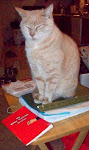
Pommes frites or French fries? Hobo doesn’t eat frogs, but he does appreciate his gourmet food as much as the next fat cat. He’ll have you know his book has traveled to France at least twice now! He’s not a culture snob, though; he’s just a wandering Hobo who found a home. Follow Hobo’s home and kitchen tips at his weekly blog at http://frommyshelf.blogspot.com or share yours with him at frommyshelf@epix.net.
Tuesday, October 20, 2009
How Low Can You Go?

How Low Can You Go?
By Sam Droke-Dickinson, of Aaron’s Books, in Lititz, PA
Modified with permission by Kasey Cox, of From My Shelf, in Wellsboro
By now, you've probably heard of the book price war that is happening online... it's now a three-way battle to the bottom, with Target joining the fray today.
The truth is, the price war is really over a very small number of hardback books. These mega-conglomorates are hoping you'll visit their site for a discounted hardback novel & stay to buy a bunch of Chinese-made junk. (No offense to the Chinese.) They aren't including the trade paperbacks that our book clubs love, the Golden Books we all remember, the histories, mysteries, or spiritual living books that we stock just for you.
So why shop with us, knowing you can get a few books for so much less somewhere else (less than we can even buy the book wholesale from the publisher)?
Here's my top 10 of why NOT to fall for the "go low" trick ....
1) When you buy from us, we've actually read many of the books on our shelves, and for the ones we really like, you've seen them on our blog or reviewed in the Wellsboro Gazette.
2) We know that JD Robb is really Nora Roberts, who herself owns a B&B and indie bookstore.
3) We can pronounce Jodi Picoult's name.
4) If you want something to go along with your ultra cheap bestseller, we can make a recommendation suited to you, and not what some computer "bot" thinks you may like based on your previous keyword search.
5) You don't have to walk (physically or virturtally) through the tire and diaper sections to see our books.
6) You can actually pick up the book, and read a few pages to test it out before buying. And you can browse books in all the other sections that interest you.
7) Will they greet your children by name and remember they like Geronimo Stilton or have read all the Junie B's? We will!
8) We don't require you to search by author or title... you can browse any section and find that unexpected book that makes you smile, cry, or laugh out loud.
9) Our customer service is easy to reach... you just call out "Kasey" or "Kevin" from any section of the store and we're there to help you.
10) When you "buy local", your money stays local. How does your community benefit when you buy from Amazon? How much support do they provide your local library? Do they buy car insurance from a local firm? Do they order their materials from a local printer? Do they offer meeting space for local groups or a train table for your kids in the play room? NOPE, NADA, NOTHING... not one dime or one second of time goes back to the community when you shop the mega-marts online!
So yes, you can save $10 today playing the "how low can you go" game, but did you really save enough to balance out all that your local independent bookstore does for your town/city/county? It comes down to choices, and sometimes making the choice to spend a few more dollars just feels right! And if you do buy the discount book, don't buy anything else. They are doing this to get you to fill your cart; don't fall for the trap. Get a bag of books you really want at your indie bookstore.
Monday, October 12, 2009
Meet Meg
Kevin Coolidge
There is one knows not what sweet mystery about this sea, whose gently awful stirrings seem to speak of some hidden soul beneath.—Herman Melville
Call me Ishmael. Call me bored. Moby Dick may be considered one of the greatest novels in the English language, but do you know anyone who has actually read it? Don’t lie. Maybe you got as far as rendering blubber, maybe you actually got through the dense, muscular prose, but did you get anything out of it? It’s definitely a book that takes a solid education to appreciate all the symbolism, imagery and metaphor, and even then you’ll probably miss something. If you’re just eager for the story, read the first page and the last hundred and you’ll get a fine tale.
Would Melville even be able to find a publisher today? "Hmm, it's a good manuscript, better in many of its parts than as an integrated work. Lose the nautical terms, streamline the story, ramp up the violence and spin off those asides on whaling into a nonfiction work on the whaleship Essex – after all, the book by Owen Chase is out of print. Who's going to know?" While Herman was working on the rewrite, the editor would have published Meg: A Novel of Deep Terror by Steve Alten.
Meg stands for Carcharodon megalodon, a giant shark that lived during prehistoric times. It was the apex predator of its time and at an estimated sixty feet and thirty tons, is the largest carnivorous fish ever known to exist. The plot is straight up pulp-fiction action, ready for the B-movie rights. Jonas Taylor is a deep sea diver working for the United States Navy on a top-secret dive seven miles down into the Mariana Trench. He comes face-to-snout with the most fearsome predator that everyone else believes to be extinct.
Rushing topside, he barely escapes with his life, while two others in the deep sea submersible aren't so lucky. Diagnosed with "aberrations of the deep" Jonas is discharged from the navy, and is determined to prove to the world that the goliath predator exists. He becomes a paleontologist and tries to prove that the megalodon is real, but is still considered a crackpot. When an opportunity to return to the trench presents itself, he takes it. But man's presence in this unexplored domain releases the demon fish from its purgatory, and now Jonas is the only one who can stop it…
Meg is no Moby Dick, but it is an adrenaline-pumping thriller that hooked me from the start with its nonstop action and graphic cover, a Tyrannosaurus Rex being torn apart. Can you scream “Jurassic Shark?” The book also grabs the attentions of students who are often reluctant to read.
The book and its sequels have become the cornerstone of the Adopt-An-Author program, a non-profit organization that encourages teens to read. Young children receive an abundance of encouragement to read, but once a student reaches high school, reading is often replaced by television, video games and a peer group that no longer thinks reading is “cool.”
The program offers fast-paced thrillers with scientific facts and research, and interaction with best-selling authors. Teachers interested can register online through www.AdoptAnAuthor.com. Registration is free. The website offers links to all the participating author's works, free curriculum materials, and interactive websites. Upon registering, each teacher will receive a free classroom poster and additional materials about the program. Students who are excited about reading, get excited about learning, and might just read a classic on their own. From hell's heart, I stab at thee. For hate's sake, I spit my last breath at thee. “Hmmm, did Melville write a sequel???”
A great, white whale? A whale of a great white? Or do you choose to stay close to shore? Email me at frommyshelf@epix.net. Miss a past column? You can go once more into the breach at http://frommyshelf.blogspot.com. Can’t get enough Hobo the Cat? Be sure to look for Hobo’s new calendar, now in glossy format. All Hobo, all the time, with full color photos by…who cares? It’s Hobo!!!

There is one knows not what sweet mystery about this sea, whose gently awful stirrings seem to speak of some hidden soul beneath.—Herman Melville
Call me Ishmael. Call me bored. Moby Dick may be considered one of the greatest novels in the English language, but do you know anyone who has actually read it? Don’t lie. Maybe you got as far as rendering blubber, maybe you actually got through the dense, muscular prose, but did you get anything out of it? It’s definitely a book that takes a solid education to appreciate all the symbolism, imagery and metaphor, and even then you’ll probably miss something. If you’re just eager for the story, read the first page and the last hundred and you’ll get a fine tale.
Would Melville even be able to find a publisher today? "Hmm, it's a good manuscript, better in many of its parts than as an integrated work. Lose the nautical terms, streamline the story, ramp up the violence and spin off those asides on whaling into a nonfiction work on the whaleship Essex – after all, the book by Owen Chase is out of print. Who's going to know?" While Herman was working on the rewrite, the editor would have published Meg: A Novel of Deep Terror by Steve Alten.
Meg stands for Carcharodon megalodon, a giant shark that lived during prehistoric times. It was the apex predator of its time and at an estimated sixty feet and thirty tons, is the largest carnivorous fish ever known to exist. The plot is straight up pulp-fiction action, ready for the B-movie rights. Jonas Taylor is a deep sea diver working for the United States Navy on a top-secret dive seven miles down into the Mariana Trench. He comes face-to-snout with the most fearsome predator that everyone else believes to be extinct.
Rushing topside, he barely escapes with his life, while two others in the deep sea submersible aren't so lucky. Diagnosed with "aberrations of the deep" Jonas is discharged from the navy, and is determined to prove to the world that the goliath predator exists. He becomes a paleontologist and tries to prove that the megalodon is real, but is still considered a crackpot. When an opportunity to return to the trench presents itself, he takes it. But man's presence in this unexplored domain releases the demon fish from its purgatory, and now Jonas is the only one who can stop it…
Meg is no Moby Dick, but it is an adrenaline-pumping thriller that hooked me from the start with its nonstop action and graphic cover, a Tyrannosaurus Rex being torn apart. Can you scream “Jurassic Shark?” The book also grabs the attentions of students who are often reluctant to read.
The book and its sequels have become the cornerstone of the Adopt-An-Author program, a non-profit organization that encourages teens to read. Young children receive an abundance of encouragement to read, but once a student reaches high school, reading is often replaced by television, video games and a peer group that no longer thinks reading is “cool.”
The program offers fast-paced thrillers with scientific facts and research, and interaction with best-selling authors. Teachers interested can register online through www.AdoptAnAuthor.com. Registration is free. The website offers links to all the participating author's works, free curriculum materials, and interactive websites. Upon registering, each teacher will receive a free classroom poster and additional materials about the program. Students who are excited about reading, get excited about learning, and might just read a classic on their own. From hell's heart, I stab at thee. For hate's sake, I spit my last breath at thee. “Hmmm, did Melville write a sequel???”
A great, white whale? A whale of a great white? Or do you choose to stay close to shore? Email me at frommyshelf@epix.net. Miss a past column? You can go once more into the breach at http://frommyshelf.blogspot.com. Can’t get enough Hobo the Cat? Be sure to look for Hobo’s new calendar, now in glossy format. All Hobo, all the time, with full color photos by…who cares? It’s Hobo!!!
Monday, September 28, 2009
Reefer Madness?
Kevin Coolidge
"If this book be false in its facts, disprove them; if false in its reasoning, refute it. But, for God's sake, let us freely hear both sides, if we choose."
Thomas Jefferson
If you are like most people reading this column, there's a good chance you have been under the influence of either alcohol or marijuana at some time in your life. Don't worry; I'm not going to tell anyone. Inhaling is the point, isn’t it? In fact, many experts believe it is an inherent, biological drive to alter one’s consciousness through the use of intoxicants. Drug use is universal. Every culture in history has used at least one psychoactive drug. Yes, drug-taking is so common that it appears to be a basic human activity.
According to a 2008 World Health Organization study, more than 90 percent of Americans have consumed alcohol during their lives, and almost 45 percent have used marijuana. Although both drugs are woven into the fabric of popular culture, booze and pot are portrayed in different ways. Alcohol is openly celebrated, often glamorized, aggressively marketed, and legal. Marijuana is commonly portrayed as highly addictive, causing permanent mental illness, being a dangerous “gateway” drug, and is illegal.
One book that encourages reassessing the way you think about these two drugs is Marijuana is Safer: So why are we driving people to drink?, written by Steve Fox, Paul Armentano, and Mason Tvert. When I picked up this book, I was surprised to read a foreword written by a former chief of police. After all, regardless of how you view current marijuana laws, it is still illegal. Norm Stamper, former Chief of the Seattle Police Department, has decades of law enforcement experience, and he agrees that it’s very rare to have a night go by without an alcohol-related incident, usually several.
Stamper’s answer isn’t unique. Ask any police officer the last time he had to fight someone under the influence of marijuana alone – usually he will pause to think, and respond, “never.” Ask the same question regarding alcohol, and he will look at his watch to see how many hours ago he wrestled with “beer muscles”. Alcohol can fuel violent behavior where marijuana does not. Alcohol is a major contributing factor in crimes like homicide (not to mention vehicular manslaughter), sexual assault, and domestic violence.
The fact that marijuana does little social harm is the reason that most law reformers give as the primary reason to legalize marijuana; however, as the authors of this book demonstrate, by prohibiting marijuana, we are driving people toward a drug that far too many people abuse already, alcohol. But can marijuana be abused?
Of course, but if everything you learned about “Mary Jane” was in a high school health class or a government-sponsored pamphlet, then this book is required reading. There is ample scientific evidence contradicting many of the government’s most popular marijuana myths – such as the new "super potent" pot, and the use of cannabis leading to harder drugs.
If marijuana poses so little legitimate harm, then why does federal government spend tens of millions on campaigns designed to maintain the criminal prohibition of cannabis? Is it a moral crusade? Part of a larger cultural battle? Or does protection of corporate profits come into play? Marijuana has only been illegal since 1937. It's not a recently discovered plant. Its known use dates back to 7,000 B.C., and can be used for textiles, rope, paper and much more. In fact, you could have been jailed for not growing hemp between 1763 and 1767 in the United States, and you could even pay your taxes with hemp. I wouldn't advise trying that today.
Why marijuana is illegal is beyond the scope of Marijuana is Safer, but I delved deeper into the events that led to the Marijuana Tax Act of 1937. Hemp fiber threatened DuPont’s monopoly on the necessary chemicals for paper from trees, and patented Nylon, a synthetic fiber, the same year hemp was made illegal. Andrew Mellon, the primary financial backer of DuPont, was also the Secretary of the Treasury. He appointed Harry Anslinger, his nephew-in-law, to director of the Bureau of Narcotics and Dangerous Drugs, the predecessor of the Drug Enforcement Agency of today.
Anslinger was an ambitious man. He realized that cocaine and opiates wouldn’t be enough to build the agency. He was determined to make marijuana illegal at the federal level. He drew upon themes of violence and racism to draw national attention. Marijuana at the time was mostly used by Mexicans, and black Jazz musicians. He received additional help from William Randolph Hearst.
Hearst was the owner of a huge chain of newspapers, and had several reasons of his own to help. He was heavily invested in the timber industry to support his newspaper empire, and didn’t want to see the development of hemp paper. One acre of hemp can produce the equivalent of three acres of timber. Hearst used yellow journalism, and his known hatred of Mexicans, to spread lies about “loco weed”. Anslinger then brought his plan to Congress, even with the opposition of the American Medical Association. Do your history homework and draw your own conclusions.
Does punishing adults who make the decision to consume a less harmful substance than alcohol make legal sense? By legalizing marijuana, the authors conclude that we would not be adding another vice, but rather offering adults a safer alternative for relaxation and recreation. I personally believe it's about freedom of choice. You ask, "Why marijuana should be legalized?". I ask, "Why should marijuana be illegal?"
Beer? Bud? Or Both? You know you want to email me at frommyshelf@epix.net Miss a past column? Get your fix at http://frommyshelf.blogspot.com Looking for something less controversial? Check out Hobo’s book “Hobo Finds A Home” a children’s book about a stray cat who found a home. A portion of the proceeds goes to Second Chance Animal Sanctuary here in Tioga County.
"If this book be false in its facts, disprove them; if false in its reasoning, refute it. But, for God's sake, let us freely hear both sides, if we choose."
Thomas Jefferson
If you are like most people reading this column, there's a good chance you have been under the influence of either alcohol or marijuana at some time in your life. Don't worry; I'm not going to tell anyone. Inhaling is the point, isn’t it? In fact, many experts believe it is an inherent, biological drive to alter one’s consciousness through the use of intoxicants. Drug use is universal. Every culture in history has used at least one psychoactive drug. Yes, drug-taking is so common that it appears to be a basic human activity.
According to a 2008 World Health Organization study, more than 90 percent of Americans have consumed alcohol during their lives, and almost 45 percent have used marijuana. Although both drugs are woven into the fabric of popular culture, booze and pot are portrayed in different ways. Alcohol is openly celebrated, often glamorized, aggressively marketed, and legal. Marijuana is commonly portrayed as highly addictive, causing permanent mental illness, being a dangerous “gateway” drug, and is illegal.
One book that encourages reassessing the way you think about these two drugs is Marijuana is Safer: So why are we driving people to drink?, written by Steve Fox, Paul Armentano, and Mason Tvert. When I picked up this book, I was surprised to read a foreword written by a former chief of police. After all, regardless of how you view current marijuana laws, it is still illegal. Norm Stamper, former Chief of the Seattle Police Department, has decades of law enforcement experience, and he agrees that it’s very rare to have a night go by without an alcohol-related incident, usually several.
Stamper’s answer isn’t unique. Ask any police officer the last time he had to fight someone under the influence of marijuana alone – usually he will pause to think, and respond, “never.” Ask the same question regarding alcohol, and he will look at his watch to see how many hours ago he wrestled with “beer muscles”. Alcohol can fuel violent behavior where marijuana does not. Alcohol is a major contributing factor in crimes like homicide (not to mention vehicular manslaughter), sexual assault, and domestic violence.
The fact that marijuana does little social harm is the reason that most law reformers give as the primary reason to legalize marijuana; however, as the authors of this book demonstrate, by prohibiting marijuana, we are driving people toward a drug that far too many people abuse already, alcohol. But can marijuana be abused?
Of course, but if everything you learned about “Mary Jane” was in a high school health class or a government-sponsored pamphlet, then this book is required reading. There is ample scientific evidence contradicting many of the government’s most popular marijuana myths – such as the new "super potent" pot, and the use of cannabis leading to harder drugs.
If marijuana poses so little legitimate harm, then why does federal government spend tens of millions on campaigns designed to maintain the criminal prohibition of cannabis? Is it a moral crusade? Part of a larger cultural battle? Or does protection of corporate profits come into play? Marijuana has only been illegal since 1937. It's not a recently discovered plant. Its known use dates back to 7,000 B.C., and can be used for textiles, rope, paper and much more. In fact, you could have been jailed for not growing hemp between 1763 and 1767 in the United States, and you could even pay your taxes with hemp. I wouldn't advise trying that today.
Why marijuana is illegal is beyond the scope of Marijuana is Safer, but I delved deeper into the events that led to the Marijuana Tax Act of 1937. Hemp fiber threatened DuPont’s monopoly on the necessary chemicals for paper from trees, and patented Nylon, a synthetic fiber, the same year hemp was made illegal. Andrew Mellon, the primary financial backer of DuPont, was also the Secretary of the Treasury. He appointed Harry Anslinger, his nephew-in-law, to director of the Bureau of Narcotics and Dangerous Drugs, the predecessor of the Drug Enforcement Agency of today.
Anslinger was an ambitious man. He realized that cocaine and opiates wouldn’t be enough to build the agency. He was determined to make marijuana illegal at the federal level. He drew upon themes of violence and racism to draw national attention. Marijuana at the time was mostly used by Mexicans, and black Jazz musicians. He received additional help from William Randolph Hearst.
Hearst was the owner of a huge chain of newspapers, and had several reasons of his own to help. He was heavily invested in the timber industry to support his newspaper empire, and didn’t want to see the development of hemp paper. One acre of hemp can produce the equivalent of three acres of timber. Hearst used yellow journalism, and his known hatred of Mexicans, to spread lies about “loco weed”. Anslinger then brought his plan to Congress, even with the opposition of the American Medical Association. Do your history homework and draw your own conclusions.
Does punishing adults who make the decision to consume a less harmful substance than alcohol make legal sense? By legalizing marijuana, the authors conclude that we would not be adding another vice, but rather offering adults a safer alternative for relaxation and recreation. I personally believe it's about freedom of choice. You ask, "Why marijuana should be legalized?". I ask, "Why should marijuana be illegal?"
Beer? Bud? Or Both? You know you want to email me at frommyshelf@epix.net Miss a past column? Get your fix at http://frommyshelf.blogspot.com Looking for something less controversial? Check out Hobo’s book “Hobo Finds A Home” a children’s book about a stray cat who found a home. A portion of the proceeds goes to Second Chance Animal Sanctuary here in Tioga County.
Thursday, September 24, 2009
Our Town, Laramie, and Wellsboro.... the history of small towns...
Kasey Cox
This past week marked eight years since the terrorist attacks our nation woke up to on September 11, 2001. Once again, I hear the words of a Tony Hoagland poem in my mind. This amazing poem, "The Change", is in Hoagland’s latest collection entitled, What Narcissism Means to Me. In it, Hoagland, as an aging white man, deals with the discomfort “his world” feels at watching a powerful, loud, darkly black-skinned young woman trounce her small, white-skinned opponent at the U.S. Open, which he openly confesses to making an analogy of a new era bumping up against the old. When our old ideas, our old stereotypes, our old comfortable categories, melt and crack before our eyes, it is difficult for us, no matter how “accepting” we believe we are. My favorite lines, the ones that give me shivers every time I read them: "There are moments when history/passes you so close/you can smell its breath,/You can reach your hand out/and touch it on its flank...."
Who among us, especially those who lived through Sept. 11th, doesn’t know what that moment feels like? I feel the same breath of history running through the pages of the play The Laramie Project. This play was a collaborative work between Moises Kaufman, the Tectonic Theater Project, and hundreds of people in Laramie, Wyoming, who agreed to be interviewed in the wake of the brutal beating and subsequent death of Matthew Shepard, a gay University of Wyoming student, in October 1998.
Indeed, in his introduction to the play, Kaufman explains:
"There are moments in history when a particular event brings the various ideologies and beliefs prevailing in a culture into sharp focus. At these junctures, the event becomes a lightning rod of sorts, attracting and distilling the essence of these philosophies and convictions. By paying careful attention in moments like this to people’s words, one is able to hear the way these prevailing ideas affect not only individual lives but the culture at large.... The brutal murder of Matthew Shepard was ... [an] event of this kind. In its immediate aftermath, the nation launched into a dialogue that brought to the surface how we think and talk about homosexuality, sexual politics, education, class, violence, privileges and rights, and the difference between tolerance and acceptance.....”
The work of the Tectonic Theater Project, in conducting over 200 interviews in Laramie, was just as much anthropology as it was theater. I think of Temple Grandin, amazing woman, internationally-known writer, designer of cattle-handling machinery used all around the world, who is an extremely high-functioning person with Aspergers'. Her work has helped many understand better the way people with autism spectrum see the world. Grandin explains her perspective, living among people with “normal” brains, as feeling like an anthropologist from Mars. She feels she is an alien, a foreigner, and that she is constantly studying human beings to see how they act and why, so she might better blend in.
In many ways, as I work through The Laramie Project with my fellow amateur actors and anthropologists, I believe this play allows us to step outside our own era, our own culture, in this same way, for a little while, to observe ourselves. What do we believe? Why? How do we act toward one another? How do we decide on those actions? And then, once we have observed ourselves, as an anthropologist from Mars, then maybe we can step inside to examine ourselves, to see that we relate to the people in this story, as we see ourselves there. As one young woman from Laramie said at the time of the vigils held for Matthew Shepard, “And we have to mourn that... we live in a town, a state, a country where ... this happens.... people [are] trying to distance themselves from this crime. And we need to own this crime, I feel. Everyone needs to own this. We are like this. We ARE like this. WE are LIKE this.”
Plays such as The Laramie Project or Our Town or The Crucible can be, and often are, read in English class. Ultimately, though, theater is meant to be experienced, watched, and participated in. I invite everyone to read this work, and then come experience it with us as Hamilton-Gibson gives all of us a chance to “reach out our hands and touch history on its flanks”, and meditate on our lives in this small town, in this era.
Hobo knows every day life is always full of drama. If this article seemed like shameless promotion of an event in town, that’s because it is. Hobo has no problem with shameless self-promotion, obviously. If you’ve got something good, then tell people about it! He does it every week in his blog, at http://frommyshelf.blogspot.com. If you’ve got things to promote, email Hobo at frommyshelf@epix.net to ask for his help.
This past week marked eight years since the terrorist attacks our nation woke up to on September 11, 2001. Once again, I hear the words of a Tony Hoagland poem in my mind. This amazing poem, "The Change", is in Hoagland’s latest collection entitled, What Narcissism Means to Me. In it, Hoagland, as an aging white man, deals with the discomfort “his world” feels at watching a powerful, loud, darkly black-skinned young woman trounce her small, white-skinned opponent at the U.S. Open, which he openly confesses to making an analogy of a new era bumping up against the old. When our old ideas, our old stereotypes, our old comfortable categories, melt and crack before our eyes, it is difficult for us, no matter how “accepting” we believe we are. My favorite lines, the ones that give me shivers every time I read them: "There are moments when history/passes you so close/you can smell its breath,/You can reach your hand out/and touch it on its flank...."
Who among us, especially those who lived through Sept. 11th, doesn’t know what that moment feels like? I feel the same breath of history running through the pages of the play The Laramie Project. This play was a collaborative work between Moises Kaufman, the Tectonic Theater Project, and hundreds of people in Laramie, Wyoming, who agreed to be interviewed in the wake of the brutal beating and subsequent death of Matthew Shepard, a gay University of Wyoming student, in October 1998.
Indeed, in his introduction to the play, Kaufman explains:
"There are moments in history when a particular event brings the various ideologies and beliefs prevailing in a culture into sharp focus. At these junctures, the event becomes a lightning rod of sorts, attracting and distilling the essence of these philosophies and convictions. By paying careful attention in moments like this to people’s words, one is able to hear the way these prevailing ideas affect not only individual lives but the culture at large.... The brutal murder of Matthew Shepard was ... [an] event of this kind. In its immediate aftermath, the nation launched into a dialogue that brought to the surface how we think and talk about homosexuality, sexual politics, education, class, violence, privileges and rights, and the difference between tolerance and acceptance.....”
The work of the Tectonic Theater Project, in conducting over 200 interviews in Laramie, was just as much anthropology as it was theater. I think of Temple Grandin, amazing woman, internationally-known writer, designer of cattle-handling machinery used all around the world, who is an extremely high-functioning person with Aspergers'. Her work has helped many understand better the way people with autism spectrum see the world. Grandin explains her perspective, living among people with “normal” brains, as feeling like an anthropologist from Mars. She feels she is an alien, a foreigner, and that she is constantly studying human beings to see how they act and why, so she might better blend in.
In many ways, as I work through The Laramie Project with my fellow amateur actors and anthropologists, I believe this play allows us to step outside our own era, our own culture, in this same way, for a little while, to observe ourselves. What do we believe? Why? How do we act toward one another? How do we decide on those actions? And then, once we have observed ourselves, as an anthropologist from Mars, then maybe we can step inside to examine ourselves, to see that we relate to the people in this story, as we see ourselves there. As one young woman from Laramie said at the time of the vigils held for Matthew Shepard, “And we have to mourn that... we live in a town, a state, a country where ... this happens.... people [are] trying to distance themselves from this crime. And we need to own this crime, I feel. Everyone needs to own this. We are like this. We ARE like this. WE are LIKE this.”
Plays such as The Laramie Project or Our Town or The Crucible can be, and often are, read in English class. Ultimately, though, theater is meant to be experienced, watched, and participated in. I invite everyone to read this work, and then come experience it with us as Hamilton-Gibson gives all of us a chance to “reach out our hands and touch history on its flanks”, and meditate on our lives in this small town, in this era.
Hobo knows every day life is always full of drama. If this article seemed like shameless promotion of an event in town, that’s because it is. Hobo has no problem with shameless self-promotion, obviously. If you’ve got something good, then tell people about it! He does it every week in his blog, at http://frommyshelf.blogspot.com. If you’ve got things to promote, email Hobo at frommyshelf@epix.net to ask for his help.
Monday, September 14, 2009
Lawn Boy
Kevin Coolidge
I’ve always been a natural entrepreneur. I remember my very first enterprise--such a classic. A variation of the sidewalk lemonade stand, the sweet catch was…the stock wasn’t mine. It was the weekend of our annual family reunion. Remember those? It’s when you see relatives that you won’t even see at Christmas. You eat and drink to excess, and then promise that you will get together before the next wedding or funeral, knowing that you won’t. I started off selling iced tea and lemonade for 25 cents a cup. “Hey, it was all profit, no overhead.” Sales were strong, but if you aren’t expanding, you’re history.
I decided to add beer to my inventory. It’s not a family reunion without beer. Business boomed. Until neighbor across the street called the cops, “Hey, how was I to know what a liquor license was?” I did add to my vocabulary, with juvenile delinquent and culpable deniability. I also learned one of the basic principles of economics, supply and demand.
I was young and broke and set out to do something about it, much like the main character in Lawn Boy by Gary Paulsen. It’s the start of summer vacation, and our protagonist is wondering where he’s going to get enough money for an inner tube for his old ten speed bike. His life changes when his grandmother gives him an old rider mower for his twelfth birthday.
Almost as soon as soon as he figures out how to run it, he’s in business. By the second day he has eight mowing jobs, and is introduced to The Law of Increasing Product Demand versus Flat Production Capacity, better known as “fast approaching your limit”. Three lawns a day, once a week, twenty-one lawns if he worked seven days, dawn to dark with no days off. At forty dollars a yard, great money, but it would mean no summer vacation.
Then he meets Arnold, a work at home stock broker who offers to barter. He will open a stock-market account in lieu of payment for cutting grass. Arnold not only invests the money, but offers business advice. Soon Lawn Boy has a partner, fifteen employees, a lot of money invested in the stock market, and is sponsoring a boxer named Joseph Powdermilk Jr. who comes in handy when Force of Arms and its Application to Business comes into play.
Learning the workings of the free-market economy has never been more fun. This book weaves the concepts of stock, the stock market, commissions, partnerships, employees, competition and more right into the fabric of the story. If you are looking for something entertaining to begin teaching third and fourth graders about finances and business, try this engaging book. Now, couldn’t you go for an ice cold lemonade???
Lemonade? Or Lawn Care? Email me at from_my_shelf@yahoo.com Miss a past column? Put the lever on the rabbit and go to http://frommyshelf.blogspot.com to catch up on past columns, book news and more. Want to read a children’s book about a cat that took the initiative? Read “Hobo Finds A Home” a children’s book about a cat who wanted more out of life.

I’ve always been a natural entrepreneur. I remember my very first enterprise--such a classic. A variation of the sidewalk lemonade stand, the sweet catch was…the stock wasn’t mine. It was the weekend of our annual family reunion. Remember those? It’s when you see relatives that you won’t even see at Christmas. You eat and drink to excess, and then promise that you will get together before the next wedding or funeral, knowing that you won’t. I started off selling iced tea and lemonade for 25 cents a cup. “Hey, it was all profit, no overhead.” Sales were strong, but if you aren’t expanding, you’re history.
I decided to add beer to my inventory. It’s not a family reunion without beer. Business boomed. Until neighbor across the street called the cops, “Hey, how was I to know what a liquor license was?” I did add to my vocabulary, with juvenile delinquent and culpable deniability. I also learned one of the basic principles of economics, supply and demand.
I was young and broke and set out to do something about it, much like the main character in Lawn Boy by Gary Paulsen. It’s the start of summer vacation, and our protagonist is wondering where he’s going to get enough money for an inner tube for his old ten speed bike. His life changes when his grandmother gives him an old rider mower for his twelfth birthday.
Almost as soon as soon as he figures out how to run it, he’s in business. By the second day he has eight mowing jobs, and is introduced to The Law of Increasing Product Demand versus Flat Production Capacity, better known as “fast approaching your limit”. Three lawns a day, once a week, twenty-one lawns if he worked seven days, dawn to dark with no days off. At forty dollars a yard, great money, but it would mean no summer vacation.
Then he meets Arnold, a work at home stock broker who offers to barter. He will open a stock-market account in lieu of payment for cutting grass. Arnold not only invests the money, but offers business advice. Soon Lawn Boy has a partner, fifteen employees, a lot of money invested in the stock market, and is sponsoring a boxer named Joseph Powdermilk Jr. who comes in handy when Force of Arms and its Application to Business comes into play.
Learning the workings of the free-market economy has never been more fun. This book weaves the concepts of stock, the stock market, commissions, partnerships, employees, competition and more right into the fabric of the story. If you are looking for something entertaining to begin teaching third and fourth graders about finances and business, try this engaging book. Now, couldn’t you go for an ice cold lemonade???
Lemonade? Or Lawn Care? Email me at from_my_shelf@yahoo.com Miss a past column? Put the lever on the rabbit and go to http://frommyshelf.blogspot.com to catch up on past columns, book news and more. Want to read a children’s book about a cat that took the initiative? Read “Hobo Finds A Home” a children’s book about a cat who wanted more out of life.
Sunday, September 13, 2009
Great Book for the Cat Lover and a Great Outdoor Book
Do you love cats? Did you love Dewey, A Home For Dixie, Chester, Splat the Cat, Kittens First Moon? Looking for a great childrens book or book for the cat lover? Hobo Finds A Home is the book for you. Hobo was a barncat who didn't want to sleep in scratchy hay, and get stepped on by clumsy cows.Check out "Hobo Finds A Home" now available at http://www.edgecliffpress.com/eckpub.html, www.amazon.com ,
and www.barnesandnoble.com and a bookstore near you.
A portion of the royalties benefits Second Chance Animal Sanctuary in Tioga PA! Check out this great grass roots organization at www.secondchanceas.org
Hobo Finds A Home is available for wholesale at www.edgecliffpress.com also available at Ingram, and Baker & Taylor.
For an autographed copy, visit www.wellsborobookstore.com and click on publications. You will receive an autographed version by Hobo the cat with his very own paw print.
Looking for a great book for the outdoor lover? If your reader loves John Gierach, or Patrick McManus. Consider Of A Predatory Heart by Joe Parry with intoduction by Bob Bell, former editor of Pennsylvania Game News. Short stories set in the great outdoors, that will make you laugh, cry, and remember your favorite hunting dog. Available for wholesale at Ingram.Check out his blog at http://ofapredatoryheart.blogspot.com for a FREE excerpt.
This great book is available at Amazon, Barnes & Noble, and your favorite bookstore. For an autographed copy visit www.wellsborobookstore.com and click on publications. Help support a Vietnam Vet and check out this book.
and www.barnesandnoble.com and a bookstore near you.
A portion of the royalties benefits Second Chance Animal Sanctuary in Tioga PA! Check out this great grass roots organization at www.secondchanceas.org
Hobo Finds A Home is available for wholesale at www.edgecliffpress.com also available at Ingram, and Baker & Taylor.
For an autographed copy, visit www.wellsborobookstore.com and click on publications. You will receive an autographed version by Hobo the cat with his very own paw print.
Looking for a great book for the outdoor lover? If your reader loves John Gierach, or Patrick McManus. Consider Of A Predatory Heart by Joe Parry with intoduction by Bob Bell, former editor of Pennsylvania Game News. Short stories set in the great outdoors, that will make you laugh, cry, and remember your favorite hunting dog. Available for wholesale at Ingram.Check out his blog at http://ofapredatoryheart.blogspot.com for a FREE excerpt.
This great book is available at Amazon, Barnes & Noble, and your favorite bookstore. For an autographed copy visit www.wellsborobookstore.com and click on publications. Help support a Vietnam Vet and check out this book.
Friday, September 4, 2009
Now & Then with Nouwen (yes, it's a cheesy pun, but, oh well!)
Kasey Cox
I’ve noticed that almost all of my book review columns for the Gazette start with the word “I”. If I manage not to begin the first sentence with an announcement that this is definitely all from my perspective, then, invariably, I won’t get through the first paragraph without a liberal smattering of me, myself, and I all over the place. When I tried to answer an advertisement to submit my freelance writing to several up-and-coming blogs on the web, I was not only a little shocked that they would ask me to send in two writing samples that were not written in first-person, but, furthermore, that I couldn’t even find one solid example from my writing over the last two years.
Perhaps this personal, subjective style of writing points to narcissism or selfishness in my character; I have been known to enjoy talking about myself and have occasionally been accused of over-sharing. Nevertheless, it is true that writing is an inherently personal process. One of my favorite writers – indeed, arguably one of the most influential religious and spiritual writers of the past century – explained his mission in writing thus: “But aren’t my own experiences so personal that they might just as well remain hidden? Or could it be that what is most personal for me, what rings true in the depths of my own being, also has meaning for others? Ultimately, I believe that what is most personal is most universal.”
This particular quote is from the original, 1971 preface to Henri Nouwen’s book, With Open Hands, though the thought reverberates throughout his work and his life. Of course, Nouwen was not saying that we should all have or will have the same opinions, or allowing his fan Kasey Cox to misuse his quote to justify how her take on a certain book is reflective of everyone’s experience with that author at this time. Whenever I doubt, however, whether or not I should share my deeper feelings in reaction to a story I read, or tell someone how a particular book touched my life, I think of Henri Nouwen. Over and over again, both during his life, and in the legacy of fellow believers he left behind, people have cited what made Nouwen special. Biographer and theologian Ronald Rolheiser, who called Nouwen this generation’s Kierkegaard, summed up Nouwen’s gift: "By sharing his own struggles, he mentored us all, helping us to pray while not knowing how to pray, to rest while feeling restless, to be at peace while tempted, to feel safe while still anxious, to be surrounded by a cloud of light while still in darkness, and to love while still in doubt.”
Never heard of Henri Nouwen? Then you are about to delve into a wealth of wisdom, kindness and inspirational reading, for Nouwen wrote over forty books during his life, as well as writing countless articles, facilitating hundreds of retreats, and teaching thousands of lectures. Among his most frequently-read books are The Inner Voice of Love: A Journey Through Anguish to Freedom; Bread for the Journey: A Daybook of Wisdom and Faith; The Return of the Prodigal Son; and The Wounded Healer: Ministry in Contemporary Society. Strangely enough, my favorite work of Nouwen’s, the book I have read several times already though I haven’t read many of his other works, doesn’t even crack the “top ten” Nouwen list of popularity. The book which has always been on my shortlisted list of favorite books – not just from Nouwen, but favorites from every author and genre – is the slim but powerful volume, With Open Hands.
I wish I could have met Nouwen, although, through his writing, I almost feel as though I knew him personally. Indeed, it felt like a personal loss when I learned that Nouwen died suddenly of a heart attack at the age of 64, in September of 1996. He was born in 1932 in the Netherlands, and felt called to the priesthood from a young age. He was ordained in 1957, studied psychology at the Catholic University at Nijmegen, then moved to the U.S. in 1964. Consequently, he taught at the University of Notre Dame, and the divinity schools of Yale and Harvard. But though Henri was a priest and a professor, he was also a restless spirit, so he spent much of the next two decades wandering, living with the Trappist monks in the Abbey of the Genessee, hosting spiritual retreats in a variety of settings and institutions, writing, living amongst the poor in South America, and eventually, settling at “L’Arche Daybreak” outside Toronto, Canada.
In keeping with Nouwen’s beliefs about relationships, the intimate and ultimate worth of every person, and the importance of compassion, “Arche” communities focus on the needs and gifts of people with disabilities as their core. Everyone who lives in at “L’Arche” helps someone with disabilities function with their daily routine. The atmosphere at Daybreak brought Nouwen out of a severe depression, allowing him to once again focus clearly on his writing, as well as his ministry to his immediate community and to the larger world. It was these “L’Arche” communities where he finally felt most at home, most centered, and where he believed his mission as giver and receiver felt ultimately fulfilled.
I’ve noticed that almost all of my book review columns for the Gazette start with the word “I”. If I manage not to begin the first sentence with an announcement that this is definitely all from my perspective, then, invariably, I won’t get through the first paragraph without a liberal smattering of me, myself, and I all over the place. When I tried to answer an advertisement to submit my freelance writing to several up-and-coming blogs on the web, I was not only a little shocked that they would ask me to send in two writing samples that were not written in first-person, but, furthermore, that I couldn’t even find one solid example from my writing over the last two years.
Perhaps this personal, subjective style of writing points to narcissism or selfishness in my character; I have been known to enjoy talking about myself and have occasionally been accused of over-sharing. Nevertheless, it is true that writing is an inherently personal process. One of my favorite writers – indeed, arguably one of the most influential religious and spiritual writers of the past century – explained his mission in writing thus: “But aren’t my own experiences so personal that they might just as well remain hidden? Or could it be that what is most personal for me, what rings true in the depths of my own being, also has meaning for others? Ultimately, I believe that what is most personal is most universal.”
This particular quote is from the original, 1971 preface to Henri Nouwen’s book, With Open Hands, though the thought reverberates throughout his work and his life. Of course, Nouwen was not saying that we should all have or will have the same opinions, or allowing his fan Kasey Cox to misuse his quote to justify how her take on a certain book is reflective of everyone’s experience with that author at this time. Whenever I doubt, however, whether or not I should share my deeper feelings in reaction to a story I read, or tell someone how a particular book touched my life, I think of Henri Nouwen. Over and over again, both during his life, and in the legacy of fellow believers he left behind, people have cited what made Nouwen special. Biographer and theologian Ronald Rolheiser, who called Nouwen this generation’s Kierkegaard, summed up Nouwen’s gift: "By sharing his own struggles, he mentored us all, helping us to pray while not knowing how to pray, to rest while feeling restless, to be at peace while tempted, to feel safe while still anxious, to be surrounded by a cloud of light while still in darkness, and to love while still in doubt.”
Never heard of Henri Nouwen? Then you are about to delve into a wealth of wisdom, kindness and inspirational reading, for Nouwen wrote over forty books during his life, as well as writing countless articles, facilitating hundreds of retreats, and teaching thousands of lectures. Among his most frequently-read books are The Inner Voice of Love: A Journey Through Anguish to Freedom; Bread for the Journey: A Daybook of Wisdom and Faith; The Return of the Prodigal Son; and The Wounded Healer: Ministry in Contemporary Society. Strangely enough, my favorite work of Nouwen’s, the book I have read several times already though I haven’t read many of his other works, doesn’t even crack the “top ten” Nouwen list of popularity. The book which has always been on my shortlisted list of favorite books – not just from Nouwen, but favorites from every author and genre – is the slim but powerful volume, With Open Hands.
I wish I could have met Nouwen, although, through his writing, I almost feel as though I knew him personally. Indeed, it felt like a personal loss when I learned that Nouwen died suddenly of a heart attack at the age of 64, in September of 1996. He was born in 1932 in the Netherlands, and felt called to the priesthood from a young age. He was ordained in 1957, studied psychology at the Catholic University at Nijmegen, then moved to the U.S. in 1964. Consequently, he taught at the University of Notre Dame, and the divinity schools of Yale and Harvard. But though Henri was a priest and a professor, he was also a restless spirit, so he spent much of the next two decades wandering, living with the Trappist monks in the Abbey of the Genessee, hosting spiritual retreats in a variety of settings and institutions, writing, living amongst the poor in South America, and eventually, settling at “L’Arche Daybreak” outside Toronto, Canada.
In keeping with Nouwen’s beliefs about relationships, the intimate and ultimate worth of every person, and the importance of compassion, “Arche” communities focus on the needs and gifts of people with disabilities as their core. Everyone who lives in at “L’Arche” helps someone with disabilities function with their daily routine. The atmosphere at Daybreak brought Nouwen out of a severe depression, allowing him to once again focus clearly on his writing, as well as his ministry to his immediate community and to the larger world. It was these “L’Arche” communities where he finally felt most at home, most centered, and where he believed his mission as giver and receiver felt ultimately fulfilled.
Sunday, August 30, 2009
Getting Boys to Read
Kevin Coolidge
Getting Boys to Read
The more that you read,
the more things you will know.
The more that you learn,
the more places you'll go.
~ Dr. Seuss ~
Sunshine streams through my window. I’m enjoying a mug of strong, black coffee and reading the results of the latest scientific study: Experts researching on how gender affects learning have found that boys and girls are different by nature and they learn in different ways. Yes, that’s right. Boys are different than girls, and if you are going to get boys to read, you must recognize the things that make boys different.
Boys' brains are wired differently from girls. They learn differently. Classrooms and libraries are quiet and orderly, the way women and girls like them. Boys need more stimuli to get their brains going — noise and color and motion. As a boy, I had trouble sitting still in class, and I never even had a male teacher until fifth grade.
As a boy, I loved to read, and I still do, but I didn’t always read what you’d call classics. Often I was steered to books my female teachers thought I should like. I loved to read, not because of the choices put before me by the school system, but in spite of those choices. Boys need to be allowed a lot of options. Boys tend to choose stories full of action, gross stuff and silly humor, because that’s what boys like. What do most boys think of many of the books that win awards? Boring.
The first way to get a boy to read is to not force him to read. Offer a well-edited selection of books after you ask his interests. The worst mistake is to assume that all boys will take to the same book. There is no one book, and that’s the challenge. Every boy is different. Let him feel like it’s his decision.
Boys tend to find nonfiction much more interesting than fiction. Growing up, I loved books on nature and animals, especially dinosaurs, as well as science fiction. I also enjoyed comic books, the predecessor to graphic novels. Boys love collecting facts on subjects that fascinate them. It may be cars, or sports, or disgusting factoids from Oh, Yikes!: History's Grossest Moments written by Joy Massoff. Using this passion is a great way to fuel the love of reading.
Boys like stories, but if your boy acts like a book is a strange object, you could try slipping in an audio book during your next car trip. Your boy may just want to stay in the car until the story is finished. Boys also like funny stories. You can get them joke books, or humorous stories. You can try the Diary of a Wimpy kid series by Jeff Kinney, a laugh-out-loud novel done in cartoons.
It’s important not to criticize the boy’s choice. Reading almost anything is better than reading nothing. It may feel that he’s choosing books that are too easy, but reading at any level is valuable practice, and success helps build confidence as well as reading skills. Don’t set unrealistic goals, but rather look for small signs of progress. Don’t expect a reluctant reader to finish a book overnight, but maybe over the next week with some gentle encouragement.
Boys will read. We just need to give them the books they want to read. If you let a boy read what he likes, he’ll be so hooked on reading that he just may read a classic, or even better, grows up to be a man who loves to read…
Fiction? Or Nonfiction? If you love to read, check out our blog for an archive of past columns, comments and more at http://frommyshelf.blogspot.com Looking for a great children’s book? Check out Hobo the cat’s book, “Hobo Finds A Home”, a children’s book about a cat who wanted more out of life. Hey, if a cat can write a book, you can read one.
Getting Boys to Read
The more that you read,
the more things you will know.
The more that you learn,
the more places you'll go.
~ Dr. Seuss ~
Sunshine streams through my window. I’m enjoying a mug of strong, black coffee and reading the results of the latest scientific study: Experts researching on how gender affects learning have found that boys and girls are different by nature and they learn in different ways. Yes, that’s right. Boys are different than girls, and if you are going to get boys to read, you must recognize the things that make boys different.
Boys' brains are wired differently from girls. They learn differently. Classrooms and libraries are quiet and orderly, the way women and girls like them. Boys need more stimuli to get their brains going — noise and color and motion. As a boy, I had trouble sitting still in class, and I never even had a male teacher until fifth grade.
As a boy, I loved to read, and I still do, but I didn’t always read what you’d call classics. Often I was steered to books my female teachers thought I should like. I loved to read, not because of the choices put before me by the school system, but in spite of those choices. Boys need to be allowed a lot of options. Boys tend to choose stories full of action, gross stuff and silly humor, because that’s what boys like. What do most boys think of many of the books that win awards? Boring.
The first way to get a boy to read is to not force him to read. Offer a well-edited selection of books after you ask his interests. The worst mistake is to assume that all boys will take to the same book. There is no one book, and that’s the challenge. Every boy is different. Let him feel like it’s his decision.
Boys tend to find nonfiction much more interesting than fiction. Growing up, I loved books on nature and animals, especially dinosaurs, as well as science fiction. I also enjoyed comic books, the predecessor to graphic novels. Boys love collecting facts on subjects that fascinate them. It may be cars, or sports, or disgusting factoids from Oh, Yikes!: History's Grossest Moments written by Joy Massoff. Using this passion is a great way to fuel the love of reading.
Boys like stories, but if your boy acts like a book is a strange object, you could try slipping in an audio book during your next car trip. Your boy may just want to stay in the car until the story is finished. Boys also like funny stories. You can get them joke books, or humorous stories. You can try the Diary of a Wimpy kid series by Jeff Kinney, a laugh-out-loud novel done in cartoons.
It’s important not to criticize the boy’s choice. Reading almost anything is better than reading nothing. It may feel that he’s choosing books that are too easy, but reading at any level is valuable practice, and success helps build confidence as well as reading skills. Don’t set unrealistic goals, but rather look for small signs of progress. Don’t expect a reluctant reader to finish a book overnight, but maybe over the next week with some gentle encouragement.
Boys will read. We just need to give them the books they want to read. If you let a boy read what he likes, he’ll be so hooked on reading that he just may read a classic, or even better, grows up to be a man who loves to read…
Fiction? Or Nonfiction? If you love to read, check out our blog for an archive of past columns, comments and more at http://frommyshelf.blogspot.com Looking for a great children’s book? Check out Hobo the cat’s book, “Hobo Finds A Home”, a children’s book about a cat who wanted more out of life. Hey, if a cat can write a book, you can read one.
Subscribe to:
Posts (Atom)
