Tuesday, February 25, 2014

Skipping Stones Across History's Stories

Read the Printed Word!
*
*
The traditional way a layman learns a little history is by reading a book (or, perhaps, watching a TV mini-series, or seeing a movie) focusing on a character in a specific slice of time. The way I first learned about Union General Sherman’s 1864 march, and the burning of Atlanta, was by watching the iconic scenes of Rhett Butler and Scarlett O’Hara fleeing the city in Gone with the Wind. I first became aware of the fact that many white people are born and raised in Africa, and have been ever since early colonialism/imperialism, when I read about the life of a British-Kenyan girl in Barbara Wood’s historical novel, an underrated book called Green City in the Sun. My dad used to kid me about these kinds of stories, calling them “hysterical fiction”, but you have to understand that calling my dad a “history buff” is like saying Paula Dean’s cookbooks call for using a little butter from time to time. For Dad, the only thing better than a four-volume set on the life of Andrew Jackson would be a five-volume set. There is no fiction, except maybe in books about unicorns.

I think for many of readers—especially, but not exclusively, kids—historical fiction helps teach history by providing a realistic foothold in a sea of facts. Instead of saying, “the Battle of X took place on Month, Date, in the Year of Our Lord, blah, blah, blah”, a story about a character whose life is surrounded by the events of a specific time period makes it seem more real – even when the actual character is made up. I’m not suggesting we teach history only through historical fiction, since “facts” can too often be romanticized by Hollywood or bodice-rippers with a historical flavor; only that we remember how fiction can spark an interest to delve for more facts.

In my adult reading life, I still enjoy historical fiction, but I’ve found that I like reading nonfiction just as much. I am particularly drawn to a new way to learn some history lessons: I’ve discovered some fascinating books, where a clever author can skip across many years of history, focusing on a subject matter instead of a specific point in time. One of the books we love recommending to people who visit the bookstore is Rats: Observations on the History and Habitat of the City’s Most Unwanted Inhabitants, by Robert Sullivan. What a cool, original method for examining the history of cities, the construction of sewers, plague, shipping, garbage,and pest control! Did you know that rats do not – cannot – exist without a human population? Our histories, our populations, like it or not, are inextricably tied together, and have been throughout time.

Another wonderful example of this type of “history” book is Blue Latitudes: Boldly Going Where Captain Cook Has Gone Before, by Tony Horwitz, is another great book that skips around the world— touching on subjects as diverse as map-making, sailing, imperialism, cannibals, beer, coral reefs, sex, natural history, the discovery of previously-unknown species—while following the journeys of Captain James Cook, who sailed and mapped a large part of the Pacific, the Antarctic, and the Arctic seas and lands, in a time when all much of the world knew of these areas was “Here There Be Dragons”. Most recently, our book club read The Disappearing Spoon: And Other True Tales of Madness, Love, and the History of the World from the Periodic Table of the Elements, by Sam Kean. It’s been too long since I had high school chemistry, and honestly, it wasn’t my best subject even then. I refused to let that put me off reading the anecdotes of prima donna scientists, poisonings accidental and possibly purposeful, backstabbing races for the Nobel Prize, the development of chemical warfare, the immigration of scientists in the face of tyranny, and the discovery of each new element. If you thought science was boring, brush up on your protons and electrons, and bring the Periodic Table to life with books like The Disappearing Spoon!

Remember that history is in the sweeping movements and in the minituae of everyday lives. There are many ways to frame our history lessons, and it never has to be boring. If you are looking to liven up your learning, look to authors like these whose eyes see a new way to organize the facts of our lives.

Monday, February 24, 2014

Pleasure of the Flesh

Kevin Coolidge

I refuse to suffer through life as a vegan. I crave meat. The flavor, the texture—I relish it. Humans are not meant to be vegetarians. Our digestive systems are too short. We require too much protein. We need fat for energy--energy for exploring, inventing, thinking, hunting. Humans are designed to eat meat.*

We aren’t stupid, savage carnivores. We don’t prey on the sick, the old or the weak. They are too scrawny. Humans choose the biggest, fattest, tastiest animals. We love meat, and of all the meats, only one is in a class of its own, steak.

Steak is reassuring. I don’t love it because it’s cheap, or because it’s healthy. I love steak because of the juicy, tender flavor it delivers. Steak is satisfying like no other flesh. It has no equal among meat.** Steak is powerful.

A man remembers a great steak. That succulent, bloody, beefy juice that makes you want to tip the plate and gulp it in one big, long slurp. Steaks are not all the same. A great steak is worth seeking, and Mark Schatzker was a man willing to search for the world’s tastiest piece of beef.

What makes a good steak good? Some people know how a steak will taste, just by looking. Of the 200 meat graders employed by the U.S Department of Agriculture, 140 of those specialize in beef. In a single day, a grader can judge as many as 1,200 beef carcasses, and each grader is mainly looking for one thing, fat. Fat is flavor.

Marbling is the spots and streaks of fat within a steak. To a USDA grader nothing is more important. Steak with the highest marbling is the best steak and it is called prime. Next down is called choice, followed by select, followed by standard, which has almost no marbling.

Achieving marbled beef is easy. All you need is corn, lots of it. Before World War II, only 5 percent of American cows were corn fed, but now nearly all of them are grain fed, raised in a feed lot, injected with hormones, and fattened too fast. The result is beef that is consistent, mass produced, a commodity.

Is there other steak? How do you grow a good steak? Is a Texas steak the same as steaks in other countries? What about Kobe beef? Japanese cows that are said to be massaged with rice wine and given cold beer to drink. What about France? The French claim to know everything when it comes to food. The French must make a good steak?

Mark knew the world is a very big place. There must be a lot of steak out there. He decided to have a look. This quest became the book Steak, and it would take him to seven countries across four continents.

His odyssey involved hundreds of various cuts of steak, prepared in dozens of different ways, seeking satisfaction, joy, and the perfect piece of steak. This book inspired me to hunt for better steak, let it inspire you to unleash your primal hunger…

*Humans aren’t true carnivores. Our livers can’t handle too much protein. Our fast digestion seems best suited for ripe fruit, certain vegetables, and of course meat.

**Bacon doesn’t count in this particular comparison; it is the candy, the dessert of meats. Steak is the main course, the heartier fare.

Raw? Medium rare? Or a steak done well is well done? Email me at from_my_shelf@yahoo.com Miss a past column. You can get your fill at http://frommyshelf.blogspot.com and ketchup. Make no mistake about it. I like my steak, but I’m an opportunavore and I’m more than happy to meet you…


Monday, February 17, 2014

The Geek’s Guide to Dating

Kevin Coolidge

What is a geek? The word comes from the German word geck, meaning fool, and in the late 1800s the term geek referred to a performer in a traveling freak show—thus the term came to be used for a peculiar person.

The word has evolved to connote someone who is extremely knowledgeable—even to the point of obsession—about a topic. There are wine geeks, sports geeks, and Ringers*, each closely following the minutiae of their chosen obsession.

What was a derogatory term for the socially inept has now been taken back. Geeks are now eccentric, intelligent, full of enthusiasm, and sometime a little awkward. That can be bad news, and it might make dating a little hard, but that’s why you want a copy of The Geek’s Guide to Dating by Eric Smith.

The good news for geeks is that their capacity for passion is a definite plus when it comes to the dating experience. Geeks can also be creative and remember even the most trivial of details, which can be a very good thing in a relationship.

Your particular geeky passion is something to keep in mind. Dating someone who loves science fiction might be great, but if not, you may still have other attributes in common—such as a mutual disdain for the “first” three Star Wars movies.

Knowing your geek type will help you access your strengths and weaknesses for dating. Are you a Pop Culture Geek, Technogeek, or an Academic Geek? If you are comfortable with technology, you can advise on purchasing electronics. Just be careful to not be snobby if she lacks your tech-fu, and remember that your date may be more knowledgeable than you.

Meeting a potential mate IRL** isn’t always easy. Geeks are lucky to have online channels available to connect and meet people with similar interests. There are MMORPGs***, social media networks, and online dating websites.

There are niche sites and more mainstream sites that cater to a general audience. Some charge fees like Match.com, but there are free ones—such as Okcupid and Plenty of Fish. There’s also Craigslist, but its pretty bare-bones and prone to serial killers.

You also have to look for opportunities in the physical world. Let’s start with some suggestions where you are almost guaranteed to find people who share your geeky interests. The comic book store is a bastion for geeks. If you see her freaking out over a TARDIS book light, make eye contact and smile.

Using the observations you’ve made about her interests, start a conversation, not a debate. Stating your opinion might come off as condescending. Ask her advice. If she’s looking at the manga, ask her what series she would recommend. Your favorite store can be more than just an establishment for getting your preferred books; it can also be a social gathering place.

Do you ask her out? There are a few important things to consider before you make your move. Are you prepared for a date? This step may seem premature, but what if she wants to hang out now? Have you gauged her interest? Throw out some casual questions: Is she dating anyone? Are there any red flags—such as recent breakups or demonic possession?

When asking her out, it’s easy to choke. You need to have a strategy. You are going to want to familiarize yourself with key moves, and practice them. If she says yes, it’s just the beginning of the game.

If she says no, take heart. You’re learning what doesn’t work. Maybe you’re mumbling. Maybe you shouldn’t have started the Star Trek vs. Star Wars debate. It’s OK. You’re building character…

*Nomenclature for LOTR fans (Lord of the Rings, a trilogy by J.R.R. Tolkien)

** IRL means “In Real Life” YW

***Massively multiplayer online role-playing game: Are you sure you should be reading this?

Geeky, sexy? Or Nerd is the word? Email me @ from_my_shelf@yahoo.com and comment. Miss a past column? Be cool. Past columns are available @ http://frommyshelf.blogspot.com Don’t be afraid to be geeky. I met my wife acting in a ten minute play festival. She lit my cigar and it’s been burning ever since…


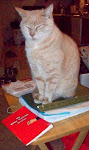
Hobo Bookstore Cat (2003 - 2014)

Dear friends, it is with heavy hearts that we inform you, if you did not already know, that we had to say goodbye to our sweet boy, Hobo, on Friday, Jan. 17th. We thank you all so much for your generous help with Hobo's vet bills, as we struggled to find out what was making him so sick. Despite our hopes, it was confirmed that Hobo did, indeed, have a "mass" nested in his thoracic cavity, pressing against both his heart, and his esophagus and trachea. We kept him as comfortable as possible, but finally it just got too difficult for him to do even the most basic things, and it was time to let him go.

All pets are special. This is obvious to anyone who has ever owned a pet, and to many people who have never had the chance, but who still love animals. Both Kevin and Kasey have owned many pets, as have most of you -- yet we all recognized that Hobo was an extra special guy. He was, in many ways, the community's cat. He belonged to everyone who came to the bookstore, who found us on facebook, who read Hobo's book, who had Hobo visit their library or school. He was a real gem, and he touched all of us with his gentle nature, his goofy antics, his affectionate attitude.

Hobo spent most of his life working in customer service. His first job was at Kevin's gym, Touch of Wellness, where Hobo first adopted Kevin in the summer of 2003. In the beginning, Hobo worked outside as a greeter, then inside, checking on all aspects of gym life. After the gym closed, Hobo took some time off to find himself, as writers are wont to do.

After much quiet reflection and a few AWOL adventures (breaking out screened-in windows to go for a summer moonlight stroll or two), Hobo began work on his memoir, a children's book entitled,Hobo Finds a Home. This was exciting, but Hobo once again yearned to be with the public. He felt customer service was his calling, and the bookstore was the answer. He began coming to From My Shelf, first only sporadically for book signings and children's events, then more regularly, until he was a full-time member of the staff at From My Shelf, from 2010 to 2014.

Hobo's jobs at the bookstore included playing with children, delighting crazy cat people, rearranging sidelines, regular maintenance on computers and the cash register, checking air flow of heating vents, and soaking up sunshine to spread to everyone he met. Hobo was also a regular model for photographs, as well as being the icon for a wooden sidewalk statue (by carver Bill Schlegel), a Christmas ornament (by Mary Wise), local children's artwork, and for the weekly Gazette newspaper column, "Cat Tales: Writing about Reading."

Hobo is not only survived by the humans he lived with, Kevin Coolidge and Kasey Cox, but by two girl cats, Gypsy and Velvet; all the people who have worked at From My Shelf as staff members, but especially Jen, Rachel, and Kris; regular bookstore visitors, both locals and tourists alike; and a community of people, near and far, who thought of Hobo as their special cat, too. Thanks for sharing him with us.

We'd like to thank Dr. Haas, and all the people who work at the Wellsboro Small Animal Hospital for the incredible kindness and patience they showed us during Hobo's illness. We'd also like to thank everyone who donated to Hobo's fundraiser. After paying Hobo's bills, the remainder of the monies raised from our fundraiser will be donated to the Animal Care Sanctuary here in Wellsboro.

Monday, February 3, 2014

The Hemingway Hoax

Kevin Coolidge

Never trust a man who doesn’t like cats…Irish proverb

Uncanny focus, curious, observant, a dislike for being disturbed—they sit for long periods of time and sleep more than they probably should. Writers are a lot like cats. Complex, unorthodox, full of personality quirks, hunting when he wills it, working when it’s time—a writer is not a herd animal.

Now, I’m not saying you have to have a cat to be a writer, but the best writers have at least one cat. Mark Twain, Neil Gaiman, Ray Bradbury, Robert Heinlein--they all loved cats. It helps to have someone to understand that writing is a process. You aren’t being unproductive or lazy. You are cultivating stillness.

One of the most influential and manliest writers* of the 20th Century, Ernest Hemingway, was a dedicated feline lover. Like most cat hoarders, he started with a single cat. A ship’s captain gave Hemingway a white six-toed cat, named Snowball.

Today, the Ernest Hemingway Home and Museum on Key West is playground to approximately 40-50 polydactyl cats. Cats normally have five front toes and four back toes. Not all the cats at the Home have the extra thumb, but they all carry the gene, and can give birth to a Hemingway cat.

If you take the tour, you’ll hear that these kitties can trace their lineage back to the original Snowball, but James Nagel, a Hemingway scholar, claims that Hemingway didn’t have cats when he lived in that house.

“Hemingway liked cats but Pauline, to whom he was married, wanted peacocks. So they got peacocks for the yard ... The time when he had so many cats was when he lived in San Francisco de Paula, Cuba.” The estate in Key West is just one of the many places trying to cash in on the writer and the cats associated with him, claims Nagel.

Regardless of where you fall on the Key West cat debate, Hemingway wrote some of his best work in this home, including the final draft to A Farewell to Arms and the short story classic The Snows of Kilimanjaro. I rather suspect there was at least one cat around.

Waiting, seeking, stalking--striking and feasting on the flesh of your thoughts to satisfy a primal need. You are a writer, and you must feed the hunger, and the cat. OK, you can get yourself a big slobbery dog**, but if you want to be a writer that is remembered, you need to get yourself a cat…

*Hemingway ran with bulls, hunted, fished, went on safari, occasionally took a rifle with him, though he preferred his fists. He wrestled bears, rode sharks, and never shed a tear when he got a paper cut. This is also a man that named a cat Snowball…

**Don’t buy into all the cat crap. Jim Kjelgaard, Wilson Rawls, Jack London—all were dog lovers. Of course, if you have a dog, the stipulation is that you are an outdoor writer.

Cats? Dogs? Or fluffy bunnies? Email me at from_my_shelf@yahoo.com and let me know. Miss a past column? No need to go hungry. Just visit http://frommyshelf.blogspot.com and get your fill. Hobo was a Hemingway and with such a rich, literary tradition of course he wrote a book, “Hobo Finds a Home”—simple, direct, unadorned, just like Papa would write…


Tuesday, January 28, 2014

Kasey's "Top Five" Favorite Reads of 2013

Read the Printed Word!
*
*
Without further ado, my top five recommendations from books I read in 2013....

Room by Emma Donoghue: We read this for book club in February 2013, or else I probably wouldn't have read it, no matter how many great reviews it got. I knew a little bit about the premise – a five year old boy has never left the small efficiency-style apartment where he was born. He lives there with his young mom. For the reader, this sends up all kinds of red flags right away, signifying a situation of abuse, kidnapping, or strange psychoses. I usually can't read this kind of book, especially dealing with children. I have so many people come in to the bookstore asking for Dave Pelzer's books, beginning with A Child Called It. I only got about fifteen pages read of A Child Called It before putting it down in revulsion. So Room was not on my “to read” list. Once I picked it up, however, I was drawn in. The story is told from the boy's perspective. To him, life is pretty good. His mom takes great care of him. There are many games they play together. They read. He watches Dora on TV. He loves his mom and feels safe with her. Sometimes she's sad, though, or worried, and she makes him sleep in a closet when the man comes to visit at night. His world is about to change, and as a reader, you watch with awe and bated breath. A fascinating study in the love between mother and child, the strength and resilience of hostages, and how our brains and bodies can adapt to almost any situation.

Code Name Verity by Elizabeth Wein: I already did a full review on this incredible book, written for young adults, about women spies and pilots – the OSS/SOE and the ATA/WAAF – during World War II. If you missed that review, here are some highlights. Julia Beaufort-Stuart and Maddie Brodatt are best friends. Though they come from completely different parts of the UK and the opposite ends of the socio-economic class spectrum, they are like long-lost sisters. Working together for the WAAF is the first thing that brings them together, but, as their individual talents begin to shine – Julia's for languages, acting, and bravado, and Maddie's for flying and mechanics – the women are reassigned to Special Operations and the Air Transport Auxiliary, respectively. When the book opens, Julia is writing her “confession” and giving all her knowledge to a high-ranking German officer, in a prison, in Nazi-occupied France. We don't know where Maggie is. As the story rolls forward, we see each girl is worried for the fate of the other, and both are in mortal danger in occupied France. How they got there, and who may get out alive, is a breathtaking, soul-searing thriller full of love, hope, despair, and daring.

In the Woods
and The Likeness by Tana French: I'm counting these books as “one” of my “top five”, because they're by the same author; I read them back to back, which you'll want to do; and though not exactly a series, they deal with the same characters. French is an Irish-American author whose books could technically be called mysteries, in the traditional police procedural vein, but her writing is easily the envy of anyone writing more lyrical, “literary” works. In the Woods garnered rave reviews and great acclaim from the moment it was published in January 2007; the follow-up but not-really-sequel, The Likeness, is even better. I could not put the darn books down. Every day, I longed to come home to race through more chapters to find out what would happen to the characters who had rapidly become beloved to me. Though I wanted desperately to find out the ending, I savored each beautifully-crafted sentence which French seems to effortlessly lay down.

The Cuckoo's Calling
by Robert Galbraith: First of all, surprise!! If you didn't see the news, Robert Galbraith is actually J. K. Rowling in disguise! If you've been living under a rock for a while, J. K. Rowling is the author of the Harry Potter series, and of one adult novel, Casual Vacancy. I am a huge fan of the Harry Potter series, and was quite impressed by Casual Vacancy, which is, in every way, the yin (darker side with white dot) to the Potterverse's yang (white with dark spot). In the Potter world, though evil exists and bad things happen, people surprise us for the good, are willing to sacrifice themselves for something greater, and ultimately, hope and love triumph. Vacancy, on the other hand, shows how small and petty we can be, where small-town politics and gossip snowball into terrible tragedy. Vacancy, though a different genre and audience for Rowling, is still filled with her voice. The Cuckoo's Calling doesn't sound like her at all. If someone hadn't outed her, I never would have guessed she wrote this traditional, noir, private detective novel which harkens back to Dashiell Hammett, Rex Stout, and Dorothy Sayers. I admit, I read it out of curiosity, not at all sure I'd like it. I was surprised.

Someone Else's Love Story by Joshilyn Jackson: I'd never read anything by Jackson, even though several of her earlier books were highly recommended in BookSense and IndieBound newsletters, and on several bestseller lists. Her newest book is a charming, rich story, full of quirky people who leap right off the pages and into your heart. Southern, contemporary, with hints of Fannie Flagg (Fried Green Tomatoes at the Whistle Stop Cafe), Billie Letts (Where the Heart Is), and Pat Conroy (Beach Music), but with a strong voice all her own, Jackson is a writer to read, enjoy, and watch. In Jackson's November 2013 release, Someone Else's Love Story, William Ashe is a shy, heartbroken, math genius. Shandi is the mother of three year old prodigy, “Natty” Bumpo Price, truly the product of a virgin birth, since Shandi has little to no memory of the scary events surrounding Natty's conception. William and Shandi first meet during a hold-up at a convenience store. If that's not exciting and strange enough to start, wait till you read their entertwining stories and the surprise ending. This book inspired me to go back and read other Jackson books, and all have pleased me.

To paraphrase Sam-I-Am in Dr. Seuss's Green Eggs and Ham, “try them, try them, and you'll see; you will like them, same as me!!!”

Monday, January 27, 2014

Of Dice and Men

Kevin Coolidge

The day I met Gimbur, I wasn’t looking for adventure. I was enjoying a hearty ale and minding my own brew. I wasn’t looking for trouble. In my defense, I didn’t start the brawl, not really. It was Bjorn. He always did think he was bard when he was deep in his cups. It was the joke that did it. How many dwarfs does it take to kill a dragon?*… He never saw the mailed fist that struck his gorget.**

Every character has a story and in Dungeon & Dragons the chances are that story starts in a tavern. Even if you’ve never played D&D, you’ve probably heard of it. It’s not a board game, though there are specific rules like Monopoly or Scrabble; it’s drastically different. It takes place in fantasy world created by its players, but inspired by centuries of storytelling.

The setting is conceived in advance by the dungeon master, or DM. It’s his job to create the scenario—such as a dragon has been raiding nearby villages, and the players have to find the lair, slay the dragon, and retrieve the treasure.

The DM sketches out the details, like making a map, deciding where the traps are, and what monsters are lurking in the darkness. This gives the other players an unknown world to explore making each gaming session different from the last.

Most players don’t sit down for a single, self-contained playing session, but instead join a campaign, with the same people who use the same characters, building on past actions. Many of these campaigns go on for months or even years.

Players are both audience and author, and play is cooperative, not competitive. Frodo Baggins needed help, and so will you. Players work within the narrative created by the DM, but rewrite the story with their actions. The result is game play that is more open-ended and can become more like writing a screenplay or novel.

Literature and books--such as Tolkien’s Lord of the Rings trilogy—inspired the first role-playing games. Players control characters in a world that exists in their collective imagination. There can be heroic quests, knights, wizards, and monsters lurking in the dark. There’s a promise of adventure, treasure, and a good story

There’s rarely a winner in D&D campaign. Most campaigns never last long enough to reach their dramatic conclusion. It’s more about the journey than the destination. It’s hard to explain how it works, and even harder to explain just how much fun it can be, but David M. Ewalt, has done a masterful job with his new book, Of Dice and Men.

David began playing D&D when he was ten years old and uses his first person experience to give a sharp analysis of D&Ds impact. Before computer games, before the internet, and before social media, this game influenced one of the first nerd subcultures.

Of Dice and Men is blend of history, journalism, and memoir. David traces the history of the game’s roots from the medieval battlefields of Europe, to chess, miniature war games, and the games’ influence on the modern video game industry.

In the same way Tolkien’s fiction inspired the first role-playing games, D&D provided a model for the first video games--having a character that has resources, encounters obstacles, and develops over time all came from D&D. According to Ian Bogost, a professor of media studies at the Georgia Institute of Technology, “Almost everyone I know in the game design field played Dungeons & Dragons.”

Great characters, interesting situations, plots twists, and storytelling--it’s the storytelling that continues to draw people to the game, and keeps them coming back, even years later. A good campaign is communal storytelling at its finest, and you tell it together. Now, you are in a tavern…

*Dwarfs can’t kill a dragon. The need a halfling to do it for them…

** A piece of armor protecting the throat.


Roll the die? Or a role to die for? Visit From My Shelf Books on Facebook and comment. Miss your saving throw? The well of knowledge is at http//frommyshelf.blogspot.com Drink your fill. You can read about Hobo’s big adventure in “Hobo Finds a Home”

Monday, January 20, 2014

Crack this Book

Kevin Coolidge


School is canceled again. My nephews are ecstatic. It’s the longest Christmas vacation ever. I would have been thrilled at their age too. More time to read. I’ve always loved books, but school was mind-numbingly boring.

My high school history teacher talked in a monotone. He inundated the class with names and dates, editing out the really cool stuff. Maybe he hoped to dampen our energy. Maybe we were easier to control if we were falling asleep. I don’t know, but I do know he lied to us.

History is filled with interesting, quirky stories. Those ancient Greek statues carved of marble? Those pure-white sculptures were actually painted in hot pinks, bright reds and more. Turns out they only look that way because of weathering. Those blank staring eyes? All the pupils were colored.

There’s all type of stuff that you didn’t know, even if you thought you knew a lot. The writers from cracked.com have the antidote to misinformation. It’s time to bring back enthusiasm and feed curiosity with The De-Textbook.

Most of the “facts” crammed in your cranium are simply not true. It’s a cold winter. Your mother said to make sure to wear your hat. After all, you lose most of your body heat through your head. It’s a myth that is based on what might be the most poorly executed studies ever conducted.

In 1951, The U.S. Army placed test subjects in arctic survival gear into the freezing cold, and measured lost body heat. Only problem? They weren’t wearing hats. Surprisingly, the majority of the measured body heat escaped through the uncovered cranium. Who would have thought?

The army proudly published in a survival manual that hats are essential survival gear, and thus gave your mother something to nag you about to this very day. The truth is that an uncovered head loses no more body heat than any other uncovered body part. So, please put on some pants.

Your teacher led you to believe that history may have some dips and plot twists, but it’s accurately plotted out. We know most of the details of major events from the beginning to the end. The truth is, humanity has forgotten, misplaced, and just plain lost some important historical records and records.

Sure we’re pretty certain of the important stuff, but all the historical facts? We have many classic works, but the world may have been a very different place if the Mongols hadn’t sacked Baghdad, which contained The House of Wisdom, basically the Library of Congress of its time.

This ancient library contained some of the oldest, rarest books written across three continents, and the great horde tossed every book in the Tigris River, and the water ran black with ink for months afterwards. All that written history and hard work washed away.

Technology doesn't progress steadily, but wanders around like a drunken sailor. Our ancestors did more than discover fire and the wheel. Man, the naked aped, has been clever for a long time, and not all technological wonder originated in the 20th Century.

The first submarine was devised in 1580 by an English innkeeper. The first battery sometime around 200 B.C., and the first flamethrower was created by a Syrian refugee and used by the Greeks to burn ships in naval warfare, that was sometime around A.D. 672.

Some things happened way more recently that you think. Your grandparents knew people that had to adapt to the doorknob as advanced technology, because the doorknob wasn’t invented until 1878, and the French were still beheading people with the Guillotine until 1981.

The world is an amazing place. Science still can’t tell us why we yawn, why we need sleep, or how bicycles work. Is Pluto a planet? Does it matter? We don’t even know for sure how many planets there are in our solar system*. There’s still more, more mystery, more truth, more than we know…

*Between Mercury and the Sun it’s too bright; beyond Uranus it’s too dark.

School is cool? Or public education makes you drool? Email me @ from_my_shelf@yahoo.com and let me know. Behind in your studies? Past columns available at http://frommyshelf.blogspot.com Hobo, the bookstore cat, is a graduate of the school of life. You can read about his first lessons in “Hobo Finds a Home”


Monday, January 13, 2014

What’s Bugging You?

Kevin Coolidge

It will soon be a new year with new people contributing to new and old problems. The overpopulation situation continues to explode. If this keeps up, it will be standing room only. Hmmm, maybe that will slow things down. Soon the Earth will be filled with Homo sapiens. You know, humans. How will we feed the masses?

Some experts claim that an all vegetarian diet would extend food supplies and still nourish the growing population. Some will never give up meat, and suggest selective cannibalism could cull the teeming hordes. I have another solution. Eat what’s bugging you.

The appropriate insects can be a good source of not only protein, but also fats, vitamins, and minerals. There are some 1,462 recorded species of edible insects. The Survival Guide to Edible Insects catalogs several that are easy to identify and have a long record of human consumption, including cicadas, worms, locusts, ants, and many beetles.

Crickets are high in calcium. Termites are high in iron. Silkworms provide 100% of the daily minimum requirement of copper, zinc, iron, thiamin, and riboflavin. Fred Demara shares helpful tips on identifying safe insects, locating their habitats, harvesting them, and preparing them properly.

These lowly bugs have served as food for most non-European cultures, and have served an important role in the history of human nutrition. Before humans had tools to hunt or farm, insects were an important staple. Insects are easy to catch and live everywhere, which is why they can be essential in a “survival” scenario.

You don’t drink water gathered in the wilds without disinfecting it. Even pristine mountain streams carry the risk of giardia.* Boiling your water or roasting your bugs** isn’t hard, and cooking, particularly roasting, hard-shelled insects can improve the taste.

Insects aren’t just a survival option. The United Nations Food and Agriculture Organization issued a 200-page report in the spring of 2013 noting that insects are high in protein and minerals and have a relatively low environmental impact.

Earthworms and termites do add to methane emissions, but significantly less than beef. Insects are also more efficient in converting what they eat into something we can eat. A typical insect can convert 4.4 pounds of feed into 2.2 pounds of insect mass. A beef cow requires 17.6 pounds of feed to produce just 2.2 pounds of meat.

If you wish to prepare earthworms at home, you might not want to “purge” them. Wash the worms and put them in cornmeal for a day, and they will trade the gritty contents of their gut for cornmeal. They are tasty deep fried or ground and used much like hamburger. In the wild, you can just grab the worm by the head and squeeze like a tube of toothpaste.

Deep-fried Earthworms

Finely chop an apple and put in with worms for a day. Chill worms. Roll in flour with paprika, salt, and pepper. Deep-fry until crisp. Add a little hot sauce and yum.

Insects are abundant and free for the taking, making them a great asset in a survival situation. They are packed with nutrients and can be tasty if properly cooked. It just may be time to swaps your burgers for bugs…

*giardia is a parasite that can cause diarrhea, stomach cramps, gas and nausea

**not all insects are bugs. A bug is an insect that has mouthparts that are modified for piercing and sucking...

To bee or not to bee? Chew it over and email me at from_my_shelf@yahoo.com Miss a past column? Fly or crawl over to http://frommyshelf.blogspot.com and eat your fill. Hobo, the bookstore cat, is a fan of butterflies. You can read about it in “Hobo Finds a Home”, a children’s book about finding your place in the world, and eating dinner…


Sunday, January 5, 2014

Online Auction for Hobo!!!!

Read the Printed Word!
*
*
Hi, Hobo Bookstore Cat fans!! We will be running an online auction of sorts, with all proceeds going to Hobo's care. If we bring in more money than is needed for vet bills, the overflow will benefit the Wellsboro and Galeton Teen Book Clubs. The auctions will be set up through our ebay account, but we will gladly accept serious "bids" through the store and/or facebook and/or email, if you are following the auctions on ebay but do not want to use your info in an online auction. Stay tuned for items to be auctioned!! And thanks again, from the bottom of our hearts, for all your help, support, love, and encouragement.

Current items on auction will include:

*Awesome gift basket from Pure Hart Soaps, with 4 goat milk soaps (Lime Rosemary, Lime Basil, Citrus Splash, and Good Morning Grapefruit) and Citrus Splash goat's milk lotion, and body puff. (a $35+ value)

*SIGNED hardcover, brand new: Seven for a Secret, by Lyndsay Faye (book cover price: $26.95)

*SIGNED hardcover, brand new: The Painted Girls, by Cathy Marie Buchanan (book cover price: $27.95)

*SIGNED hardcover, brand new: The Dark Path, by David Schickler (book cover price: $27.95)

*SIGNED hardcover, brand new: The Bookman's Tale, by Charlie Lovett (book cover price: $27.95)

*SIGNED hardcover, brand new: A Man Without Breath, by Philip Kerr (book cover price: $26.95)

*SIGNED hardcover, brand new: Robert B. Parker's 'Wonderland', by Ace Atkins (signed by Ace Atkins, not Robert Parker, since Parker died over a year ago) ... (book cover price: $26.95)

*SIGNED paperback, brand new: The Monsters of Templeton, by Lauren Groff (incidentally, one of Kasey's favorite books), cover price $14.95

*Bacon gift basket, including Mr. Bacon bendable action figure (otherwise known as a "Bacon Buddy"); a package of Bacon Stix snacks; a Bacon swirled lollipop; a tin of Bacon Mints; a tin of Bacon-flavored toothpicks, and maybe one or two other bacon goodies

.... we'll be adding more. We'll post the ebay links as they go live.

THANKS!!!