Showing posts with label Andrew Seubert. Show all posts

Saturday, May 21, 2011

Riptide

Read the Printed Word!

During April’s book club meeting, we met at the bookstore to discuss Dave Eggers book, Zeitoun, which follows the Zeitoun family and their experiences with the events surrounding Hurricane Katrina. Although Zeitoun never presents itself as an overall expose of the crises that arose from Katrina’s damage, nevertheless, it is a poignant and painful narrative that certainly addresses wider issues than one family saying, “This is our story.” We, as a book club, had a lively discussion over a two-hour period … with perhaps half an hour actually focusing on the book itself. Ultimately, I believe that we were avoiding deeper examination about the powder keg of political, religious, and psychological questions that Zeitoun brings out.

This is comparable to my approach to the review I want to write for this week’s column. I feel firmly committed to telling readers about Barbara Hale-Seubert’s recently-published book, Riptide: Struggling with and Resurfacing from a Daughter’s Eating Disorder, though it is an emotionally difficult task. Luckily for the reader, this book is much easier to read than it may be to discuss. Tackling these painful issues, however, is precisely what makes Barb’s book so powerful and necessary. Riptide is a courageous, insightful, honest examination of a journey few families want to talk about – the addiction and self-destruction of a loved one, and the family’s roller-coaster ride alongside them.

Without a doubt, families trying to deal with a loved one’s psychiatric illness or addiction, struggle through exhausting waves of guilt, anger, shame, love, helplessness, self-doubt, despair and hope. Though our culture has become more accepting of and open about addiction issues, still families struggle with what to say to people in their communities. They feel the addicted loved one somehow serves as an indictment of their family, shouting to the community that “there’s something wrong with those people, that someone in their family would have to deal with things in such a self-destructive way.” Families are afraid people will judge their loved one – or the entire family – as weak, lacking in self-control, crazy, bad parents, bad Christians, abusive, ignorant – you name it. Whether the blame and shame comes from the community or only from the minds of the family themselves, there’s no doubt there’s usually more than enough to go around. Thus, families protect the loved one and themselves by keeping the issues “private”.

As Erin’s mother, Barb too struggled with all these feelings. Though Barb Hale-Seubert and her husband Andrew Seubert are therapists, their profession did not always ease their suffering through the many years of dealing with Erin’s illness, her short recoveries and her many relapses. As a matter of fact, being a therapist often increased Barb’s feelings of shame and guilt. A mother often blames herself for her child’s patterns of self-destruction, thinking the “if only I were a better mother” that our culture and perhaps our own deep-rooted psychology plants inside us. Worse for Barb, she would think: “In my professional capacity, I have helped so many people. Why can’t I help my own daughter? What will people think of me as a therapist when they see my daughter slowly killing herself?”

We have so many stories and studies and sayings that tell us the lengths a mother will go to in order to save her child: Barb, too, fought like hell to save her daughter Erin from the disease which ravaged her for ten years. The problem was, too often, Barb ended up fighting Erin to save her from herself. Riptide takes passages from the journals that Barb kept over the years of Erin’s illness, until and beyond Erin’s death in 2000, at the age of 23. Through her writing, Barb was able to move to a more peaceful place in being with Erin. Barb began to understand how Erin’s eating disorder had a stranglehold on Erin, that Erin believed that she could not cope with life without the eating disorder, even while those coping techniques were killing her. Near the end of Erin’s life, Barb was able to be with Erin in a place of love and forgiveness, instead of endless tension and struggle, knowing that the only one who could save Erin was Erin herself.

Barb gives her readers an amazing gift sharing her Erin’s life and death, and Barb’s own struggles alongside her daughter, in this book. Frederic Luskin, Ph.D., author and director of the Stanford Forgiveness Projects, praises Riptide as “a well-written and searingly honest account of a mother’s journey through loss and grief…. [this] story culminates in what healing from pain can lead to – finding the compassion and forgiveness that offer meaning to our heartbreaks.” With Riptide, Barb Hale-Seubert offers inspiration and guidance to families living with a loved one’s addiction, mental illness, and/or eating disorder. Though I cried while reading it, though I had a terrible time getting started in writing this review, I feel blessed to have read it and proud to recommend and sell this important book.

Saturday, August 9, 2008

The Tin Man Was Smarted and Braver than He Thought

Kasey Cox

Dar Williams, a folk singer whose popularity began in the coffeehouse and folk festival scene of New England in the early 1990’s, wrote these words: “And when I talk about therapy, I know what people think/ That it only makes you selfish and in love with your shrink….”

I ruefully smile at these lyrics as I go about my review for Andrew Seubert’s new book, The Courage to Feel: A Practical Guide to the Power and Freedom of Emotional Honesty. Andrew Seubert, co-founder of The ClearPath Healing Arts Center in Corning, NY, has been a licensed psychotherapist for the past 25 years. He and his wife, Barbara Hale-Seubert, practice out of offices in Mansfield and in Corning, and I daresay have probably worked with a great number of the folks in the Twin Tiers. Lately, Andrew’s expertise has lead him to more seminars and workshops where he trains other therapists, as far away as Holland and England.

Perhaps I’m not the best person to write this review, because I’m not sure how many people will take me seriously. Why? I am completely biased. I’ve known Andrew, and his family, for almost a decade. I think Andrew is a great person, and an amazingly talented, effective therapist. I’ve already learned the techniques he outlines in his book, most of them in the privacy of Andrew’s office and in my own life as I struggled to grow through very rocky soil. Therefore, I can’t come to this book with a fresh perspective. I read it as one cheering Andrew’s success, hoping that it is everything he wants it to be, and also as one for whom the explanations for these concepts are already well-ingrained. For me, this book is a refresher course as much as anything.

On the other hand, maybe that makes me particularly well-suited to recommend this book. After writing several articles in the last year in which I publicly disclosed my struggles with manic-depression (bipolar disorder), I have had a staggering number of people call, email, or come to the store to ask advice on books on mental health, and to thank me for speaking up. While I can now speak up about my feelings and experiences, suggesting books that give good advice to people in dealing with their feelings is difficult at best. Each person, each family’s situation is so different. The Courage to Feel, however, allows me a more solid recommendation, since it is advice for everyone to use.

Seubert’s book is exactly what the title describes it to be – above all else, a practical guide to feeling our feelings, which takes a great deal more courage than most of us imagine. After all, feelings are just there, right? They happen to us, they’re part of life, and growing up means learning to deal with them – essentially, at least for most of us, that means shoving them away, tuning them out, so we can deal with life. Not so fast, Andrew says. That is not really dealing with feelings at all. Feelings are life: they are the vital energy that keeps us engaged with ourselves, the people and the world around us. When we shove them aside or tell ourselves they’re not important, we are missing crucial messages that are built into our physiology for essential reasons. And most of us were never taught to interpret those messages, or, in fact, to “deal” with them at all.

Most of The Courage to Feel shows us, step by step, in clear, practical, down-to-earth words, how to unpack the years of feelings we’ve stuffed away, and how to begin to learn from our feelings now, in our day-to-day lives, instead of pushing them into the background like some kind of dirty secret. Andrew explains how we will find incredible energy in this process, a new passion for our relationships and our work, better physical health as well as mental and emotional renewal. There are many books out there, and practitioners, who promise the same kind of things, but that are too easily dismissed as “New Age” or “psychobabble.” I believe you’ll be really pleased with Andrew’s style. There is very little of the language that makes therapy-shy people squirm. For those who need the imaginative, there is the fable of Simon the Turtle woven throughout the book to guide their way. For those who are more business-like, trained as we are for most of our lives to respond to steps and outlines and how-to’s and outcomes, Andrew also provides this.

So which is it? Am I an excellent choice for this review, or should my thoughts on it be taken with a grain of salt roughly the size of Rhode Island? I once asked Andrew a similar either/or question, when I was struggling to decide which part of my life was most real – the achiever or the hospital patient. The simple wisdom is an answer that applies much more universally, to many situations, to many a person, place or thing – “you’re both”.


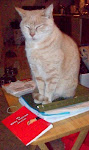
Hobo isn’t the cowardly lion – he tells everyone his feelings. His photo has been absent lately because he’s been in negotiations. He wanted more pay and fewer public appearances, and he’s certain his photo is worth at least as much as those first photos of Brangelina’s twins. He has currently settled for a break from the summer tour he’d planned – sorry, local senior centers – but his thoughts are still available online at frommyshelf.blogspot.com. He’ll also answer email at frommyshelf@epix.net.