Showing posts with label mythology. Show all posts

Wednesday, November 3, 2010

Walk Like An Egyptian! Rick Riordan & the Red Pyramid


All the school kids so sick of books ….
When the buzzer rings (oh way oh)
They’re walkin’ like an Egyptian…

--“Walk Like An Egyptian”, performed by The Bangles, lyrics by Liam Sternberg

Well, folks, summer vacation is here! [Well, it was when I first wrote this!!] The kids always think they’re so sick of school, but the first time they say they complain they’re bored, tell them to walk like an Egyptian, right into their local bookstore.

If you and your kids are fans of the Rick Riordan series that relayed the adventures of Percy Jackson and the Olympians, then you’re in luck! (If you don’t know about Percy Jackson, or the Lightning Thief, or this great young adult series weaving new, contemporary fun out of Greek and Roman mythology, then check out past reviews in our blog, from earlier this year.) Alas, the Percy Jackson series is finished, but bestselling author and former history teacher Riordan has gifted us a brand new series, focusing on Egyptian mythology, beginning with the book The Red Pyramid.

Riordan’s newest venture, “The Kane Chronicles”, gives brother and sister team, Carter and Sadie Kane, the chance to tell their story of how the world of ancient Egypt exploded from ancient history to modern reality during their vacation. Their father, brilliant Egyptologist Dr. Julius Kane, takes them to visit the Rosetta Stone fragment housed at the British Museum in London. Ever since their mother’s death several years ago, the two siblings have lived separately – Sadie, with her grandparents, in London; Carter, traveling with his father, doing research, going on digs, and being homeschooled along the way. When the two Carter men come visit Sadie, Dr. Kane enigmatically promises to “set things right,” then disappears in a huge explosion at the Museum. Before they can gather their wits or mourn their father, Sadie and Carter are whisked away by strange relatives, traveling through time-and-space warps with an ancient Egyptian boat, protected by a cat and a crocodile, befriended by a baboon, attacked by mythological creatures, and charged with saving the world.

Some of the devices Riordan uses in The Red Pyramid follow the same plotline as his “Olympians” series, making the book at times a little formulaic, although there are some wonderful additions to the Kane Chronicles which promise to hook an even wider audience. First of all, the story is told from alternating perspectives, with chapters switching back and forth between Carter, the older brother, a young black man who has traveled with his famous father but longs for a permanent home; and Sadie, younger sister, fairer-skinned like her mother, little Brit smart-aleck ‘tween, longing for time with her father and for world-traveling adventures like her brother. I really enjoyed the modern truths about mixed-race families, both the normalcy of it alongside the reality of people’s deep-seeded reactions. I was also extremely pleased to have the story from both brother and sister, a narrative which should draw in the children who grew up on the Magic Tree House series.

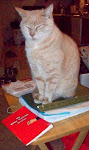
Since I know little about Egyptian history, culture, or mythology, I decided to bone up a little by studying Linda Honan’s guide, Spend the Day in Ancient Egypt. Written predominantly for use with 8 to 12 year old children, perhaps as a curriculum guide, Honan’s book describes a typical day in ancient Egypt, following a fictitious but probable family, including mother, father, son, daughter, and the family cat. This wonderful book gives little pieces of history, explanations for customs and beliefs, information about clothing and food (including recipes!), typical names, lessons on basic hieroglyphics, games and activities, the geography and weather of the region, and more. I learned more history, culture and geography from this little book than I would have learned in a summer school session devoted to Egypt! Perhaps my favorite part was learning how to play Senet, the world’s oldest board game….. but don’t tell Hobo the game was my favorite. He’s still convinced I read this book to learn how cats ruled ancient Egypt, with some help from their assistants, the Pharoahs.

Since Hobo wants to continue his “vacation” from writing the column for the Gazette, Kasey and Kevin are stepping up to do it again. In the meantime, Hobo will be studying up on the ways cats were honored in ancient Egypt – just don’t pierce his ears! The Bangles or bangles & bling? Tell us what you think at from_my_shelf@yahoo.com. Want to go back and read past columns, like the earlier ones on Rick Riordan? Check out our blog at frommyshelf.blogspot.com.

Sunday, January 24, 2010

Don't Myth Out!!


There’s a lot of shouting and posturing and writing of articles, wrestling with the extent to which we have or have not been “dumbing down the curriculum”. Normally, I would agree with the people who are concerned that we as Americans have lowered our standards in education. However, I must confess that there are areas of the classic canon that intimidate me. Unlike my partner, Kevin, who always loved mythology, no book of Greek myths caught my interest as a child, and somehow none of my coursework ever included a solid overview of any of the major cultural mythologies – even though I’ve studied authors who based much of their work on Greek, Roman, or Norse myths, I never got the original foundation.

If we only scratch the surface of English vocabulary, the names of the constellations, medical terms, poetry, theater, literature, science fiction and fantasy, even modern film, we see references to these stories everywhere. How much richer our experiences would be if we knew the origin of the “Hippocratic Oath” and how much easier to read Shakespeare and Lord Byron without referring to the footnotes all the time!

I tried to remedy the holes in my background by buying first Bullfinch’s and later Edith Hamilton’s Mythology. Both are excellent texts, and important references to have in the library. Nevertheless, I’ll admit to enjoying in this case some of the simpler, more colorful, more artistic approaches that have been published “for children.” My advice is to check them out with your kids, by all means, but revel in them for yourself as well!

The easiest, most inexpensive book is most likely The Gods and Goddesses of Olympus by Aliki. Penned to offer an overview of Greek mythology for the youngest readers, this book might give a softer, simpler foothold to the adventures of the original “Olympic” crew. The first part gives a brief description of the birth/creation of the deities, including the rise and fall of Cronos and the defeat of the Titans. Unless they are certain of the sensitivities of the children learning these stories, some parents and teachers may want to follow Aliki’s lead in avoiding long explanations of how Cronos ate his children (“don’t worry, he puked them up whole again later!”). Obviously, these stories are not meant to seed your child’s nightmares or be read as a morality guide. The second part of the book dedicates a page to each of Cronos’ disgorged children, who join with Zeus to rule the universe. Aliki’s distinct art warms the entire book, grounding the simplified character profiles. Recommended for kids who perhaps want to see the film version of “The Lightning Thief” with an older sibling, or are struggling to read the book on their own, I included this book in the list also for the benefit of its low price.

Another book which achieves the same goal as Aliki’s, with its focus on the earliest age group or those who need more visuals and fewer words, is Usbourne Books’ Greek Myths for Young Children, written by Heather Amery and illustrated by Linda Edwards. Usbourne Books’s signature style includes bright graphics which, though colorful, are clean, neat, simple, pleasing the eye and mind of the reader without overwhelming it. Usbourne is well-known for their beautiful products for children – art books, an “I Spy”-type of series called “1,000 Things to Spot”, cute board books with things to touch, early language books, science and nature facts and more. This lovely hardcover adds another feather in their cap.

Moving up the ladder in terms of reading difficulty and fuller explanations of the Greek gods, goddesses, monsters, myths, adventures, quests, legends and heroes, we have two wonderful choices. The D’Aulaire’s Book of Greek Myths, first published in 1962, is a classic; the other, The Mythology Handbook, is a newcomer from March 2009.

Ingri and Edgar Parin d’Aulaire were European immigrants who came to the United States in the early 1930s after distinguished art training and professional work on the Continent – Edgar was a pupil of Henri Matisse; in his early career, he had illustrated books in Germany and painted frescoes in Norway. Ingri was first a student of Norwegian artist Harriet Backer, who then continued her art studies at several prominent schools in Germany and France. Though at first the couple began working on individual art careers after their move to New York City, soon they were encouraged to turn their collective efforts to children’s literature. Both Doubleday and Viking Press published the couple’s children’s books throughout the rest of the 20th Century. Many of their lovely books depict myths and folktales from around world, while others focus on American historical figures. With their inimitable combination of modernity and antiquity, storytelling fun and classic education, clear wording and evocative art, many now-adult readers credit this book as THE foundation to their understanding of why the Greeks matter to us today.

The Mythology Handbook, a spin-off of its parent book, Mythology, will be a format perhaps most familiar to children and teens who have purchased other books in the popular Candlewick series known as the ‘ologies. Beginning in 2003 with Dragonology, Candlewick has published an interactive group of books written by early “experts” such as “Sir Ernest Drake” the dragonologist or “Emily Sands”, nineteenth century explorer and Egyptologist. All of the ‘ology books fascinate kids and teens with pull-out maps, sealed letters, compasses, insets, stylistically “period” art and souvenirs of each writer’s various adventures.

Before you head out to the theaters to see “The Lightning Thief” with your grandkids, before you try to help your child with his paper on Shakespeare, before you take the family to Cherry Springs Sky Park for a little stargazing, why not brush up your mythology?

Hobo says there’s no shame in loving picture books. He wrote a picture book about the epic journey of a little kitten. He didn’t slay gorgons, but he did meet a spice kitty who smelled pretty bad. Share your adventures with Hobo at frommyshelf@epix.net. Or get an overview of other great books at frommyshelf.blogspot.com.

Monday, January 4, 2010

Myth Adventures

by Kevin Coolidge


"Without a knowledge of mythology much of the elegant literature of our own language cannot be understood and appreciated." -- Thomas Bulfinch

The hard seat of the desk presses into my butt. My back itches. I want to scratch. I need to stretch. The hands of the clock aren’t moving. I have to go to the bathroom. There’s an incessant buzzing sound. It’s a fly. Suzie’s hair has gotten longer. X equals five!

Miss Lamia scornfully tells me to raise my hand before blurting out an answer. I’m told to stay after class, again. I’m writing on the chalkboard, “I will not blurt out the answer before raising my hand,” for the 78th time, when an odd smell invades the air, a mixture of sulfur and dirt. I spin around and Miss Lamia is coiled on the desk, her eyes glowing red, a scaled tail poking out of her long white skirt…

We’ve all had teachers who were monsters, but not like the creatures Percy Jackson must face. Percy is having problems. He’s about to be kicked out of boarding school…again, and lately mythological beings and the Gods of Mount Olympus seem to be emerging from his Greek mythology textbook, and into his life. And even worse, he’s angered quite a few of them. Welcome to the world of Percy Jackson & the Olympians.

Percy Jackson & the Olympians is a series of young adult fantasy adventure books authored by Rick Riordan. The series consists of five books, The Lightning Thief, The Sea of Monsters, The Titan’s Curse, The Battle of the Labyrinth, and The Last Olympian. The main protagonist, Percy, discovers that he is a demigod, a son of Poseidon, Greek god of the sea and earthquakes, and the mortal woman, Sally Jackson.

He learns that the legendary beings in Greek myths really exist, as well as the Olympians (Greek Gods) and that Olympus is now situated on the mythical 600th floor of the Empire State building. Percy finds himself frequently plagued by monsters, as he meets other young “half-bloods”, both friendly and hostile. He’s the center of a prophecy that could change the balance of power. He embarks on several quests, discovers powers, explores the Greek mythos, saves his friends, tangle with the gods, and saves Mount Olympus.

Percy, like most demigods, has dyslexia, because his brain is wired to read ancient Greek instead of modern languages, and he’s been diagnosed with Attention-Deficit Hyperactivity Disorder, which is actually a heightened alertness that keeps demigods primed for battle. This was inspired by the author’s son, who had recently been diagnosed with both ADHD and dyslexia. His son had been studying Greek mythology in school, and asked his father to create bedtime stories using characters from mythology, and thus Percy Jackson sprang to existence from Riordan’s head.

I’ve been interested in Greek mythology since Junior High, and I was looking forward to reading the Lightning Thief, first book in the series. Instead of just enjoying the first book and writing a review, I found myself jumping into the next three books of the series, and will soon finish The Last Olympian. I found the series to be a fun, entertaining introduction to Greek mythology for grade levels 6th through 8th, without being intimidating or overbearing.

The Greek myths, from the epic struggle of the Trojan War to the wanderings of Odysseus, form the foundation of Western literature. Greek mythology has exerted an extensive influence on the culture, arts and literature of Western civilization and remains part of Western heritage and language. With a better understanding of these myths, we gain a better understanding of ourselves.

Does your vorpal sword go snicker-snack? Or does it just snicker? Email me at frommyshelf@epix.net. Miss a past column? Consult the oracle at http://frommyshelf.blogspot.com If you want to be the hero of your own story, you may have to write it. Hobo did just that in “Hobo Finds A Home” about a kitten’s heroic journey into the unknown.