Showing posts with label post-apocalyptic novels. Show all posts

Wednesday, March 17, 2010

The Moon is a Harsh Mistress


This past Friday brought us the last weekend of January 2010, and the brightest, biggest full moon we’ll see this New Year. The perigee of the Moon (the point when the Moon is the closest distance to Earth in its elliptical trip around our planet each month) just happened to coincide with a full moon this month, which means since it’s also been clear, crisp, and freezing cold, it was perfect viewing of the winter landscape by the light of a full, glorious Moon for anyone crazy enough to stand out in the freezing night air for more than a few minutes. According to www.spaceweather.com, the conditions of Friday night gave us a 14% wider view and about 30% brighter appearance than any other full moon this year.

This really cool website, besides having fantastic side-by-side comparison photos of what we see when the moon is at apogee versus at perigee, also has a somewhat sobering chart listing the “potentially hazardous” Earth-asteroid encounters for each month. There’s a chart giving the size of each asteroid, its scientific name (usually a combination of numbers and letters, nothing as sexy as “Asteroid Wolf-Biederman” or “The Coolidge Comet”), how close it came to Earth, and the date of its closest approach to Earth.

You know, there are so many disaster movies and post-apocalyptic books that deal with asteroids hitting the Earth that I never thought much about the quite possible scenario of a large, dense asteroid hitting our Moon. After all, asteroids hit the moon fairly often. As a matter of fact, all those dimples and pits and “Seas” on the Moon’s face are referred to as “impact craters.” Most of the time, all of those space rocks hitting the Moon don’t make much difference, except occasionally to add a few more beauty marks to her face. Cue Susan Beth Pfeffer’s young adult novel, Life As We Knew It.

Without a doubt, one of the best young adult novels I read in the last year, Pfeffer’s book Life As We Knew It gives a fresh perspective to an old theme. Although the novel deals with “what-if” scenarios and earth and space science, the stories read much more like real, immediate survival stories than they do science-fiction. Indeed, Life As We Knew It gives the reader the credible, first-person account of Miranda, a junior in high school in small-town, northeastern Pennsylvania, whose journal entries reflect the normal worries of an American teenage girl – math tests, her stepmom’s announcement of a baby on the way and whether or not she’ll get asked to the prom. Miranda complains to her journal how all of her teachers are making a big deal about a large asteroid that will collide with the Moon in mid-May: all of her homework assignments, from history to French class, deal with the 1969 Moon Landing or “la lune.”

No one expects the asteroid to be anything except interesting to watch in the spring night sky. However, not even the scientists predicted that this asteroid, denser than any other that has collided with our Moon, would have far-reaching, life-changing consequences, the kind that life on Earth hasn’t seen since the last Ice Age or the great mass extinctions of the dinosaurs. This asteroid knocks the moon off-kilter, pushing it closer to Earth. The climactic changes are both immediate and ongoing, as tides abruptly shift, causing huge tsunamis, killing millions along the seaboards, wiping out entire cities, states, even countries. Next come shifting tectonic plates, and later, newly active volcanoes, as the Earth’s crust and magma respond in frightening ways to the changes in the magnetic pull between the Moon and the Earth.

When the asteroid firsts knocks the Moon closer to Earth, Miranda is scared and sad like everyone else, but she thinks her mother’s immediate plans to start stockpiling canned food, batteries, gas lanterns, firewood, bottled water, even tampons, is a little extreme. Surely, the scientists, the government, the people in charge will get things back on track soon, won’t they? They’ll have to come up with plans to take care of people, right?

Once you pick up this exciting novel, you’ll find yourself right there with Miranda, her resourceful mother, her brothers, their neighbors and friends, and the world as we knew it, as it changes right in front of their eyes. And you’ll find yourself turning pages late into the night, then creeping out into the kitchen to check on how many cans of peaches and chicken noodle soup you have in your cupboard.

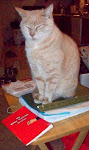
“Deep Impact” or “Armageddon”? Email Hobo your survival tips at frommyshelf@epix.net. Hobo says there’s even a cat in the book, and his family made sure to store up lots of cat food, so it wasn’t so scary for him. The cat’s name is “Horton”, which is close enough to “Hobo” to make him extra-cool. Missing real victuals? Look through Hobo’s stockpiled articles at his blog, http://frommyshelf.blogspot.com.

Sunday, March 14, 2010

Peasants Under Glass?


Voice mail from Diane Eaton, at the Gazette: “Keep me posted on the Mike D’Aloisio author event coming up in March.” (Sorry, Diane … an invisible, unbreakable force field just sealed off the town of Chester’s Mill, Maine, in Stephen King’s newest book … let me just find out what happens to the people initially injured ….)

Reminder email, automatically generated from “etides”, telling me sales tax is due soon. (Sorry, Governor, they’ve just doubled the size of the emergency ‘police’ force, and I’ve got to see if the missile breaks through the Dome or not…)

Every night this past week or so, I have come home, and as quickly as possible, shut out the world, to get lost Under the Dome. You would think as the manager of a bookstore, I would read each day for hours on end, actually being able to justify my reading time more than other people can (“It’s my job!”). As much as I love to read, I don’t often allow myself the luxury of getting completely swept away in a book, because I have to be careful, rationing my time and energy to take care of the business, my relationships, and my health.

My approach to reading is different now: trying to be an adult, mindful of my responsibilities, I budget my time, savoring my books for an hour here and a half hour there, instead of inhaling them. Not so with Stephen King’s Christmas gift of 2009. Despite its hefty 1,074 pages, this latest novel from King does not drag under the bloat which has weakened many of his books of recent years. The pace is relentless, compelling the reader to walk, trot, run and full-out sprint to the finish, then leaving him sorry to leave the (remaining) people of Chester’s Mill, and their struggle, behind.

Compared by many in the literary world and across King’s readership to his other weighty, survival-story novel, The Stand, King also began this novel early in his career, in 1976, but abandoned it after several attempts at making the more scientific aspects – medical, meteorological, militarily – plausible enough. Fans of The Stand will easily recognize themes with which King has wrestled in his best work – the psychology and actions of ordinary people in extraordinary circumstances, and the importance of hope.

An enormous difference, however, between the two books – besides their actual publication date – is the manner in which God is handled, and the actual manifestations of Good and Evil. Sure, there’s an obvious struggle of good versus evil in Under the Dome, as the population of “The Mill” quickly divides into two camps, but it is more subtle and a lot less supernatural than the population division that happens in The Stand.

In The Stand, the characters, the only survivors of a U.S. devastated by a superflu virus, begin dreaming of God’s representative on Earth, an old black woman from Nebraska, and Evil’s representative, a man who is, if not the Devil, at least an incarnation possessed with the ability to do dark magic and to inspire extreme destruction. People choose which representative to join, as the book moves towards the final stand of humanity. Under the Dome presents an entirely different scenario: the two camps are those trapped in a small town, many who choose to follow Town Selectman “Big Jim” Rennie, and a few who distrust, oppose, and eventually act against him. Rennie has no supernatural powers; in fact, he is a big fish in a small pond that has now turned fish bowl. Whereas most of the population of “the Mill” desperately pray that the scientists and military minds working on breaking the Dome will succeed, Rennie seizes the situation as his God-given chance to come in to full power. In a matter of days, life in the Mill is less like small-town America and more like Hitler’s Third Reich or Stalin’s Russia.

With this, King delivers the theme that will make Under the Dome one of his most remembered works: this is a tale of the slippery slope of evil – not evil as in some supernatural clown-ghost in a sewer pope, but the hurt we human beings can inflict on each other, from playground bullying to nuclear war.

Peasant under glass or Small World in a Snow Globe? Email Hobo your thoughts at frommyshelf@epix.net. “Lord of the Flies” or “Brave New World?” For more book reviews, go to Hobo’s blog, frommyshelf.blogspot.com. Hobo warns his readers that King’s new book does include sex, drugs, and a Christian radio station gone bad, but no cats. For a great book about cats, check out Hobo’s book, “Hobo Finds a Home” – soon to be available at the bookstore in Chester’s Mill.

Monday, November 9, 2009

Armageddon

Kevin Coolidge

Day by Day Armageddon

Screw Armageddon, this is Hell.—unknown survivor

September 29th
All Laurel Health System flu clinics have been canceled until further notice. What the? I can’t even turn on the TV without hearing some scary swine flu story. Ok, I get it. Flu shots are good; the flu is bad. But the “must have” accessory of the season, the flu shot, isn’t to be had anywhere. I’m assured that production is being ramped up. There is nothing to worry about…

October 23rd
I get a call from the Don Gill Elementary School. My nephew is running a fever and my sister can’t be reached. I pick him up and I find out that many children have become ill. Yes, this is a little unusual, but there is nothing to worry about…

October 25th
President Obama declares the swine flu outbreak a national emergency. We are assured that this is not a response to new developments. Illness is more prevalent than ever and production delays mount, but there is nothing to worry about…

October 27th
The hospital has canceled the local Halloween festivities. LHS is restricting anyone under the age of 19 from entering facilities. This is for the safety of the patients and employees. There is nothing to worry about…

October 28th
I begin reading Day by Day Armageddon written by J.L Bourne and published by Pocket Books. This apocalyptic, zombie novel is written in first person format as a journal. The narrator is an unnamed US Naval officer who starts the diary as a New Year’s resolution. As the days progress, It appears something is happening in China. News sources report a mysterious disease sweeping the Middle Kingdom.

The highly contagious influenza quickly spreads around the globe, and our chronicler is stranded in his home while on leave. He decides to remain barricaded in his home, improving his defenses, buying more ammo and stocking up on MREs (Meals Ready to Eat)while society quickly crumbles around him.

The government’s precautionary measures fail to contain the plague, and politicians and the remnants of the military retreat to hidden bunkers, leaving the civilian population to fend for themselves. Our protagonist teams up with his only surviving neighbor, and they trek the landscape, searching for a zombie-free zone. Along the way, our heroes encounter hordes of undead, rampaging rednecks, and realistic survival situations.

The author, J.L. Bourne, is an active duty naval officer, and his use of military jargon, accurate descriptions of weapons, as well as realistic survival strategies add a keen edge to the tale that many zombie stories ignore. In many ways, this book is as much an insightful look into the psyche of a skilled survivor, as it is a post-apocalyptic thriller. I did see, however, some lack of dramatic tension, as the characters were so well prepared for almost every scenario. I found the journal format a clever storytelling device, but the first person format does make it harder to give depth to the supporting characters. I also appreciated the addition of crossed off words, as well as coffee rings that gave this zombie survival journal verisimilitude and an authentic bite…

October 31st
It’s time to finish up my book review column and turn on the porch light. It’s Halloween night and soon children dressed as ghosts and ghouls will be banging on my door begging for treats. Here comes a group shambling along now. Wow, I swear the costumes get more realistic every year. If I didn’t know better, I’d swear it was the dead crawling from the grave, but it’s Halloween and there’s nothing to worry about…

Ghosts? Ghouls? Or brain-chomping zombies? Email me at frommyshelf@epix.net Miss a past column? Visit the crypt at http://frommyshelf.blogspot.com and get your fill. Looking for a story with a happy ending? Check out “Hobo Finds a Home,” a children’s book soon to be awarded the Nobel Prize for Literature. All Hobo had to do was promise to write a sequel…