Kevin Coolidge
A long time ago, in a memory far, far away, I was in a darkened movie theater watching the birth of an epic, but I didn't know that. I was eight years old and watching starships and Wookies and light sabers and things exploding in a fairy-tale made larger than life. It was good battling evil and a grand call to adventure in what was to be the birth of the "Star Wars" saga, truly a hero's journey.
"Star Wars"-based fiction actually predates the release of the movie, with the novelization of "A New Hope," written by Alan Dean Foster. The novel was released a couple months before the movie. In 1978, Foster wrote the first original "Star Wars" novel, Splinter of the Mind's Eye, and thus began a very successful literary spin-off franchise.
The stories told through these books extend from a time long before The Phantom Menace to a time long after Return of the Jedi. Books authorized by Lucas are written by fans of the films, and are part of a collection known as the Expanded Universe. The first books considered to be part of the Expanded Universe began to appear in the late 1970s. There are several books dealing with the lives of Han Solo and Lando Calrissian just before the movies.
Many of the books that have been written also take place during the events of the film. For fans, these can be more exciting stories, as it opens up the narrative for many characters who only have a minor role, or are even just briefly seen, in the movies. Also, many elements first introduced in the Expanded Universe were later included in the films-such as Boba Fett and Coruscant.
Since the release of A New Hope in 1977, the "Star Wars" saga has become a passion bordering on religion for millions the world over.It's not just the adventurous plots, the likable characters, high-tech props, and dazzling visual effects that keep fans begging for more. Behind the light-saber duels and screaming dog fights, there is a mythology that reaches to the core of the human psyche...
Sunday, May 4, 2014
To Respond or Not to Respond? Reading & Writing in Our Social Media Age
*
*
A customer called today to order a book. I was pleased with her initiative in contacting us via facebook, especially since she's a senior citizen. She gave me her payment information and her address, so we could ship it to her. She can't get out much now, due to health concerns of her own, she said. Then, she paused, and said, “I don't want to hurt your feelings, but I'd like to give you some feedback.”
I braced myself a little, because I have been sensitive for most of my life. I told her, “No, that's fine; go ahead. I appreciate your feedback,” and I meant it, knowing it's good for my professional and my personal growth at this stage of my life.
“I want to applaud your bravery in sharing your diagnosis, your struggles, and your triumphs with bipolar disorder,” she began, “especially since I, too, have had some mental health troubles of my own. But you've posted quite a lot about it lately on your facebook page, and that's enough. You're beating a dead horse now. Yes, yes, we know you're bipolar; we still love you. So you don't have to announce it any more.”
Again, I thanked her for sharing her opinion with me. I paused, trying to gather my thoughts, before explaining to her, briefly, why I continue to post information – not just about my journey with bipolar, but about mental health issues, in general. I share, in the newspaper, on facebook, in various conversations with friends in the community, in order to advocate. To educate. To try to help end the stigma which is not just a continuing problem for all discussions of mental health, but which becomes a potentially lethal enemy in the fight to save people from illnesses all too misunderstood, hidden, and shamed into silence.
As I've since thought about that conversation, I've decided I can't just politely, quietly accept her feedback. I'd no more ask a friend with bipolar to stop posting information about it than I'd ask my friend who survived ovarian cancer to stop posting about the Relay for Life, or about important anniversaries in her recovery.
In this age of social media, public personalities are no longer just for movie stars. If we choose to blog, tweet, or post, aren't we inviting the world to comment? Even, in a slightly more old-fashioned way, if we write columns for a newspaper or a magazine, or write a book, or speak on a television show, we open ourselves up to public opinion. In this uber-public society, though, before we comment, give feedback, react, rant, write rebuttals, or flame someone for what they have said, I would suggest we all start asking ourselves a few important questions. We seem to forget the critical thinking part, the skills of introspection that reading and writing used to develop. Before we respond to something we've read, we need to ask ourselves, first, “what right does the writer have to write-post-comment publicly about this issue?” I believe the answer, especially in the U.S., is that everyone, in almost any situation, has the right to write. And the reader has the choice, then, whether or not to read it.
If the content or delivery upsets you, don't read it. Or better yet, be brave enough to read it, and ask yourself WHY it bothers you. You may come away understanding the other person's viewpoint better. You may still disagree, but with better insight into your own opinions and experiences.
Saturday, May 3, 2014
Elmira: Death Camp of the North
Why did the death toll at the Elmira prison camp exceed that of similar camps? The Civil War prison camp at Elmira, New York, opened on July 6, 1864, and closed the following July. During that single year, almost 3,000 Confederate prisoners died. The prison's death rate of nearly 25 percent was the highest of any camp in the North, compared to an average death rate of just over 11 percent in all Northern camps and about 15 percent in the South. Clearly, something went wrong in Elmira. Drawing on ten years of research, this book traces the story of what happened.
Elmira's Civil War prison camp from 1864 to 1865 could have comfortably accommodated 4,000 prisoners. Instead, it held more than 12,000, and nearly 25 percent died.
Malice Domestic
When people in publishing or film think of conventions, nicknamed "Cons", they usually think of crazy science-fiction fans -- thirty and forty year old guys dressed in Star Trek uniforms, or teen girls dressed in elaborate costumes from Japanese comics. This kind of scene has recently featured in an episode (or two) of the popular TV show, "The Big Bang Theory."
There is another fan base, however, that people don't think of as being passionate enough to show up for huge conventions like Comicons -- mystery lovers. One of the largest such conventions is Malice Domestic, celebrated each May in Washington, D.C. since 1989.
Malice Domestic brings together hundreds of authors of the "traditional mystery" -- loosely defined as a mystery in the style of Agatha Christie, without 'excessive' violence or sex. For this most recent Malice Domestic, May 3 - 5, 2013, there were 235 authors registered to meet with fans. During the three day event, there are panel discussions on topics ranging from the new forensics lab in D.C., fascinating letters received from fans, mysteries set in exotic locations, how to team-write a novel, mysteries involving TV and/or film, male writers in a female-dominated genre, the kinds of research performed while writing a mystery, and obviously many more. There are also plenty of opportunities for author signings, and at this past year's Malice, an event described as being like "speed dating, only with authors." Near the end of the convention, this year's recipient of the Agatha Award is announced. This Award is given to a mystery published during the previous year -- in hardcover, paperback, or as an e-book, by a traditional publishing firm, or one that won another widely-recognized mystery award -- that best exemplifies Agatha Christie's style of mystery and the spirit of the Malice Domestic organization.
Many of the mysteries written in this style are known as "cozy mysteries" -- the subject of several columns I've written for the Gazette over the past few years. A recent favorite discovery in this genre is the "Liss MacCrimmon series" by Kaitlyn Dunnett (pen-name for author Kathy Lynn Emerson), which take place in the small town of Moosetookalook, Maine. There's a book in this series entitled "Scotched", which features Moosetookalook as the location for a smaller mystery convention, and the perfect location for the accidental (?) death of one of the writers attending the gathering.
While I enjoy mysteries, I don’t have the time or inclination to be quite as involved as some fans. I depend on regular customer Rae Lerner to keep me updated on new releases in this busy and still-burgeoning field. Rae follows the interconnected blogs of many of these authors and their passionate readers, participating in mystery-reading challenges and ordering the newest series to grab her fancy. A recent request was for the museum series by author Sheila Connolly. I’d never heard of Connolly, but on Rae’s advice, I ordered the museum series, a series about heirloom apple orchards in small-town Massachusetts, and the first in Connolly’s newest series, which takes place in Ireland.
As luck would have it, who would wander in to the bookstore one day but Sheila Connolly’s husband! He didn’t identify himself until after he found the large stash of his wife’s mysteries stocked on our shelves. At that point, he told us how pleased Sheila would be, to know her books are in an independent bookstore outside their region, and that they arrived there by positive word-of-mouth and not corporate edict. The second time Mr. Connolly came through on business, we told him how well Sheila’s books had been selling – in particular, the orchard series. Next time, he said, he’ll drag his wife away from her multiple deadlines to make a visit to Wellsboro, although mystery writers don’t have as much free time as one might think, especially if they’re balancing several series.
At the beginning of TV’s popular show, Castle, which features fictional mystery writer Richard Castle, the character comments that only two kinds of people sit around thinking about ways to kill others – serial killers and mystery writers. Fans of the mystery genre certainly put in their fair share of time focused on the world of murder, as well. Whether in an apple orchard or a bookstore, a museum or a quilt shop, it’s obvious that as long as mystery writers keep creating new death scenarios, there are plenty of people who want to vicariously solve the crime.
Friday, May 2, 2014
Two for your TBR
At the bookstore, we often say you're not a “real” reader unless you have a fairly large “to be read” pile or list. This “TBR” looks a little different from reader to reader, but if you are one of these “real” readers, or know one well, then you know what I'm talking about. The tech-savvy may have the TBR saved in a phone, or at a website designed for this task. The TBR may be stored in a journal, either as cute little commercial book diary, or in spiral-bound notebooks of the reader's own making. People often ask us book advice, looking for suggestions for new books to add to their “TBR” list. Although I certainly have perennial favorites, a lot of the time what I end up mentioning first are the books that I just recently finished reading. Being a part of two book clubs means that my go-to recommendation is at least one of my two “required” books for the month.
For February, I got lucky: I thoroughly enjoyed the selections for both the teen and the adult book clubs, though they couldn't have been more different. The teens chose a survival-disaster novel set in a quite realistic scenario in the not-too-distant future. As the book opens, kids riding the morning school bus find themselves dealing with a sudden, giant hailstorm which causes terrible accidents all around them. Their bus driver, a tough older woman, keeps her head and saves their butts by pulling the bus into a “Greenway” (think: Walmart or Target) parking lot and then driving the bus right through the front windows. The kids who survive do not yet understand the cause of the freak, fatal storm, nor how far-reaching the issue is. They are stuck in the Greenway, in the small city of Monument, CO, while the bus driver goes for help, warning them not to leave, and not to let any strangers in. This is just the beginning of their ordeal. They are the Monument 14; thus the title of this exciting book by first-time author Emmy Laybourne. In an overcrowded field of post-apocalyptic, survival-adventure, and/or dystopian young adult books, Monument 14 definitely stands out, for plausibility of the situation, for character development, and for a microcosm which allows for a contemporary, perhaps more hopeful twist on The Lord of the Flies.
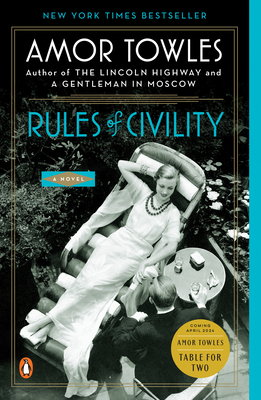
While the teen time machine was set on 2033, the adult book club traveled back for a look at life in New York City, circa 1938, in Amor Towles' literary debut, The Rules of Civility. This novel features beautiful prose, and fascinating insights into the layers of socioeconomic class in the Big Apple – and in America herself – at the time, as well as satisfying characters, and some surprising plot turns. Protagonist Katie Kontent, born and raised in Brooklyn, sees all her dreams about coming of age in the glamour of the jazz age go up with the smoke of her fifteenth birthday candles, as the Stock Market takes its infamous 1929 Crash. The daughter of a Russian immigrant whose family struggled for money anyway, the Great Depression doesn't necessarily change Katie's life that much, but it does change the city and the attitudes of the people who live and work there. Alone as a young woman, Katie lives in a boarding house with other girls of similar age and career status, working her days in a secretarial pool for a large law firm, spending her nights socializing mostly with the other boarders. Once in a while, the girls go out on the town, finding boys who will take them out for a dinner or a drink or two, in exchange for a kiss goodnight. Katie and her roommate, Evelyn, set specific rules for themselves about what they will and won't do to go out with a guy.
New Year's Eve 1937, however, finds the two girls in a second-class jazz bar, drinking cheap gin, when an obviously well-to-do young man sits at the table next to theirs. The three strike up a conversation, which leads to a friendship, which will change all three of their lives in far-reaching, life-changing, unimaginable ways. Through the complicated relationships of Katie, Evey, and the handsome and wealthy Tinker Grey, Towles offers pitch-perfect descriptions of the City and the era, which is simultaneously melting pot and blue-blood domain. Here, the easy wealth and entitled ways of the blue-blooded, the daily grind of the taxi drivers and the doormen, and the subtle and not-so-subtle actions of the ambitious drive plot tensions the reader may not have expected to find in such a lyrical novel.
Thanks to our book clubs, my recommendations this month span the gambit from action-packed, life-and-death situations to lovely descriptions of smoky jazz clubs and opulent hotel rooms. These two books do have a few elements in common, however: they are both first novels from writers who originally found success in other jobs; their characters deal with unexpected ethical dilemmas; and both books offer some plucky heroines and heroes, whose little idiosyncracies become surprisingly endearing. Whether served on silver trays or on paper plates from aisle 6, the stories here are good fare.
Thursday, May 1, 2014
Technology Built a Bookstore
Kevin Coolidge
I don't have a cell phone. I don't use GPS. I don't own a Kindle. I don't need one. I can read a map. I prefer real books. I still enjoy the newspaper.
Technology changes everything. When, I got my first computer. I didn't feel I needed it. It wasn't required for work. I was self-employed as a personal trainer and a massage therapist.
Facebook, LinkedIn, and Twitter didn't exist. I didn't need my computer for networking or scheduling appointments. I mostly used it to email friends, and get news that wasn't covered in my daily newspaper.
In November of 2003, the wellness center where I was employed closed. I decided to move. It was close enough that I still had some of my massage clients, but I needed to supplement my income.
I had always enjoyed reading, and loved books. One of my favorite ways to spend a Saturday afternoon was to wander around book shops looking for a new book to read, or a cherished favorite. I decided to sell my used books on eBay.
I started small. Just the books I didn't plan on reading again. After all, a mystery is not a mystery once you've read it. I could part with a few, and it'd give me space on my book shelves again, and I needed to pay my rent.
I listed some books, arranged them where I could find them once I sold them, and bought some shipping supplies. I quickly sold several books, and wrapped them for the post. I learned the difference between first class, parcel post, and media mail.
I was off to a great start, but I needed more books. This was my favorite part. When I didn't have massage clients, I would comb thrift shops and yard sales to find books. I found new books to read and then I could turn around and sell them. Soon, I had more books than when I started.
I love books and so does my wife. I didn't know she was going to be my wife when I met her, but I knew she had to love books. She had recently moved back to our hometown, and was also selling books online.
We joined inventories and our love of books and took the leap to Main Street and opened our store, From My Shelf Books in 2006 with only 3,000 used books and dreams of filling the 800 square feet.
It's been just over ten years since I sold my first used book. Today, From My Shelf Books & Gifts has outgrown the original location and now has over 50,000 used and new books, and is bursting with puzzles, cards, games, book-related gifts, and general good cheer. Some bibliophiles fear that technology will kill the bookstore, but it helped build this one.
Huck, one of our store kitties
front of From My Shelf Books
I don't have a cell phone. I don't use GPS. I don't own a Kindle. I don't need one. I can read a map. I prefer real books. I still enjoy the newspaper.
Technology changes everything. When, I got my first computer. I didn't feel I needed it. It wasn't required for work. I was self-employed as a personal trainer and a massage therapist.
Facebook, LinkedIn, and Twitter didn't exist. I didn't need my computer for networking or scheduling appointments. I mostly used it to email friends, and get news that wasn't covered in my daily newspaper.
In November of 2003, the wellness center where I was employed closed. I decided to move. It was close enough that I still had some of my massage clients, but I needed to supplement my income.
I had always enjoyed reading, and loved books. One of my favorite ways to spend a Saturday afternoon was to wander around book shops looking for a new book to read, or a cherished favorite. I decided to sell my used books on eBay.
I started small. Just the books I didn't plan on reading again. After all, a mystery is not a mystery once you've read it. I could part with a few, and it'd give me space on my book shelves again, and I needed to pay my rent.
I listed some books, arranged them where I could find them once I sold them, and bought some shipping supplies. I quickly sold several books, and wrapped them for the post. I learned the difference between first class, parcel post, and media mail.
I was off to a great start, but I needed more books. This was my favorite part. When I didn't have massage clients, I would comb thrift shops and yard sales to find books. I found new books to read and then I could turn around and sell them. Soon, I had more books than when I started.
I love books and so does my wife. I didn't know she was going to be my wife when I met her, but I knew she had to love books. She had recently moved back to our hometown, and was also selling books online.
We joined inventories and our love of books and took the leap to Main Street and opened our store, From My Shelf Books in 2006 with only 3,000 used books and dreams of filling the 800 square feet.
It's been just over ten years since I sold my first used book. Today, From My Shelf Books & Gifts has outgrown the original location and now has over 50,000 used and new books, and is bursting with puzzles, cards, games, book-related gifts, and general good cheer. Some bibliophiles fear that technology will kill the bookstore, but it helped build this one.
Huck, one of our store kitties
front of From My Shelf Books
Wednesday, April 30, 2014
Godzilla
Kevin Coolidge
I've always loved monster movies, and among my favorites is Godzilla. I don't count the movie in 1998, not a bad monster movie, but a giant irradiated iguana is not Godzilla.
I'm looking forward to the new movie coming out May 16, 2014. The trailers look much more like the Godzilla I know, and I've read that he's the biggest and baddest ever.
From My Shelf Books has lots of Godzilla graphic novels, as well as taking pre-orders for the novelization of the movie coming out May 20, and today I got in a mini Godzilla figurine complete with "atomic ray" light and his iconic roar. It's time to get your kaiju* on...
*kaiju is a Japanese word that literally translates to "strange creature." The word has been translated and defined in English as "monster" and is used to refer to a genre of movies.
click here to order, or come on in.
I've always loved monster movies, and among my favorites is Godzilla. I don't count the movie in 1998, not a bad monster movie, but a giant irradiated iguana is not Godzilla.
I'm looking forward to the new movie coming out May 16, 2014. The trailers look much more like the Godzilla I know, and I've read that he's the biggest and baddest ever.
From My Shelf Books has lots of Godzilla graphic novels, as well as taking pre-orders for the novelization of the movie coming out May 20, and today I got in a mini Godzilla figurine complete with "atomic ray" light and his iconic roar. It's time to get your kaiju* on...
*kaiju is a Japanese word that literally translates to "strange creature." The word has been translated and defined in English as "monster" and is used to refer to a genre of movies.
click here to order, or come on in.
I Heart My Little A-Holes
Popular blogger Karen Alpert shares her hysterical take on the many "joys" of parenting--I Heart My Little A-Holes is full of hilarious stories, lists, thoughts and pictures that will make you laugh so hard you'll wish you were wearing a diaper.
Hiking in the Pennsylvania Grand Canyon
Kevin Coolidge
I hear the whisper of pines. The trail is calling. It's been a long winter, but spring is finally here. It's time to dig out my hiking shoes and drive to the Pine Creek Gorge, also known as the Pennsylvania Grand Canyon.
The Canyon offers many recreational activities-such as hiking, fishing, biking, birding, and whitewater rafting in the spring. This gem of the Northeast is located just ten miles outside Wellsboro, Pennsylvania on PA 660.
Two state parks straddle the rim of the canyon, overlooking Pine Creek, and the Pine Creek Rail Trail. Leonard Harrison State Park is more developed and is located on the east rim. There is a visitor center here with a scenic overlook, and the top entrance to the Turkey Path.
The Turkey Path is a winding, one-mile trail that descends to the canyon floor, where it connects to the rail trail. The path starts with an easy grade, but quickly becomes a series of switchbacks. It can be a strenuous hike. Be sure to have sturdy shoes and water. Down and up usually takes less than two hours.
You may want to take extra time to enjoy the scenery. About halfway down, the trail parallels Little Four Mile Run and several waterfalls. There are several wooden observation decks, steps and railings that were built in the mid 90s. This makes the hike more accessible, and helps prevent erosion of the canyon walls.
Before you begin the return hike, you may want to walk along the Pine Creek Rail Trail, which presently is about 62 miles long. It's a nice, flat grade that is great for biking. Many entrances to the trail can be accessed by car if you want to bike or horse ride. Several area businesses rent bicycles.
The Gorge was officially designated by the Pennsylvania Audubon Society as an important birding area in 2004. You may view numerous woodland species on your hike down-such as hermit thrushes and scarlet tanagers.
American Bald Eagles have been nesting in the canyon since the late 80s. It's not unusual to see a bald eagle up close while walking along the Pine Creek Trail, and from the overlooks it is common to see Cooper's hawks and other raptors.
If you haven't tried birding from a bicycle, this is a good place to give it a try. You won't scare the wildlife, and it allows you to cover several habitats, which will increase your species count while visiting the canyon.
Afterwards, check out the town of Wellsboro. You can find several choices for dinner, stroll the gas-lit Main Street, or shop at a family owned business. Check out the local chamber of commerce for a calendar of events.
Wellsboro Area Chamber of Commerce
114 Main St
Wellsboro PA 16901
www.wellsboropa.com
(570)724-1926
Start of the Turkey Path
One of the many waterfalls along the Turkey Path
Photo of one of our eagles in the area.
I hear the whisper of pines. The trail is calling. It's been a long winter, but spring is finally here. It's time to dig out my hiking shoes and drive to the Pine Creek Gorge, also known as the Pennsylvania Grand Canyon.
The Canyon offers many recreational activities-such as hiking, fishing, biking, birding, and whitewater rafting in the spring. This gem of the Northeast is located just ten miles outside Wellsboro, Pennsylvania on PA 660.
Two state parks straddle the rim of the canyon, overlooking Pine Creek, and the Pine Creek Rail Trail. Leonard Harrison State Park is more developed and is located on the east rim. There is a visitor center here with a scenic overlook, and the top entrance to the Turkey Path.
The Turkey Path is a winding, one-mile trail that descends to the canyon floor, where it connects to the rail trail. The path starts with an easy grade, but quickly becomes a series of switchbacks. It can be a strenuous hike. Be sure to have sturdy shoes and water. Down and up usually takes less than two hours.
You may want to take extra time to enjoy the scenery. About halfway down, the trail parallels Little Four Mile Run and several waterfalls. There are several wooden observation decks, steps and railings that were built in the mid 90s. This makes the hike more accessible, and helps prevent erosion of the canyon walls.
Before you begin the return hike, you may want to walk along the Pine Creek Rail Trail, which presently is about 62 miles long. It's a nice, flat grade that is great for biking. Many entrances to the trail can be accessed by car if you want to bike or horse ride. Several area businesses rent bicycles.
The Gorge was officially designated by the Pennsylvania Audubon Society as an important birding area in 2004. You may view numerous woodland species on your hike down-such as hermit thrushes and scarlet tanagers.
American Bald Eagles have been nesting in the canyon since the late 80s. It's not unusual to see a bald eagle up close while walking along the Pine Creek Trail, and from the overlooks it is common to see Cooper's hawks and other raptors.
If you haven't tried birding from a bicycle, this is a good place to give it a try. You won't scare the wildlife, and it allows you to cover several habitats, which will increase your species count while visiting the canyon.
Afterwards, check out the town of Wellsboro. You can find several choices for dinner, stroll the gas-lit Main Street, or shop at a family owned business. Check out the local chamber of commerce for a calendar of events.
Wellsboro Area Chamber of Commerce
114 Main St
Wellsboro PA 16901
www.wellsboropa.com
(570)724-1926
Start of the Turkey Path
One of the many waterfalls along the Turkey Path
Photo of one of our eagles in the area.
Tuesday, April 29, 2014
Kronos Rising
Kevin Coolidge
Here there be dragons…
Dragons, dinosaurs, huge killer sharks--I’ve always loved monsters. It’s one of the reasons I enjoy the “Meg” books by Steve Alten. Meg stands for Megalodon, a giant shark that lived during prehistoric times. It was huge, the largest carnivorous fish known to exist.
It wasn’t, however, the only predator of the deep. There was Kronosaurus, a marine reptile characterized by a thick head, short neck, and outsized flippers. Its ecological niche appears to be the similar as the Great White Shark. It ate squid, turtles, fish, and smaller dinosaurs, anything that swam into its path.
Remains of these creatures have been found from Australia to South America, proof that these reptiles attained an especially wide distribution. Kronosaurus ruled the seas during the Cretaceous period, but that was millions of years ago.
It couldn’t possibly exist today, or could it? The oceans’ depths still remain mostly unmapped. It’s said we are more familiar with the surface of the Moon than our planet’s oceans. Maybe, just maybe, something has survived from long ago.
Max Hawthorne wonders this very thing. In Kronos Rising, a small, breeding population has survived. One of these prehistoric predators rises from the depths to terrorize a coastal community that won’t be idyllic soon.
A series of disappearances and horrific deaths sends waves of panic through the small town. The local sheriff begins to investigate what might be murder, but when a full-grown whale carcass surfaces, the true terror begins.
Marine horror isn’t new. Peter Benchley started the modern trend with Jaws. Steve Alten gave us Meg, and now we have giant lizards gnawing at our fears. It still works. I love the genre, but it’s hard to do anything new with it. Max has managed to give me a couple surprises.
Kronos Rising is a well-written story, better than it had to be to deliver its biting horror. There are flawed heroes that are likeable. Villains that I looked forward to being eaten, and a back story that’s both feasible, and well researched, and most importantly, it’s fun.
The Bible tells of a terrible sea creature called Leviathan. The Norse have myths of Jörmungandr, the World Serpent. Sailors see things that terrify them. Stories of sea monsters and eyewitness accounts persist to this day. Unknown, primal, lurking in the darkness, I’ve always feared monsters…
Here there be dragons…
Dragons, dinosaurs, huge killer sharks--I’ve always loved monsters. It’s one of the reasons I enjoy the “Meg” books by Steve Alten. Meg stands for Megalodon, a giant shark that lived during prehistoric times. It was huge, the largest carnivorous fish known to exist.
It wasn’t, however, the only predator of the deep. There was Kronosaurus, a marine reptile characterized by a thick head, short neck, and outsized flippers. Its ecological niche appears to be the similar as the Great White Shark. It ate squid, turtles, fish, and smaller dinosaurs, anything that swam into its path.
Remains of these creatures have been found from Australia to South America, proof that these reptiles attained an especially wide distribution. Kronosaurus ruled the seas during the Cretaceous period, but that was millions of years ago.
It couldn’t possibly exist today, or could it? The oceans’ depths still remain mostly unmapped. It’s said we are more familiar with the surface of the Moon than our planet’s oceans. Maybe, just maybe, something has survived from long ago.
Max Hawthorne wonders this very thing. In Kronos Rising, a small, breeding population has survived. One of these prehistoric predators rises from the depths to terrorize a coastal community that won’t be idyllic soon.
A series of disappearances and horrific deaths sends waves of panic through the small town. The local sheriff begins to investigate what might be murder, but when a full-grown whale carcass surfaces, the true terror begins.
Marine horror isn’t new. Peter Benchley started the modern trend with Jaws. Steve Alten gave us Meg, and now we have giant lizards gnawing at our fears. It still works. I love the genre, but it’s hard to do anything new with it. Max has managed to give me a couple surprises.
Kronos Rising is a well-written story, better than it had to be to deliver its biting horror. There are flawed heroes that are likeable. Villains that I looked forward to being eaten, and a back story that’s both feasible, and well researched, and most importantly, it’s fun.
The Bible tells of a terrible sea creature called Leviathan. The Norse have myths of Jörmungandr, the World Serpent. Sailors see things that terrify them. Stories of sea monsters and eyewitness accounts persist to this day. Unknown, primal, lurking in the darkness, I’ve always feared monsters…
Subscribe to:
Posts (Atom)