When seventy-something new author Alan Bradley sat down to write a mystery, he never expected eleven year old Flavia de Luce to become the main character. Bradley confessed that he was writing a wholly different novel, but when his detective character came to the family manor of Colonel de Luce, Flavia “hijacked” the story, entering into the plotline fully formed with her bold voice, her curiosity, her intelligence, her love for chemistry, her stubborn determination to solve a puzzle – or a murder – herself. If Flavia were none other than herself, one might feel sorry for her. She lives with her two older sisters, who torment her and with whom she shares nothing in common except their distracted, aloof father and a mother who died when Flavia was only a toddler. Critics call Flavia a combination of Harriet the Spy and Sherlock Holmes. As she and her bicycle “Gladys” journey back and forth between her family’s great house of Buckshaw and the local village of Bishop’s Lacey, Flavia digs around the dusty library archives, sneaks into the bell tower at her father’s former private school, learns more about the heretofore boring history of her father’s beloved stamp collecting, trespasses at a local inn, and delves into the secrets in her father’s background in order to absolve him of the murder of the man Flavia finds gasping his last breath in their cucumber patch at pre-dawn one early summer morning in 1950.
The Sweetness at the Bottom of the Pie was not intended to be a “young adult” novel, nor is it specifically marketed as one, but as more than one reviewer noted, this is a mystery novel without grisly descriptions of death, explicit sexual situations, or involved political plots. This book presents, at first, as a fairly simple mystery, but it has more than enough satisfying plot turns and eccentric characters to keep the pace lively and the story unique. More Agatha Christie or Nero Wolfe than Nancy Drew, this book would still be an excellent choice for younger readers with higher reading levels, so take note, parents and teachers who worry about finding books that will engage the minds of your advanced readers while not exposing your kids to ‘inappropriate’ content.
As author Alan Bradley reveals in several interviews about the Flavia books – since he has already been awarded a contract for at least four more in this series – what makes the character of Flavia work so well as a sleuth is the way that children’s curiosity is often ignored. Bradley says children are forgiven for asking hundreds of questions, for flitting about the house or the village doing whatever, and people don’t question them or fear them the way that they would if an adult were doing the same things. Therefore, adults don’t always pay attention to what they may let slip in front of children, or what a child might do with information he has seen or she has gathered. In this way, Flavia became the perfect sleuth: even when she was caught nosing around where she shouldn’t have been, most of the adults in her village underestimated her plans and her determination.
At her “tween” age and with her precociousness, Flavia makes a fascinating narrator, as she tries to gather information – like any good scientist – and make linear, logical order of the events she witnesses. It’s fun for the reader to both admire her intelligence and forgive her the mistakes she makes, balanced as she is between the magical thinking of childhood and the rational mind of the adult she is becoming.
In this first story about Flavia, Bradley weaves together several mysteries, ably brings to life period details and the verisimilitude of rural England, and resolves the central murder of Sweetness at the Bottom of the Pie. He also teases the reader, leaving the door open for further adventures with the de Luce family, dropping hints about the circumstances of Harriet de Luce’s death nearly ten years prior, and the history that Colonel de Luce shares with his groundskeeper, “Dogger”, with whom he served during the war. Follow the intrepid Flavia and this quirky cast of characters into the next story, The Weed that Strings the Hangman’s Bag, as well as the third, newly-released, A Red Herring without Mustard.
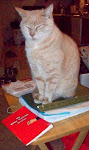
Red herring or fishy alibi? Email Hobo your thoughts at from_my_shelf@yahoo.com. Miss a clue? Check out the archives at Hobo’s blog, http://frommyshelf.blogspot.com. There’s no mystery as to why Hobo left the farm: he wanted to become a bookstore cat!
Showing posts with label Sweetness at the Bottom of the Pie. Show all posts
Showing posts with label Sweetness at the Bottom of the Pie. Show all posts
Saturday, April 23, 2011


Sunday, January 16, 2011
Reading Deliberately in the New Year, Part One
For many bibliophiles, New Year’s Resolutions are not so important as is a plan of action for reading in the coming year. Just in the past week, I’ve had five different people come to the bookstore to ask for suggestions to populate their upcoming book club calendars. Just like athletes devising a training schedule, or business owners aiming to diversify their customer base, many book lovers scheme a reading plan for the months to follow.
In her popular blog, www.thebookladysblog.com, the passionate bibliophile Rebecca Jones Schinsky recently mused on her reading goals for 2011. For 2009, she tried to read 100 books in a year; in 2010, she made a list of specifically-chosen books, so that she might read “more deliberately”; for 2011, her goal is to become a more well-rounded reader, by reading at least one book from every section of her favorite independent bookstore. In her endeavor for 2011, I believe “the Book Lady” is taking practical steps to meet her more loftily stated goals of “expanding her literary horizons” by “exploring new genres.”
I had been pondering a more “deliberate” list for myself, since I feel as though I end up recommending many of the same books over and over. They are certainly excellent books, all of which I’ll continue to recommend, but I need some new fodder for my “recommended” list as well as new challenges in my own reading life. I sorted through books in my huge “TBR” (to be read) pile, slid in a couple of classics I want to challenge myself to read, mixed in several genres, borrowed a few from the newsletters of other independent bookstores, and, voila, the reading list I’ve set for myself for 2011. My goal is to read as many on list as possible before year’s end; hopefully, I’ll read all of them and more. I haven’t set too many “rules” for myself, except the following: I really have to hate it to quit a book on the list; I can only quit after getting at least halfway through it; that if I quit a book, I need to try to pick it up at least once more during the year; and there’s no specific order in which I need to read them. Brief reasons for each selection follow each title.
The Sweetness at the Bottom of the Pie by Alan Bradley: came highly recommended from all over the book world, even when it was in hardcover. The main character is a plucky eleven year old chemistry nerd, determined to solve a murder mystery which lands in her backyard. A book written for adults yet featuring a child as the narrator; a British period piece written by an American who had never been to England; a debut novel from a 70 year old author; a well-written novel that just happens to be a mystery novel – there are so many aspects of this book which call to me. This has been on my “TBR” pile for over a year, so it’s definitely time.
Unbroken by Laura Hillenbrand -- the newest book from the acclaimed author of Seabiscuit brings us the incredible story of one American man’s wild journey of a life through a hell-raising youth during the Great Depression to the track in the 1936 Olympics in Berlin, on to the skies above the Pacific in World War II, to the depths of a Japanese POW camp, and the silent torments of recovering from all the trauma this man, and so many other soldiers like him, had to face. Hey, I’m a sucker for stories of resilience and survival, and for World War II history. In the gifted hands of a writer and researcher like Hillenbrand, no wonder folks are raving.
The Watchmen by Alan Moore: I find graphic novels harder to read, because I am someone who processed so predominantly through words, and graphic novels require the reader to process a story via words and pictures. Although we process story visually and auditorily by watching movies, which I also enjoy, when it comes to the page in front of me, I find it more difficult to process with the visual images and the words. I have a growing admiration for storytellers who are giving us their complicated, elaborate stories in this visual and literary format, and want to challenge myself to be more comfortable in this genre. Although there are many excellent graphic novels available, The Watchman was the only graphic novel listed by Time magazine as one of the top 100 books written in the U.S. since the 1920s.
Zen and the Art of Motorcycle Maintenance by Robert M. Pirsig: one of the “new classics”, originally written in 1974 as a novel exploring, among other things, our philosophical heritage, why our technology often leaves us feeling separate from the world, the quest to balance our lives between disparate experiences by being feeling present to them. This book is commonly given to people to pave the way more gently into the “big” questions of philosophy and all the tomes of philosophic rhetoric that attempt to address those questions. It is one of my sister’s favorite books, and she even documented her struggles with it in a gigantic mixed-media painting that became part of the collection of works she presented for her college senior showing. Philosophy intrigues me a great deal, as I have long been interested in “THE BIG QUESTIONS”, but have been afraid of reading too much, for fearing of falling too deeply into the rabbit hole. This seems a safe way to begin.
Tune in next week for the rest of the list! With the introduction of said list out of the way this week, there will be much more room for the actual listing and describing of the rest of the books. For a cheat peek, check our blog at http://frommyshelf.blogspot.com, where you’ll find the entire list now, but not the description or reasons. Can’t steal Hobo’s fire for next week! By the way, Hobo’s hat wasn’t stolen by a grinch, but was returned by a good Samaritan who found it run over in the street.
In her popular blog, www.thebookladysblog.com, the passionate bibliophile Rebecca Jones Schinsky recently mused on her reading goals for 2011. For 2009, she tried to read 100 books in a year; in 2010, she made a list of specifically-chosen books, so that she might read “more deliberately”; for 2011, her goal is to become a more well-rounded reader, by reading at least one book from every section of her favorite independent bookstore. In her endeavor for 2011, I believe “the Book Lady” is taking practical steps to meet her more loftily stated goals of “expanding her literary horizons” by “exploring new genres.”
I had been pondering a more “deliberate” list for myself, since I feel as though I end up recommending many of the same books over and over. They are certainly excellent books, all of which I’ll continue to recommend, but I need some new fodder for my “recommended” list as well as new challenges in my own reading life. I sorted through books in my huge “TBR” (to be read) pile, slid in a couple of classics I want to challenge myself to read, mixed in several genres, borrowed a few from the newsletters of other independent bookstores, and, voila, the reading list I’ve set for myself for 2011. My goal is to read as many on list as possible before year’s end; hopefully, I’ll read all of them and more. I haven’t set too many “rules” for myself, except the following: I really have to hate it to quit a book on the list; I can only quit after getting at least halfway through it; that if I quit a book, I need to try to pick it up at least once more during the year; and there’s no specific order in which I need to read them. Brief reasons for each selection follow each title.
The Sweetness at the Bottom of the Pie by Alan Bradley: came highly recommended from all over the book world, even when it was in hardcover. The main character is a plucky eleven year old chemistry nerd, determined to solve a murder mystery which lands in her backyard. A book written for adults yet featuring a child as the narrator; a British period piece written by an American who had never been to England; a debut novel from a 70 year old author; a well-written novel that just happens to be a mystery novel – there are so many aspects of this book which call to me. This has been on my “TBR” pile for over a year, so it’s definitely time.
Unbroken by Laura Hillenbrand -- the newest book from the acclaimed author of Seabiscuit brings us the incredible story of one American man’s wild journey of a life through a hell-raising youth during the Great Depression to the track in the 1936 Olympics in Berlin, on to the skies above the Pacific in World War II, to the depths of a Japanese POW camp, and the silent torments of recovering from all the trauma this man, and so many other soldiers like him, had to face. Hey, I’m a sucker for stories of resilience and survival, and for World War II history. In the gifted hands of a writer and researcher like Hillenbrand, no wonder folks are raving.
The Watchmen by Alan Moore: I find graphic novels harder to read, because I am someone who processed so predominantly through words, and graphic novels require the reader to process a story via words and pictures. Although we process story visually and auditorily by watching movies, which I also enjoy, when it comes to the page in front of me, I find it more difficult to process with the visual images and the words. I have a growing admiration for storytellers who are giving us their complicated, elaborate stories in this visual and literary format, and want to challenge myself to be more comfortable in this genre. Although there are many excellent graphic novels available, The Watchman was the only graphic novel listed by Time magazine as one of the top 100 books written in the U.S. since the 1920s.
Zen and the Art of Motorcycle Maintenance by Robert M. Pirsig: one of the “new classics”, originally written in 1974 as a novel exploring, among other things, our philosophical heritage, why our technology often leaves us feeling separate from the world, the quest to balance our lives between disparate experiences by being feeling present to them. This book is commonly given to people to pave the way more gently into the “big” questions of philosophy and all the tomes of philosophic rhetoric that attempt to address those questions. It is one of my sister’s favorite books, and she even documented her struggles with it in a gigantic mixed-media painting that became part of the collection of works she presented for her college senior showing. Philosophy intrigues me a great deal, as I have long been interested in “THE BIG QUESTIONS”, but have been afraid of reading too much, for fearing of falling too deeply into the rabbit hole. This seems a safe way to begin.
Tune in next week for the rest of the list! With the introduction of said list out of the way this week, there will be much more room for the actual listing and describing of the rest of the books. For a cheat peek, check our blog at http://frommyshelf.blogspot.com, where you’ll find the entire list now, but not the description or reasons. Can’t steal Hobo’s fire for next week! By the way, Hobo’s hat wasn’t stolen by a grinch, but was returned by a good Samaritan who found it run over in the street.
Subscribe to:
Posts (Atom)
