Kevin Coolidge
New, used, or borrowed: I’ve always loved books. The smell and texture of a pulp era treasure, or the bright, glossy cover of a New York Times bestseller, I love books and I love the hunt – browsing shelves, finding an old favorite, a new title, or an interesting topic, in the dark corner of a second hand store, the bright aisle of a supermarket, or from a table made by throwing a board over two sawhorses. There are many places to buy books, but time flows differently in a bookstore. I love a good bookstore, but are bookstores going out of print?
Borders, the big box bookstore, has filed for bankruptcy. Does this mean the end of the bookstore? The story of Borders began in Ann Arbor, Michigan in the early 1970’s, founded by two brothers, Tom and Louis Borders. Borders started with just a meager supply of used books. In 1975, the brothers bought the stock of Wahr’s, a bookstore closing its doors after 80 years, at which point Borders moved to larger quarters, and a new chapter began.
As Borders spread nationwide, many smaller independent bookstores were closing. Borders offered more choices at better prices, and in the early 90’s was bought by Kmart, who owned the mall-based bookstore chain Waldenbooks. Kmart hoped that the senior management of Borders could help the floundering Waldenbooks, but many of the senior management left. Kmart, facing its own problems and pressure from stockholders, spun off a new structured stock selloff, forming the Borders-Walden Group, which later was renamed Borders Group.
Borders had grown from a cozy little independent into a cold, box store behemoth. No longer a community based bookseller, but a corporation that sold books, Borders became a corporation that sought to conquer the bookselling market, and yet failed to see where the market was going. What did Borders do wrong?
Borders expanded too quickly, and failed to adapt to the digital marketplace, but where it really failed was reading the writing on the wall. Certainly, there are more entertainment and education resources today than even two years ago. More movies, more DVDs, eBooks, iPads, ipods, eReaders, video streaming over the internet, and more books than any caffeinated consumer could ever hope to read. Really good books, books that keep you up at night turning pages, are not as quite as common as the publishers want you to think. Many bestselling books are rushed into print to take advantage of a literary trend. Publishers hope that if you buy one book on teenage vampires, that you will buy twenty, but all you really wanted was a really good story.
I don’t think the story of the bookstore is over, but I do think the era of the big box bookstore has come to a close. I don’t know what books without Borders is going to look like. Borders is seeking chapter 11, and owes millions to publishers. It doesn’t matter if you haven’t bought a book from Borders in years, if you are a book lover; you are going to feel this. This collapse of empire will affect the publishing landscape with a ripple effect that has yet to be felt.
Borders and big box stores belonged to an era when book retailing was a big enough business to dominate, but you have to sell a lot of books to keep the lights on, and there’s just not as much money in it anymore. The story of the book is not over, but maybe it’s time to go back to start a new chapter, shopping for books in stores that let cats wander through the store, and booksellers that know the community and their readers, and maybe they won’t even serve coffee…
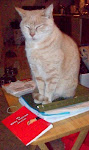
Big Box Bookstores? Or Community minded booksellers? Drop me an email at from_my_shelf@yahoo.com and let me know. Miss a past column? Visit our blog at http://frommyshelf.blogspot.com and catch up on your reading. Hobo says a real bookstore has a personality, and preferably a cat. For a book with a personality, check out Hobo’s book, “Hobo Finds a Home”, a children’s book about a cat who wanted more out of life.
Monday, February 28, 2011


Monday, February 14, 2011
GOOD NEWS, BAD NEWS
Kevin Coolidge
It’s cold and quiet, the dead of winter. Life consists of trying to keep warm, shoveling snow, and waiting for spring. It’s pretty boring, and that’s the good news. Your teachers, your parents, and the media have been conspiring against you. The good news is that life is bigger, more exciting, and more interesting that you were taught to believe. The bad news? Life is going to kill you.
There are some facts that are just too terrifying to teach in school. Unfortunately, there’s a book called You Might Be a Zombie from the editors of cracked.com that is more than happy to educate you. You will find answers to questions you didn’t even know you should be asking. Questions like, why is humanity doomed? What five popular brands did the Nazis give us? And is a zombie apocalypse really possible???
The bad news is that the police officer harassing you really was abusing his authority. The good news is according to research, if the roles were reversed, you’d likely be a brownshirt too. Turns out that fear of repercussion is all that keeps us from torturing other human beings.
You may have heard of the Stanford Prison Experiment: a newspaper article asked for volunteers for the experiment. After tests to evaluate health and mental stability, twenty-four were chosen and divided into twelve guards and twelve prisoners. The goal was to test how captivity affects subjects put into positions of authority and submission.
It took less than one day for the subjects to abuse their authority. On day two, the prisoners rioted. The guards saw this as a good excuse to make prisoners sleep naked on concrete, restrict bathroom use, and make prisoners clean toilets with their bare hands. Keep in mind the entire experiment was voluntary and no one asked to be let out of the experiment.
The good news is that most of the natural disasters that Hollywood worries over are grossly exaggerated. The bad news is that nature is full of ticking time bombs quietly waiting to explode, and you’ve probably never heard of most of them.
People worry that the San Andreas Fault will shake Los Angeles right off the continental shelf. What you should be worrying about is the New Madrid Seismic Zone that stretches from Illinois to Alabama. In an earthquake, coastal towns are actually better off, as a portion of the seismic activity gets dissipated out to sea. No such luck for the landlocked inhabitants living in the New Madrid’s million square mile zone.
From 1811 to 1812 a series of quakes cracked sidewalks from Missouri to Baltimore and permanently altered the course of the Mississippi River. The quake swallowed the entire town of Little Prairie, Missouri, when it liquidated the ground it was built on. It no longer exists. Consider yourself warned.
According to Shakespeare and the editors of cracked.com, there are more things in heaven and earth, which are dreamt of in your philosophy. The bad news is that it just may be three-inch, Japanese giant hornet that can spray flesh-melting poison. Now which do you want to hear first???
Good News? Or Bad News? Drop me an email at from_my_shelf@yahoo.com For all the news that’s fit to print, or to just catch up on past columns, check out our blog at http://frommyshelf.blogspot.com The good news is that Hobo is finished with his new book. The bad news is that its release is tied up in litigation over the estate of Gonzo, the big mean cat next door…
Thursday, February 10, 2011
Wise Man's Fear
Although some would disagree, book people will tell you that sometimes it’s nice to read a book again. Reasons to re-read are numerous, and often overlapping – to indulge in the pleasure of a familiar, beloved experience, like comfort food; to obtain a new perspective on a book you read years ago; to review the material for an academic reason; to refresh your memory on the plot and characters because a new installment of a series has been published.
Re-reading a book is one thing; re-using a column is, perhaps, another. Nevertheless, I hope you will forgive me for re-visiting a book review I wrote in July 2008. This, then, is a piece of that review:
Sometimes, the superlatives aren’t enough. … I have been accused of tending towards hyberbole. I have a hard time holding myself back, though: I say “H-U-G-E!”, drawing out the letters for emphasis; I say “awesome” and “amazing” quite a bit; I also like “fantastic” and “fabulous”. As a person who loves life and feels things deeply, it’s not unusual that my descriptions would be on the dramatic end of the spectrum.
This presents a bit of a problem, on occasion, when reviewing books. I love books. It’s easy to give all kinds of books an enthusiastic thumbs-up, employing any one of my favorite words noted above. But then what to do when a truly special book comes along? How to explain that this book, this author, the writing here, set themselves apart from anything else you’ve read in a long time?
Well, is that enough build-up, or have I exceeded my exaggeration threshold once again? If you can’t hear me on this, then look at what authors Ursula LeGuin, Terry Brooks, Anne McCaffrey, and Orson Scott Card – to name just a few – have to say about Patrick Rothfuss’s debut novel, The Name of the Wind. In just the short time since the first printing in hardcover in April 2007, Rothfuss has garnered praise from major newspapers all across the U.S. and Europe, as well as earning multiple-starred reviews in The New York Times, the Library Journal, Publishers Weekly, and The Onion A.V. Club. Reviewers didn’t just intimate that Rothfuss was the next J.K. Rowling or J.R.R. Tolkien, they crowed it from the rooftops.
Just as I reassured readers in that past review, so I must emphasize again that, even if you don’t normally read a lot of ‘epic fantasy’, you may very well “still enjoy The Name of the Wind and the books to follow in ‘The Kingkiller Chronicles.’ Rothfuss’s writing is so mature, so capable, so smooth, that it transcends genre. In the same way that Tolkien wrote his Middle Earth books inspired by the legends of Classic Literature that he taught, so too, Rothfuss’s story reads like a modern telling of the heroes of old, the story of a man who became a legend in his own time. Rothfuss’s protagonist Kvothe reminds me of a Ulysses or Achilles, or more recently of Tolkien’s Aragorn. His story is by turns sentimental and sweet, intriguing, sad and desperate, triumphant, exciting, frightening. Both plot and the telling kept me turning pages well into the night.”
At the end of my review that July, over two years ago, I encouraged readers to sink their teeth into a wonderful new book, the start of an exciting, satisfying new trilogy. My last sentence was a blasé little warning: “The only problem… [is] waiting for Rothfuss’s second installment, The Wise Man’s Fear,” which at that time was due out the following April of 2009, less than a year from my first read of The Name of the Wind and my subsequent review.
The next time I enjoy the first book by a new author as much as that, I’ll remember to bite my tongue. April of 2009 arrived, and no book from Rothfuss. Also, no news, no word from him or his publisher, nothing from the distributors. Finally, after two or three months of wondering what on earth happened, news showed up on Rothfuss’s blog. He admitted to his fans that the pressure had been incredible: for years, he was simply a creative writing professor at a small university in Wisconsin; then, suddenly, he was internationally known. True hardcover first editions of The Name of the Wind are now selling for thousands of dollars. Rothfuss and his wife were expecting their first child. Bookstores, fans, his publisher and his agent were demanding that he go on a wide book tour. The re-writes of his second book had slowed to a crawl. Rothfuss asked his fans for forgiveness and patience. The part of that appeal that won me over was how Rothfuss explained that, as a reader, he truly understood how it feels to wait on the next installment in a series you love, but that as a writer, he was not going to release this second book until it met his expectations for himself.
After another missed release date in the early summer of 2010, we are finally at the gate for the real release of The Wise Man’s Fear, on March 1, 2011. Now, of course, I will have to go back to re-read the first story of Kvothe, to see how he got to the point where the second book opens in March. Was it worth the wait? Join the legions of Rothfuss fans to find out.
Hobo assures you that it will also be worth the wait for his second book. Want to re-read other book reviews in the meantime? Check out our blog at http://frommyshelf.blogspot.com
Monday, January 31, 2011
WHAT’S A SNOOKI?
Kevin Coolidge
It’s coming. You know it. You dread it. But if you don’t talk to your children about it someone else will. What is a Snooki? Yes, I know what a Snooki is, and as a bibliophile, I’m not happy about it. It’s only recently that I leaned that Snooki, star of the reality television show Jersey Shore, has written a book. I don’t watch a lot of television, and I don’t watch any reality TV, but as a bookseller, I have to keep up with new books being published, and I’m not always thrilled with that part of the job.
The publishing industry’s job is to publish books and hopefully make money, and the fact that a book is or is not published is not a statement on the quality of the book. Jersey Shore has a huge following, and Simon & Shuster actually approached Snooki to write the book, It’s A Shore Thing. Why, I’m not really sure, because though the theory is sound, I sincerely doubt those rabid fans are avid readers, or even literate.
I’m saddened that a new writer may never get a publishing contract, but I’m angry that Good Morning America decided not to air its ten year traditional morning-after interview with the winners of the Newbery and Caldecott Medals, and instead decided to run an eight minute segment with a woman who has claimed to only have read two books in her entire life. Is it any wonder that America’s children have such a hard time reading?
The Newbery and Caldecott Medals, for those of you that don’t know, are presented annually by the Association for Library Service to Children, a division of the American Library Association. The Newbery Medal was named for eighteenth-century British bookseller John Newbery, and is awarded to the author of the most distinguished contribution for that year to American literature for children. The winner of the 2011 Newbery Medal winner is Moon over Manifest by Clare Vanderpool.
The Caldecott Medal was named in honor of nineteenth-century English illustrator Randolph Caldecott. It is awarded annually by the Association for Library Service to Children to the artist of the most distinguished American picture book for children. The 2011 Caldecott Medal winner is A Sick Day for Amos McGee, illustrated by Erin E. Stead, written by Philip C. Stead.
There have been a lot of great winners, and I’ve read many of them. I still enjoy reading them, and I believe many children would also. I am disappointed in Good Morning America and feel that the choice to air Snooki’s segment over the awards is a sad commentary on mainstream media, and inadvertently demonstrates just how important reading is. I was angry enough to drop the producers an email, but as reading obviously isn’t that important. I doubt anyone will read it. I did make sure to use small words…
Children’s Books? Or Childish Television? Drop me an email at from_my_shelf@yahoo.com and let me know. Miss a past column? Visit our blog at http://frommyshelf.blogspot.com for all past columns and extras. Don’t miss Hobo in his pilot episode for prime time TV in the exciting new reality series “Don’t Judge A Book by Its Cover” -- the reality TV show that takes place in a bookstore!!!
Tuesday, January 25, 2011
Reading Deliberately: My 2011 Reading Plan, Part 2
My “Read Deliberately” Plan for 2011, Part Two: If you missed part one last week, suffice it to say that I’ve made a list of books that I intend to read this year, set down a few rules for said reading plan, gave a partial list, as well as descriptions of and reasons for choosing these books. The list continues here:
The Undertaking, by Thomas Lynch: reading a review for this National Book Award finalist simultaneously put goosebumps up my neck, tears in my eyes, and a wry smile on my face. Written by a poet-essayist-undertaker from small-town Michigan, this book collects Lynch’s reflections on life and death, as seen from the perspective of one who “serves the living by caring for the dead.” I immediately thought of my friend Jim, who has a lovely, quirky sense of humor, a fine mind, a compassionate nature, and one of the hardest jobs in the world. You’ll see him greeting people at the door of Tussey-Mosher. People skills? Ministry? Science? To face daily those bedrock issues of being human, to help others deal at the worst time, all with diplomacy and gentility? A book chronicling these experiences? Wow.
Everything That Rises Must Converge, by Flannery O’Connor: the last collection of short stories written by O’Connor, published shortly after her death in 1965. O’Connor was a brilliant woman whose writing career was cut short by debilitating hereditary lupus; a devout Catholic living in the Protestant deep South; a Christian academic who refused to write apologetics. Her appreciation for the ironies of her life – indeed, of our lives in general – was readily apparent in her stories, where strange and often unlikeable characters found their intentions turned around to slap them in ways they hadn’t expected. O’Connor’s stories consistently wove together the grotesque and the sacred, wrestling with morality, ethics, with a trademark use of foreshadowing and allegory. My favorite professor in college was a die-hard fan. Evidently, so are many other American book lovers, since last year her “Collected Stories” was voted the best book to have captured the title of “National Book Award” in sixty years.
A Visit from the Goon Squad, by Jennifer Egan: Jen Egan has been an author I’ve trumpeted about ever since I read her first novel, The Invisible Circus, over ten years ago. I keep telling people, “she’s one to watch. In the meantime, read her books.” Goon Squad is her newest endeavor, and showed up on no less than four “big name” lists as one of the best novels written in 2010.
Anna Karenina, by Leo Tolstoy: I need to read this for many reasons – because I have never read any Tolstoy; because I need to try some of the “classics” again; because I am woefully ignorant of “the Russians” but have many crazy friends who adore them; because I do not want to read War and Peace.
A Fine Balance, by Rohinton Mistry: Once upon a time, a popular television talk show host named Oprah had a list of book club suggestions, and she chose authors that the general public may not have known but whom deserved to be read. Many of the books she chose told sad stories about characters struggling mightily, but the writing of said stories was beautiful, and Oprah did a wonderful service, bringing these books and their authors to national attention. A Fine Balance was one of the books on the Oprah List for 2001, before she chickened out and chose books from the required freshman reading list at half the colleges in the nation. I am finally reading it, after being drawn to stories about India, by way of wonderful recent reads from Jhumpa Lahiri, Chitra Banerjee Divakaruni and Abraham Verghese.
Murder in the Marais, by Cara Black: I really do enjoy the entire gamut of styles and situations offered by the mystery genre, but I especially appreciate a well-written novel that happens to focus on unraveling a mystery – a disappearance, a murder, a motive. After hearing me wax ecstatic about Elizabeth George’s “Scotland Yard” mystery novels, and knowing my Francophile streak, Judge Dalton recommended these mysteries to me, featuring French-American computer forensic specialist, Aimee LeDuc, with this first novel set in the Jewish quarter of Paris.
As will no doubt happen with my reading plan, I am running short – on column space now, most assuredly on calendar pages later – and so need to end my blabbing about these great books before I actually finish listing them. No matter: If I ever expect to make progress on the list, I need to get away from the computer and put my nose in a book. Seems like good advice on many levels, for most of us.
Miss last week’s launch of the list? Stop by Hobo’s blog at http://frommyshelf.blogspot.com to see it from the start. Want to share your own reading plan for the year? Email Hobo at from_my_shelf@yahoo.com, or stop by the bookstore for your own personalized reading plan.
Sunday, January 16, 2011
Reading Deliberately in the New Year, Part One
For many bibliophiles, New Year’s Resolutions are not so important as is a plan of action for reading in the coming year. Just in the past week, I’ve had five different people come to the bookstore to ask for suggestions to populate their upcoming book club calendars. Just like athletes devising a training schedule, or business owners aiming to diversify their customer base, many book lovers scheme a reading plan for the months to follow.
In her popular blog, www.thebookladysblog.com, the passionate bibliophile Rebecca Jones Schinsky recently mused on her reading goals for 2011. For 2009, she tried to read 100 books in a year; in 2010, she made a list of specifically-chosen books, so that she might read “more deliberately”; for 2011, her goal is to become a more well-rounded reader, by reading at least one book from every section of her favorite independent bookstore. In her endeavor for 2011, I believe “the Book Lady” is taking practical steps to meet her more loftily stated goals of “expanding her literary horizons” by “exploring new genres.”
I had been pondering a more “deliberate” list for myself, since I feel as though I end up recommending many of the same books over and over. They are certainly excellent books, all of which I’ll continue to recommend, but I need some new fodder for my “recommended” list as well as new challenges in my own reading life. I sorted through books in my huge “TBR” (to be read) pile, slid in a couple of classics I want to challenge myself to read, mixed in several genres, borrowed a few from the newsletters of other independent bookstores, and, voila, the reading list I’ve set for myself for 2011. My goal is to read as many on list as possible before year’s end; hopefully, I’ll read all of them and more. I haven’t set too many “rules” for myself, except the following: I really have to hate it to quit a book on the list; I can only quit after getting at least halfway through it; that if I quit a book, I need to try to pick it up at least once more during the year; and there’s no specific order in which I need to read them. Brief reasons for each selection follow each title.
The Sweetness at the Bottom of the Pie by Alan Bradley: came highly recommended from all over the book world, even when it was in hardcover. The main character is a plucky eleven year old chemistry nerd, determined to solve a murder mystery which lands in her backyard. A book written for adults yet featuring a child as the narrator; a British period piece written by an American who had never been to England; a debut novel from a 70 year old author; a well-written novel that just happens to be a mystery novel – there are so many aspects of this book which call to me. This has been on my “TBR” pile for over a year, so it’s definitely time.
Unbroken by Laura Hillenbrand -- the newest book from the acclaimed author of Seabiscuit brings us the incredible story of one American man’s wild journey of a life through a hell-raising youth during the Great Depression to the track in the 1936 Olympics in Berlin, on to the skies above the Pacific in World War II, to the depths of a Japanese POW camp, and the silent torments of recovering from all the trauma this man, and so many other soldiers like him, had to face. Hey, I’m a sucker for stories of resilience and survival, and for World War II history. In the gifted hands of a writer and researcher like Hillenbrand, no wonder folks are raving.
The Watchmen by Alan Moore: I find graphic novels harder to read, because I am someone who processed so predominantly through words, and graphic novels require the reader to process a story via words and pictures. Although we process story visually and auditorily by watching movies, which I also enjoy, when it comes to the page in front of me, I find it more difficult to process with the visual images and the words. I have a growing admiration for storytellers who are giving us their complicated, elaborate stories in this visual and literary format, and want to challenge myself to be more comfortable in this genre. Although there are many excellent graphic novels available, The Watchman was the only graphic novel listed by Time magazine as one of the top 100 books written in the U.S. since the 1920s.
Zen and the Art of Motorcycle Maintenance by Robert M. Pirsig: one of the “new classics”, originally written in 1974 as a novel exploring, among other things, our philosophical heritage, why our technology often leaves us feeling separate from the world, the quest to balance our lives between disparate experiences by being feeling present to them. This book is commonly given to people to pave the way more gently into the “big” questions of philosophy and all the tomes of philosophic rhetoric that attempt to address those questions. It is one of my sister’s favorite books, and she even documented her struggles with it in a gigantic mixed-media painting that became part of the collection of works she presented for her college senior showing. Philosophy intrigues me a great deal, as I have long been interested in “THE BIG QUESTIONS”, but have been afraid of reading too much, for fearing of falling too deeply into the rabbit hole. This seems a safe way to begin.
Tune in next week for the rest of the list! With the introduction of said list out of the way this week, there will be much more room for the actual listing and describing of the rest of the books. For a cheat peek, check our blog at http://frommyshelf.blogspot.com, where you’ll find the entire list now, but not the description or reasons. Can’t steal Hobo’s fire for next week! By the way, Hobo’s hat wasn’t stolen by a grinch, but was returned by a good Samaritan who found it run over in the street.
Thursday, January 13, 2011
Kasey's "Intentional Reading Plan" for 2011
Books I Plan to Read in 2011: list only; descriptions, explanations, and book review column stuff to come later!! :)
The Sweetness at the Bottom of the Pie, by Alan Bradley
Unbroken, by Laura Hillenbrand
The Watchmen, by Alan Moore
The Undertaking, by Thomas Lynch
Everything that Rises Must Converge, by Flannery O’Connor
A Visit from the Goon Squad, by Jennifer Egan
The Help, by Kathryn Stockett
Anna Karenina, by Tolstoy
The Corrections, by Jonathan Franzen
Death Comes for the Archbishop, by Willa Cather
A Fine Balance, by Rohinton Mistry
Seek the Living, by Ashley Warlick
Zen and the Art of Motorcycle Maintenance, by Robert M. Pirsig
Conquer the Chaos: How to Grow a Successful Small Business without going Crazy, by Clate Mask, Scott Martineau, Michael Gerber
Where We Lived, by Christina Fitzpatrick
Light in the Forest, by Conrad Richter
Unless it Moves the Human Heart, by Roger Rosenblatt
Murder in the Marais, by Cara Black
Wide Sargasso Sea, by Jean Rhys
The People of the Book, by Geraldine Brooks
The entire book of “Psalms” in the Bible, preferably in more than one translation
The only Narnia book I never read: The Silver Chair, by C.S. Lewis
Monday, January 10, 2011
A HAPPY AND PROSPEROUS NEW YEAR
Kevin Coolidge
"I've been rich and I've been poor. Rich is better.” --Sophie Tucker
It’s 2011 and time to get a fresh start in a new year. Many resolve to get fit, lose fat, or erase that credit card debt that’s been eating away at your take home pay, or maybe you are unemployed and hoping to pay the mortgage without selling a kidney. Well, money can’t buy you happiness. Anyone with lots of money and two kidneys will tell you that, but what they usually won’t say is how they got their money. I don’t think money will buy you happiness, but it does make it easier to pay your electric bill if you have something in your wallet other than pocket lint. If this year, you would like to find out for yourself if having a little more cash would bring a smile as well as an umbrella, then here are some books you might find helpful…
Secrets of a Stingy Scoundrel: 100 Dirty Little Money-Grubbing Secrets by Phil Villarreal: Phil believes that money is to be saved and not spent, and in Secrets of a Stingy Scoundrel he offers 100 ways that anyone can save money in some of the most satisfying ways possible—by taking advantage of banks, car dealerships, and big movie complexes.
For example, buy a ticket for an early movie, and hop from theater to theater. After all, the movie theater only pockets about 10% of the ticket price. The rest is commandeered by the studio. The snack counter is where the theatre sees most of the profit. So, if you buy another ticket, the theater might see another dollar. If you load up on artery clogging popcorn, you are doing the manager and the coroner a favor…
How to Get Rich as a Televangelist or Faith Healer by Bill Wilson: You’ve tried hard work, but you find that it just leads to more hard work. Well, money, power, prestige and even sex can be yours in your new career as religious con artist. This handy book delves into the psychology of a sucker, what credentials you will need, and how to build your flock. Of course, you shouldn’t actually believe what you preach, as the Bible is filled with dangerous concepts like self-sacrifice, living simply, and serving others. So, enough of the suits off the rack, dress for success. Lights….camera….salvation….
Don’t be a Victim: How to Protect Yourself from Hoaxes, Scams, and Frauds by Michael E. Chesbro: Thousands of people are cheated out of their life savings every year. There are many scams and no book can identify every variation, but this book can help you be aware of the more common, as well as to recognize the underlying principles that make these crimes so successful. A con artist might not be able to cheat an honest man, but he could trick him into giving up his social security number…
There you have it. A book on how to save your money, a book on how to take someone else’s money, and a book on how to make sure you keep your hard-earned money. Here’s to a happy and healthy New Year. Pass the sauerkraut…
For richer? Or for poorer? Drop me an email at from_my_shelf@yahoo.com Can’t commit to reading us weekly? Visit http://frommyshelf.blogspot.com now for money saving coupons and great extras. Looking to save more than just a buck? Check out “Hobo Finds A Home,” a children’s book about a stray cat. A portion of the proceeds goes to saving animals here in Tioga County.
Monday, December 27, 2010
Days Of Vengeance
Kevin Coolidge
“Revenge is an act of passion; vengeance, of justice.” ~Samuel Johnson
It’s cold. Bitter cold, hard to believe anyone would be out in this weather. Hard to believe a young girl could leave home and go off in the winter to avenge her father’s death, but Mattie Ross always was a bull-headed gal. It may seem strange now. You don’t see it everyday, but Mattie hired herself the meanest, toughest U.S. Marshal to bring the coward Tom Chaney to justice. She aimed to see him pay for his crime. She aimed to see him dance at the end of a noose….
True Grit tells the story of Mattie Ross, who is just fourteen when her father is shot down in Fort Smith, Arkansas, and is robbed of his life, his horse, and $150 in cash. She leaves home to avenge her father’s blood, with one-eyed Rooster Cogburn, the meanest available U.S. Marshal, and pursues the killer into Indian Territory, which is present day Oklahoma. .
True Grit by Charles Portis first appeared as a serial in the Saturday Evening Post, and then was re-issued as a novel in 1968, and became the basis for two movies – the 1969 Western classic starring John Wayne, and the soon to be released version directed by the Coen brothers.
Reuben J. “Rooster” Cogburn is an aging, overweight, brutal man who “likes to pull a cork”, but “fear don’t enter into his thinking” and has true grit. Mattie, with a cash incentive, is able to persuade him to take on the job, and as part of the bargain, she must go along.
Before this odd, mismatched pair can take the trail, a Texas Ranger by the name of La Boeuf enters town. He too is tracking Chaney who is wanted for killing a senator in Texas. La Boeuf wants to take Chaney alive and back to Texas, where a big cash award and glory awaits, but Mattie wants to see him hang for his crimes in Arkansas.
Rooster and La Boeuf join forces in the hunt, even though they don’t care much for each other. They decide it’d be safer for the girl to stay in town, and they leave without Mattie, but she proves to be tenacious and resourceful, and shows that she too has true grit.
I found True Grit to be a stark, simple narrative that must be one of the most under appreciated novels in American Literature. I don’t know why I waited this long to read it. I’m not sure if it’s because the Western genre is often underestimated by the critics, or if I didn’t read the book because I watched the movie starring John Wayne, but I haven’t read anything that captures the American voice better since I read Huckleberry Finn. I’m now very much looking forward to the new film, which is suppose to follow the novel more than the first film, and book or movie…You’ll not soon forget Rooster or Mattie…
Revenge--the best way to get even? Or best to forgive? Drop me an email at from_my_shelf@yahoo.com Miss a past column? Turn the other cheek at http://frommyshelf.blogspot.com and catch up. Hobo the cat says the best revenge is living well. Check out his new self-help book “Hobo Helps Himself” to find out how you to can live the good life.
Monday, December 20, 2010
HOLIDAYS ON ICE
Kevin Coolidge
Ho, ho, oh, I just want this holiday season to be over. My back aches. My cheeks are numb from smiling, and this red suit makes my butt look fat – and still the kids keep coming and coming. This used to be a good gig, but what started as a three-week seasonal avocation has turned into a two-month grind. It starts the day after Halloween with its sugar-laden latex up to New Year's Day with its remorse and resolutions. The hours are exhausting and you wouldn’t believe the pressure. I have to answer to the mall, the parents, and that damn photographer, and don't forget the controlling boss, the kid. I’m supposed to be a cross between a birthday clown and God, and it's a lot to carry on my red velvet shoulders. Kids have always been tough customers. But it used to be "What does Mrs. Klaus do?” Now it’s “what direction is the stock market going?” I sure could use a shot, a smoke, and a chuckle, and here are some of the books I’m reading on my break…
Holidays on Ice by David Sedaris: If you are dreading the holiday season, then this hilarious book filled with sarcasm and cynicism is for you. My favorite was the SantaLand Diaries, where David works as one of Santa’s elves at Macy’s. If you’ve worked in retail, you’ll appreciate these bitter Santa’s helpers…
It's Beginning to Look a Lot Like Zombies!: A Book of Zombie Christmas Carols by Michael P. Spradlin: Few things cannot be improved with the addition of animated carrion, and with such soon-to-be classics such as--"I Saw Mommy Chewing Santa Claus" and "Deck the Halls with Parts of Wally"--Christmas caroling is fun again. So buy it, barricade the door, and prepare for the hordes of rotting carolers...
The Zombie Night before Christmas by H. Parker Kelley: ‘Twas the night before Christmas and all through the house not a zombie was stirring… This illustrated book finds Santa attempting to turn back a full-out, flesh-devouring zombie attack. Sure, this book might make Clement Moore roll over in his grave, but that's why you leave milk, cookies, and some shotgun shells out for old Saint Nick....
Drinking with Dickens by Cedric Dickens: Written by the great-grandson of Charles Dickens, he shares his forebear's taste for "enlivening fluids". All drinks mentioned in the famous novels are included, 69 in all. Also included is the origins of various drinks as well as their social significance to Victorian England, and the contents of Dickens’ wine cellar when he passed away. I guess he passed on the figgy pudding and went straight to the "Dog's Nose" punch. Nothing like the hair of the dog that bit you....
Well, my benny is over. It’s time to drag my red velvet butt out there and finish my shift. I think I'll see if the cute elf in wrapping wants to get naughty and save Santa the trip...
Neat? Or on the rocks? Drop me an email at from_my_shelf@yahoo.com and let me know. Miss a past column? For undiluted content, unwrap and unwind at http://frommyshelf.blogspot.com. Looking for a stocking stuffer? Ho, Ho, Hobo, don’t forget about the cat who wrote a book, “Hobo Finds A Home”, a children’s book about a cat who wanted more than what life offered him.
Subscribe to:
Posts (Atom)
