Kevin Coolidge
Humans have always been afraid of snakes. Maybe it’s a vague mammalian memory from when timid, chipmunk-sized creatures scurried in the looming shadow of the giant reptiles. It is no wonder we discovered fire, and invented the repeating rifle -- just to make sure it’s “really, really dead”. Ophidiophobia, the irrational fear of snakes, is quite common. Although fear of snakes may be instinctive, it is increased by ignorance and lack of factual knowledge. With accurate information about venomous snakes, you can enjoy the great outdoors, and learn to appreciate these interesting creatures.
I recommend picking up Wild Guide: Venomous Snakes by Cynthia Berger. Cynthia and her publisher, Stackpole both reside in Pennsylvania. She is also the author of Wild Guide: Dragonflies and Wild Guide: Owls. Also a contributor to the NPR radio program “Earth and Sky” and “The Ocean Report” and Cynthia has written for Birder’s World and Sports Afield, among other magazines.
Cynthia’s Wild Guide is especially informative about the species that live in North America – including rattlesnakes, copperheads, water moccasins, and the coral snake, found in specific environments. Cynthia Berger vividly details their habits and behaviors -- how they hunt and catch their prey, the effects of their venom, where they live, and how they survive in the wild. The book includes a mini-field guide with descriptions and photographs of twenty species.
It is important to note that venomous snakes are not common in the United States. Most states are home to just a few species, though Pennsylvania does contain three of the four venomous species -- rattlesnakes, copperhead and the cottonmouth. You aren’t likely to see them if you don’t know where to look. Venomous snakes make up only a small minority of the snakes you might encounter.
According to the U.S. Center for Disease Control, only 7,000 people per year are bitten by venomous snakes, and those bites result, on average, in about five deaths per year. It is of interest to note that alcohol is often involved. Medical professionals report that forty to a hundred percent of venomous snakebite victims they treat are intoxicated. Therefore, it would seem most bites could be avoided. Cynthia Berger gives sensible precautions that will reduce the risk of a dangerous encounter: never go hiking alone, don’t touch snakes, and teaching children to stay away from snakes.
If you do happen to get bitten, remain calm. Do not cut the wound and suck out the poison. Do not apply a tourniquet. Do not offer the victim a Jelloä shot. Get the victim to a hospital. It is helpful to identify the snake, but not necessary. The antivenin formulations contain a mixture of the most common venomous snakes in the region. Keep the patient calm. Be reassured the likelihood of dying is extremely low.
As a naturalist, Cynthia includes a chapter on conservation and ecology issues. The focus of this chapter in Venomous Snakes is that snakes are an important part of the ecosystem, and like many animals they are threatened by a loss of habitat. Cynthia gives some basic conversation tips, including how to keep a snake-free yard if you live in rattler country. She also discusses the rattlesnake roundup – a mountain tradition -- and its often-detrimental effect on the rattler. Though only one venomous snake is on the U.S. federal endangered species list -- the New Mexican ridge-nosed rattlesnake -- many others are threatened by habitat loss, past bounty hunting, and rattlesnake roundups. It is important to understand that anyone who is so passionate about animals that she’d write several guidebooks will have grave concerns and strong opinions about activities which are potentially threatening to that species, be they owls, snakes, or sidehill mooties.
Snakes figure prominently in religion and literature around the world, and Venomous Snakes also features a chapter on venomous snakes in folklore and mythology. The Bible may connect snakes with old Scratch, but not all cultures portray snakes as evil. Some see them as a symbol of rebirth or immortality, and regard them as the wisest of animals. So, enjoy the outdoors, put down that stick, save that cold brew for later, observe, and maybe you will come to appreciate instead of fear the snake.
Kevin Coolidge’s den is at From My Shelf Books on 7 East AveMain Wellsboro. Check it out at www.wellsborobookstore.com He won’t bite, unless poked with a stick.
Saturday, May 31, 2008
Wednesday, May 21, 2008
The acme of mystery's evolution: THE CAT!
Kasey Cox
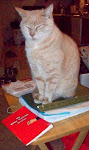
Hey, all! Hobo here. Kevin keeps pestering me to get working on my next book, but I’ve been a little intimidated by all his insistence on showing him a solid marketing plan, providing him with statistics on popular genres, profit margins, and projected trends in the bookselling world. Usually when he starts digging me about this stuff, I turn in circles on the bed, show him my rear, stretch, kneed the blanket a little, and curl up to nap.
I didn’t want Kevin to think I was taking him too seriously, or that his lectures actually work on me – can’t let humans think they have any real control over cats – so I conducted my online research when Kevin wasn’t home. (Ha! Lest he wonder why there was so much hair in his keyboard, I threw him off by rubbing along his arms as he was trying to type, and by walking on the keys when he was playing games the other day!) That’s when I knew for certain: my next book should be a mystery.
I found that the genre of the mystery has been around for more than most cats’ nine lives. Mystery stories have their origins in the spooky tales that were part of Edgar Allen Poe’s repertoire, followed soon after by the novels of Wilkie Collins, and then the first real famous detective, Arthur Conan Doyle’s Sherlock Holmes. It seems lots of humans enjoy reading “whodunit” stories, and the mystery genre has continued to spark the imagination, taking on as many forms as colors of cats, producing some of the most beloved popular writers ever, including Agatha Christie and Alfred Hitchcock. Kids got in the action early with super-sleuths Nancy Drew and the Hardy Boys.
As the mystery has moved into contemporary American culture, we now have a true American melting pot of folks who catch the bad guy and save the day. The Superhero genre is one great spin-off, and so is the Western. Think of all the choices! Today’s mysteries feature perky bounty hunters, gritty private investigators, sharp young lawyers, otherwise burnt-out investigative journalists, leftist ex-governors, forensic scientists, smart kids with nicknames like “Encyclopedia” or “Cam” (for Camera), women who run catering businesses or B&B’s. And, the superlative of sleuths, the obvious pinnacle to the evolutionary process of crimesolvers – THE CAT.
In order to check out the competition, maybe steal a few secrets for my own mystery series and avoid re-inventing the wheel, I decided to read one cat mystery by several of the most popular cat mystery authors. And before those of you nay-sayers or cat-doubters start snickering into your newspapers, let me tell you that not only are cat mysteries popular, but they have incredible holding power on bestseller lists, and yes, there are many authors who write in this sub-genre. So even if you think little old ladies who wear cat sweaters and hold up the line at the grocery store with huge bags of cat food aren’t exactly cute, you’d better admire their influence.
I chose one book from Lillian Jackson Braun’s long-running “The Cat Who…” series, one book from Shirley Rousseau Murphy’s Joe Gray mysteries, and one book from Rita Mae Brown’s pet mysteries that she writes with her cat, Sneaky Pie Brown. What I found surprised me. I was certain that Braun’s cats who, as the longest and most successful of these series, would be the one that I enjoyed the most. I know I’ll probably offend a lot of humans when I tell you that I thought the cat characters in these books are stupid. First of all, the two cats are Siamese, and even friendly cats like myself have some issues with Siamese. I mean, I love everybody, and I’m a pretty laid back guy – except when Kevin’s parents’ dog Buster comes to visit – and even I think Siamese cats can be pretty obnoxious. Anyway, these two cats in Lillian Jackson Braun’s series could be okay, even as Siamese, but they don’t talk or anything!! They don’t really help out that much, at least not in the book I read. I did like the setting for this book, in a remote part of the northern United States, like Michigan’s Upper Peninsula, and I really liked the main human character, Mr. Qwilleran, but my respect for him was greatly diminished by the dreadful names he gave his cats – Koko and Yum-Yum. Isn’t Koko that famous gorilla they taught sign language to? And Yum-Yum? Please. I do feel a bit sorry for those cats.
Shirley Rousseau Murphy’s supernaturally-smart feline detective, Joe Gray, and his pals, made for a pretty great read, one I warmed to the deeper I got into the book. Unfortunately for me, I chose a book from near the end of the series, and this is a series you should probably read in order. Although Murphy provides recaps of important events from earlier books, I would have enjoyed these cats and their community more if I’d read the full stories myself.
The winner of these three authors, in my not-so-humble opinion? Rita Mae Brown and Sneaky Pie, hands and paws down. These stories are well-written; all characters, human and animal, have interesting, fleshed out, individual personalities and voices; the community in a little town in Virginia had echoes, albeit in a Southern tone, of small-town life in Wellsboro; and it didn’t matter at all which book I picked up first.
Now I just have to think of a title for the first book in my mystery series…. Hobo and the Missing Aquari-Yums? No, I guess that’s not much of a mystery. If you have any ideas, email me at frommyshelf@epix.net. Searching for past reviews? Get a clue about books at http://frommyshelf.blogspot.com
Hey, all! Hobo here. Kevin keeps pestering me to get working on my next book, but I’ve been a little intimidated by all his insistence on showing him a solid marketing plan, providing him with statistics on popular genres, profit margins, and projected trends in the bookselling world. Usually when he starts digging me about this stuff, I turn in circles on the bed, show him my rear, stretch, kneed the blanket a little, and curl up to nap.
I didn’t want Kevin to think I was taking him too seriously, or that his lectures actually work on me – can’t let humans think they have any real control over cats – so I conducted my online research when Kevin wasn’t home. (Ha! Lest he wonder why there was so much hair in his keyboard, I threw him off by rubbing along his arms as he was trying to type, and by walking on the keys when he was playing games the other day!) That’s when I knew for certain: my next book should be a mystery.
I found that the genre of the mystery has been around for more than most cats’ nine lives. Mystery stories have their origins in the spooky tales that were part of Edgar Allen Poe’s repertoire, followed soon after by the novels of Wilkie Collins, and then the first real famous detective, Arthur Conan Doyle’s Sherlock Holmes. It seems lots of humans enjoy reading “whodunit” stories, and the mystery genre has continued to spark the imagination, taking on as many forms as colors of cats, producing some of the most beloved popular writers ever, including Agatha Christie and Alfred Hitchcock. Kids got in the action early with super-sleuths Nancy Drew and the Hardy Boys.
As the mystery has moved into contemporary American culture, we now have a true American melting pot of folks who catch the bad guy and save the day. The Superhero genre is one great spin-off, and so is the Western. Think of all the choices! Today’s mysteries feature perky bounty hunters, gritty private investigators, sharp young lawyers, otherwise burnt-out investigative journalists, leftist ex-governors, forensic scientists, smart kids with nicknames like “Encyclopedia” or “Cam” (for Camera), women who run catering businesses or B&B’s. And, the superlative of sleuths, the obvious pinnacle to the evolutionary process of crimesolvers – THE CAT.
In order to check out the competition, maybe steal a few secrets for my own mystery series and avoid re-inventing the wheel, I decided to read one cat mystery by several of the most popular cat mystery authors. And before those of you nay-sayers or cat-doubters start snickering into your newspapers, let me tell you that not only are cat mysteries popular, but they have incredible holding power on bestseller lists, and yes, there are many authors who write in this sub-genre. So even if you think little old ladies who wear cat sweaters and hold up the line at the grocery store with huge bags of cat food aren’t exactly cute, you’d better admire their influence.
I chose one book from Lillian Jackson Braun’s long-running “The Cat Who…” series, one book from Shirley Rousseau Murphy’s Joe Gray mysteries, and one book from Rita Mae Brown’s pet mysteries that she writes with her cat, Sneaky Pie Brown. What I found surprised me. I was certain that Braun’s cats who, as the longest and most successful of these series, would be the one that I enjoyed the most. I know I’ll probably offend a lot of humans when I tell you that I thought the cat characters in these books are stupid. First of all, the two cats are Siamese, and even friendly cats like myself have some issues with Siamese. I mean, I love everybody, and I’m a pretty laid back guy – except when Kevin’s parents’ dog Buster comes to visit – and even I think Siamese cats can be pretty obnoxious. Anyway, these two cats in Lillian Jackson Braun’s series could be okay, even as Siamese, but they don’t talk or anything!! They don’t really help out that much, at least not in the book I read. I did like the setting for this book, in a remote part of the northern United States, like Michigan’s Upper Peninsula, and I really liked the main human character, Mr. Qwilleran, but my respect for him was greatly diminished by the dreadful names he gave his cats – Koko and Yum-Yum. Isn’t Koko that famous gorilla they taught sign language to? And Yum-Yum? Please. I do feel a bit sorry for those cats.
Shirley Rousseau Murphy’s supernaturally-smart feline detective, Joe Gray, and his pals, made for a pretty great read, one I warmed to the deeper I got into the book. Unfortunately for me, I chose a book from near the end of the series, and this is a series you should probably read in order. Although Murphy provides recaps of important events from earlier books, I would have enjoyed these cats and their community more if I’d read the full stories myself.
The winner of these three authors, in my not-so-humble opinion? Rita Mae Brown and Sneaky Pie, hands and paws down. These stories are well-written; all characters, human and animal, have interesting, fleshed out, individual personalities and voices; the community in a little town in Virginia had echoes, albeit in a Southern tone, of small-town life in Wellsboro; and it didn’t matter at all which book I picked up first.
Now I just have to think of a title for the first book in my mystery series…. Hobo and the Missing Aquari-Yums? No, I guess that’s not much of a mystery. If you have any ideas, email me at frommyshelf@epix.net. Searching for past reviews? Get a clue about books at http://frommyshelf.blogspot.com
Hobo and Kevin's Summer Book Tour!
Look out, world .... or at least Twin Tiers .... as Hobo and Kevin go on tour! That's right, check out when Hobo will be at a library or senior center near you! If you'd like to schedule Hobo to come to an event at your school or community center, email or call us: (570) 724-5793 or frommyshelf@epix.net And now, on with the show!
HOBO'S SUMMER TOUR 2008
Thursday, May 22nd Mansfield Senior Center 12:30pm
Saturday, June 14th Galeton Library children's story hour
Friday, July 11th Wellsboro Senior Center 11am
Monday, July 14th Elkland Senior Center 11am
Tuesday, July 22nd Millerton Senior Center 11am
As many of you know, Hobo has already made successful appearance at the Blossburg Library, and had his book read to the kids at the Bradford-Tioga Head Start. He'd love to go see the kids at Head Start, or other story hours, or go sit in the laps of folks at other senior centers. If you have an idea for people or places who would benefit from time with Hobo, let us know!
HOBO'S SUMMER TOUR 2008
Thursday, May 22nd Mansfield Senior Center 12:30pm
Saturday, June 14th Galeton Library children's story hour
Friday, July 11th Wellsboro Senior Center 11am
Monday, July 14th Elkland Senior Center 11am
Tuesday, July 22nd Millerton Senior Center 11am
As many of you know, Hobo has already made successful appearance at the Blossburg Library, and had his book read to the kids at the Bradford-Tioga Head Start. He'd love to go see the kids at Head Start, or other story hours, or go sit in the laps of folks at other senior centers. If you have an idea for people or places who would benefit from time with Hobo, let us know!
Tuesday, May 13, 2008
Go Local!!
Kevin Coolidge
"Without question, the greatest invention in the history of mankind is beer. Oh, I grant you that the wheel was also a fine invention, but the wheel does not go nearly as well with pizza."
Dave Barry
I was born naked, wet and hungry. The situation, thankfully, has improved, but I've never lost my appetite for good food. I was born lucky, because I've always found some of the best food and cooking right here in Tioga County. I love the black diamond steak at the Steak House, the French fries at the Hornet's Nest, and the mix and match six-packs you can get at Your Mama's Mug. Yep, if you want to know the best places to eat local and drink local, you ask a local. One man that has applied this wisdom to his travels is Ken Hull, author of Going Local: An Adventurer's Guide to Unique Eats, Cool Pubs & Cozy Cafés of Central Pennsylvania.
Ken Hull is a self-taught artist who resides in Boalsburg, Pennsylvania. When he's not creating and painting, he likes to spend his time riding the byways and back roads of central Pennsylvania on his Harley, scouting out cool places to eat and drink. Hey, why settle for boring, cookie-cutter chain restaurants when you can eat well and eat local?
Going Local is more than a guidebook. Its part journal, travelloge, and memoir. It's about Ken's experiences as he's traveled through Central Pennsylvania, and the places he's discovered and the folks he's met along the way. He starts with the 200 year old tavern in Boalsburg and goes on to include eateries like Webster's Bookstore & Café in State College, Restless Oaks in Mcelhattan, the Bullfrog Brewery in Williamsport, as well as Wellsboro's very own Wellsboro Diner. He focuses on unique places, mostly the smaller places--places with a history, a sense of self, real personality. Ken says, "My general rule is not to include any chains, `big-time' operations or really upscale restaurants, unless they possess some uniqueness, creativity, or oddities..."
Since the book is somewhat of a guidebook, Ken starts off each listing with a section called Just a Taste. Here you will find the name of the establishment, the address, contact information and other basics like price ranges, cuisine specialties, and local attractions so you can plan ahead. The book also includes a detachable map that allows you to navigate your way around and find the places he's visited and listed. Find a place you would like to visit, unfold the map, and have fun.
Ken's intention with this book is to inspire and encourage you to break away from the ordinary. Free yourself of the monotony of chains and fast food restaurants, and experience the enjoyment of independently owned eating and drinking establishments that we have in central Pennsylvania. The book is not a definitive work. There's more to discover along the wonderful roads, sweet byways, and little towns and villages. You can even find some of your own. Just use your map, ask the locals. And hit the road to discover what's around the next curve. Take the time to slow down this summer and share these experiences with family and friends, or maybe even a stranger. Have your own adventures, and maybe write your own stories as well...
Be sure to catch Ken at From My Shelf Books on May 31st from noon to 3pm. He'll be signing and discusing his book "Going Local" For more information about this great book, check out the author's website www.goinglocalpa.com
"Without question, the greatest invention in the history of mankind is beer. Oh, I grant you that the wheel was also a fine invention, but the wheel does not go nearly as well with pizza."
Dave Barry
I was born naked, wet and hungry. The situation, thankfully, has improved, but I've never lost my appetite for good food. I was born lucky, because I've always found some of the best food and cooking right here in Tioga County. I love the black diamond steak at the Steak House, the French fries at the Hornet's Nest, and the mix and match six-packs you can get at Your Mama's Mug. Yep, if you want to know the best places to eat local and drink local, you ask a local. One man that has applied this wisdom to his travels is Ken Hull, author of Going Local: An Adventurer's Guide to Unique Eats, Cool Pubs & Cozy Cafés of Central Pennsylvania.
Ken Hull is a self-taught artist who resides in Boalsburg, Pennsylvania. When he's not creating and painting, he likes to spend his time riding the byways and back roads of central Pennsylvania on his Harley, scouting out cool places to eat and drink. Hey, why settle for boring, cookie-cutter chain restaurants when you can eat well and eat local?
Going Local is more than a guidebook. Its part journal, travelloge, and memoir. It's about Ken's experiences as he's traveled through Central Pennsylvania, and the places he's discovered and the folks he's met along the way. He starts with the 200 year old tavern in Boalsburg and goes on to include eateries like Webster's Bookstore & Café in State College, Restless Oaks in Mcelhattan, the Bullfrog Brewery in Williamsport, as well as Wellsboro's very own Wellsboro Diner. He focuses on unique places, mostly the smaller places--places with a history, a sense of self, real personality. Ken says, "My general rule is not to include any chains, `big-time' operations or really upscale restaurants, unless they possess some uniqueness, creativity, or oddities..."
Since the book is somewhat of a guidebook, Ken starts off each listing with a section called Just a Taste. Here you will find the name of the establishment, the address, contact information and other basics like price ranges, cuisine specialties, and local attractions so you can plan ahead. The book also includes a detachable map that allows you to navigate your way around and find the places he's visited and listed. Find a place you would like to visit, unfold the map, and have fun.
Ken's intention with this book is to inspire and encourage you to break away from the ordinary. Free yourself of the monotony of chains and fast food restaurants, and experience the enjoyment of independently owned eating and drinking establishments that we have in central Pennsylvania. The book is not a definitive work. There's more to discover along the wonderful roads, sweet byways, and little towns and villages. You can even find some of your own. Just use your map, ask the locals. And hit the road to discover what's around the next curve. Take the time to slow down this summer and share these experiences with family and friends, or maybe even a stranger. Have your own adventures, and maybe write your own stories as well...
Be sure to catch Ken at From My Shelf Books on May 31st from noon to 3pm. He'll be signing and discusing his book "Going Local" For more information about this great book, check out the author's website www.goinglocalpa.com
Wednesday, April 30, 2008
Treasure Hunting
Kevin Coolidge
Arrggh, I’m tired of dragging my butt out of bed at 5:30AM, rushing to a thankless job, and punching a time clock. I want to sleep in, have exotic fruit for breakfast and wash it all down with rum. After lounging in my hammock, I’ll head out with my crew, capture a ship, and finish in time to enjoy one of those cool, tropical drinks with the little umbrella. What other job can you hang around a boat all day with guns and booze, and make tons of money? I mean, other than war profiteering, or politics. I want to be a modern day pirate.
There are those who scour the globe today in search of treasure, using only a compass as their guide, in a hunt where X no longer marks the spot, but it seems they prefer the term Geocacher. Geocaching is a modern day treasure hunt in which participants search for hidden caches using coordinates and a GPS device. The caches can range from small to large, and the treasure found inside isn't in the form of doubloons or pieces of eight, but small trinkets like baseball cards, Matchbox cars, or prizes like gift certificates, event tickets, or even cash.
Geocaching combines “geo” for geography and “cache,” a term used for both hidden provisions and in a more modern sense, data stored on a computer. Combine them and you have one of the newest and hottest outdoor activities around. Hey, how do you legally tap into an outdoor game that has a government budget of more than half a billion dollars? No, what your uncle is doing with that cable box and a coat hanger to get WrestleMania™ isn’t legal.
The goal of geocaching is to locate hidden treasure from latitude/longitude coordinates found on websites such as Geocaching.com or handed out in passbooks at geocaching events like the one upcoming in Wellsboro on May 16th, 17th, and18th. While most caches are a hidden watertight box, this event sponsored by the Wellsboro Chamber of Commerce* is set up with “Virtual Caches.” It’s the destination, not the booty, that’s of interest, bringing you to historic sites, beautiful vistas, and a wonderful view of nature. Nothing is traded except photos and the experience. Each of the caches can be driven to, with some requiring only a brief walk.
I talked to Charlie Messina, the driving force behind Wellsboro’s new event. Charlie began geocaching in 2003 as part of a Boy Scout camp program. He developed and ran orienteering events** and felt that geocaching would allow a new program to be added with minimal expense. “The program was a huge success, and added a new level of enjoyment as we searched for hidden caches and found great outdoor locations we would never have found. In basic terms geocaching is a high-tech hide & seek. Anyone with a GPS unit and a basic understanding of how to use it can enjoy an outdoors adventure. It is great fun for the entire family”
If you’ve recently received a GPS unit, and you’ve been wondering what to do with it, check out The Complete Idiot’s Guide to Geocaching by Jack W. Peters. The book is comprehensive. It covers what geocaching is (sport, hobby, excuse to go outdoors and play with electronics), what you need to have, what you need to bring, and techniques for geocaching. It covers a good bit more than the basics with tips on how to get more accurate measurements from your GPS unit, search techniques like the cloverleaf and triangulation, and how to speak the lingo.
If you are looking for adventure, a fun family activity, or just another way to appreciate and explore Tioga County, grab your GPS, a compass, some trail mix, and remember not to spend too much time staring into the receiver’s screen. You’ll miss the beauty of the natural surroundings, and you might crash and spill your tropical drink…
*Information on the Geocaching event is available on the chamber’s website www.wellsboropa.com . Registration is only $3 and takes place on the Green.
**Orienteering is a competitive form of land navigation. The object of orienteering is to locate control points by using a map and compass to navigate through the woods.
Kevin Coolidge works at From My Shelf Books on Main St. in Wellsboro. Check it out at www.wellsborobookstore.com
Arrggh, I’m tired of dragging my butt out of bed at 5:30AM, rushing to a thankless job, and punching a time clock. I want to sleep in, have exotic fruit for breakfast and wash it all down with rum. After lounging in my hammock, I’ll head out with my crew, capture a ship, and finish in time to enjoy one of those cool, tropical drinks with the little umbrella. What other job can you hang around a boat all day with guns and booze, and make tons of money? I mean, other than war profiteering, or politics. I want to be a modern day pirate.
There are those who scour the globe today in search of treasure, using only a compass as their guide, in a hunt where X no longer marks the spot, but it seems they prefer the term Geocacher. Geocaching is a modern day treasure hunt in which participants search for hidden caches using coordinates and a GPS device. The caches can range from small to large, and the treasure found inside isn't in the form of doubloons or pieces of eight, but small trinkets like baseball cards, Matchbox cars, or prizes like gift certificates, event tickets, or even cash.
Geocaching combines “geo” for geography and “cache,” a term used for both hidden provisions and in a more modern sense, data stored on a computer. Combine them and you have one of the newest and hottest outdoor activities around. Hey, how do you legally tap into an outdoor game that has a government budget of more than half a billion dollars? No, what your uncle is doing with that cable box and a coat hanger to get WrestleMania™ isn’t legal.
The goal of geocaching is to locate hidden treasure from latitude/longitude coordinates found on websites such as Geocaching.com or handed out in passbooks at geocaching events like the one upcoming in Wellsboro on May 16th, 17th, and18th. While most caches are a hidden watertight box, this event sponsored by the Wellsboro Chamber of Commerce* is set up with “Virtual Caches.” It’s the destination, not the booty, that’s of interest, bringing you to historic sites, beautiful vistas, and a wonderful view of nature. Nothing is traded except photos and the experience. Each of the caches can be driven to, with some requiring only a brief walk.
I talked to Charlie Messina, the driving force behind Wellsboro’s new event. Charlie began geocaching in 2003 as part of a Boy Scout camp program. He developed and ran orienteering events** and felt that geocaching would allow a new program to be added with minimal expense. “The program was a huge success, and added a new level of enjoyment as we searched for hidden caches and found great outdoor locations we would never have found. In basic terms geocaching is a high-tech hide & seek. Anyone with a GPS unit and a basic understanding of how to use it can enjoy an outdoors adventure. It is great fun for the entire family”
If you’ve recently received a GPS unit, and you’ve been wondering what to do with it, check out The Complete Idiot’s Guide to Geocaching by Jack W. Peters. The book is comprehensive. It covers what geocaching is (sport, hobby, excuse to go outdoors and play with electronics), what you need to have, what you need to bring, and techniques for geocaching. It covers a good bit more than the basics with tips on how to get more accurate measurements from your GPS unit, search techniques like the cloverleaf and triangulation, and how to speak the lingo.
If you are looking for adventure, a fun family activity, or just another way to appreciate and explore Tioga County, grab your GPS, a compass, some trail mix, and remember not to spend too much time staring into the receiver’s screen. You’ll miss the beauty of the natural surroundings, and you might crash and spill your tropical drink…
*Information on the Geocaching event is available on the chamber’s website www.wellsboropa.com . Registration is only $3 and takes place on the Green.
**Orienteering is a competitive form of land navigation. The object of orienteering is to locate control points by using a map and compass to navigate through the woods.
Kevin Coolidge works at From My Shelf Books on Main St. in Wellsboro. Check it out at www.wellsborobookstore.com
Friday, April 25, 2008
Food for Thought
Kasey Cox
From bumper stickers and news headlines, from the aisles of the supermarket to the presidential candidates’ promises of the last decade, several buzzwords keep jumping out at us – organic, local, sustainability, outsourcing, biotechnology, global warming, recession, environmentalism, terrorism. From Baptists to Wiccans, from staunch Republican to loud liberal, there are books being written from every religious and political perspective, strangely overlapping in their focus on the same concerns: how to stretch the dwindling supply of natural resources to feed, house, clothe, and care for the people of this planet; as well as how to care for the planet itself, if for no other reason than that it will continue to sustain us.
Indeed, the shelves of libraries and bookstores are near-bursting with new titles addressing these issues: their explanations and possible resolutions are more linked than we ever thought possible. Some of the books are reprints, as many of the ideas we’re discussing now come to us from the soil of our history, like the homesteading stories from Helen and Scott Nearing, beginning in the Great Depression, whose writings greatly influenced the “back-to-the-land” movement of the 1970’s. Wendell Berry began publishing his books during the ‘70’s, and continues to write and speak today about rural areas, being rooted in a place, community support and identity, sustainability, and agriculture. America has tried communes and co-ops over many decades, with varying degrees of success, met with varying degrees of suspicion. “Deep ecology” became a spiritual as well as political movement of the 1990’s. And the 1990’s gave birth to the celebration of “Earth Day” – at first just one day in a calendar too full of “Month of Orthodontic Health Awareness”-type designations, now a celebration whose size and influence has grown exponentially.
Before you dismiss these ideas as the stuff of aging hippies, young idealists, treehugger granola eaters, or doomsday criers, have a look at a few of the hundreds of books available to you at present. If you don’t know a CAFO from the NCER, here’s a suggested reading list and hopefully helpful reading order.
First and foremost, I suggest Bill McKibben’s 2007 book, Deep Economy: The Wealth of Communities and the Durable Future, just recently released in paperback. If no other book in this article intrigues you or informs you, this book should. Critics from both sides of the fence – any fence – as well as scholars and business people and commentators from every discipline are insisting on the same sentiment as one book critic, from The Oregonian newspaper: Deep Economy should be required reading. When I mentioned this book to a friend of mine recently – college radical and environmentalist turned Yuppie dad and commuter – he asked me if I was confusing this book with the title work of the deep ecology movement of twenty years ago, Deep Ecology: Living as if Nature Mattered by Bill Devall and George Sessions. No, I answered, although McKibben credits them as the source for the key phrase of his book.
So what’s different about what McKibben has to say? Mostly, it’s the way the issues are fleshed out, but not dumbed down, for someone – such as myself – who avoided economics and political science classes like the plague. McKibben is able to give a history of economic thought and business practices, especially in the United States, showing how our driving belief and subsequent behavior has always been based around the fact that MORE is BETTER. We practiced efficiency with religious fervor. McKibben allows that this is a normal and necessary attitude, not just for humans, but for all living things who cannot be certain they will have enough food or shelter to survive.
At some point, however, we as a people – especially in the “First World” or most developed countries – have passed the tipping point: we are using our resources faster than we can replenish them. As we continue in our frenetic pace, the difference between the haves and the have-nots, not just between the poor of India and the poor of the U.S., but between the U.S. and the entire world, is becoming a chasm. More interestingly, today’s Americans, who have more – more stuff, more comfort, more food, more space – than at any other time in human history, report themselves as less happy and less satisfied than their grandparents or great-great-grandparents. They report their happiness levels in tests that stand up to scientific validity, a subject about which many other books have been written of late.
Weaving in references to hundreds of studies that made my hair stand on end, Deep Economy shows how we got to the impending crisis and what all the different camps have to say about that. Instead of finding this information disheartening or overwhelming, I found myself strangely hopeful. My head didn’t swim and my heart didn’t drown in the myriad of information McKibben presents. I felt informed and empowered. Ultimately, McKibben’s point is that, no matter who we are, or what we believe, or what job we do, we all have to eat. And we should be concerned about where our food is coming from and how it will continue to get to us.
Thus, McKibben’s book serves as a crystal clear, user-friendly guide to the wealth of other books and news out there now on food, agriculture, the new seed vault in the Arctic, health, the environment, and local communities’ sustainability. From Deep Economy, I would suggest moving next to The Sustainability Revolution: Portrait of a Paradigm Shift by Andres Edwards and David Orr. (Don’t worry about the complex title; this is “sustainability for dummies” without insulting your intelligence.) Next, try Michael Pollan’s newest book, In Defense of Food. It’s still only in hardcover, but worth the price. Michael Pollan has become the new guru of the crossroads of science and food, with his string of recent bestsellers, including The Botany of Desire and The Omnivore’s Dilemma.
If these books have whetted your appetite (har har har) and you feel ready to move on to more specific programs amongst these topics, or more complex philosophies, try any or all of the following: Uncertain Peril: Genetic Engineering and the Future of Seeds by Claire Hope Cummings; McWorld vs. Jihad: How Globalism and Tribalism are Reshaping the World by Benjamin Barber (from 1996, with a few dated references, but still amazingly relevant); the catchingly-titled Everything I Want to Do is Illegal: War Stories from the Local Food Front by Joel Salatin; or my new favorite, just in time for gardening season, Food, Not Lawns by Heather Coburn Flores.
The key is to let yourself be educated, not intimidated. Certainly, I encourage you to inquire about these books at your local library or favorite independent bookstore. When you feel overwhelmed by the news or the price of gas, think Rosa Parks. Look at all the examples Bill McKibben gives of how small steps ARE making a difference. Check out your local farmers’ markets, plant a small square foot garden in your yard, co-op a garden with a neighbor, ask your candidates what they’re supporting in the world of agriculture. The bumper stickers are true: “local” IS the new “organic”. See what you can do.
Fresh ideas, or full of fertilizer? Let Hobo know: how does your garden grow? He promises not to be too contrary. And he wants to let Farmer Brown and the cows know that leaving them was nothing personal. See Hobo dancing with cows, in Hobo: The Musical! Soon opening on Broadway.
From bumper stickers and news headlines, from the aisles of the supermarket to the presidential candidates’ promises of the last decade, several buzzwords keep jumping out at us – organic, local, sustainability, outsourcing, biotechnology, global warming, recession, environmentalism, terrorism. From Baptists to Wiccans, from staunch Republican to loud liberal, there are books being written from every religious and political perspective, strangely overlapping in their focus on the same concerns: how to stretch the dwindling supply of natural resources to feed, house, clothe, and care for the people of this planet; as well as how to care for the planet itself, if for no other reason than that it will continue to sustain us.
Indeed, the shelves of libraries and bookstores are near-bursting with new titles addressing these issues: their explanations and possible resolutions are more linked than we ever thought possible. Some of the books are reprints, as many of the ideas we’re discussing now come to us from the soil of our history, like the homesteading stories from Helen and Scott Nearing, beginning in the Great Depression, whose writings greatly influenced the “back-to-the-land” movement of the 1970’s. Wendell Berry began publishing his books during the ‘70’s, and continues to write and speak today about rural areas, being rooted in a place, community support and identity, sustainability, and agriculture. America has tried communes and co-ops over many decades, with varying degrees of success, met with varying degrees of suspicion. “Deep ecology” became a spiritual as well as political movement of the 1990’s. And the 1990’s gave birth to the celebration of “Earth Day” – at first just one day in a calendar too full of “Month of Orthodontic Health Awareness”-type designations, now a celebration whose size and influence has grown exponentially.
Before you dismiss these ideas as the stuff of aging hippies, young idealists, treehugger granola eaters, or doomsday criers, have a look at a few of the hundreds of books available to you at present. If you don’t know a CAFO from the NCER, here’s a suggested reading list and hopefully helpful reading order.
First and foremost, I suggest Bill McKibben’s 2007 book, Deep Economy: The Wealth of Communities and the Durable Future, just recently released in paperback. If no other book in this article intrigues you or informs you, this book should. Critics from both sides of the fence – any fence – as well as scholars and business people and commentators from every discipline are insisting on the same sentiment as one book critic, from The Oregonian newspaper: Deep Economy should be required reading. When I mentioned this book to a friend of mine recently – college radical and environmentalist turned Yuppie dad and commuter – he asked me if I was confusing this book with the title work of the deep ecology movement of twenty years ago, Deep Ecology: Living as if Nature Mattered by Bill Devall and George Sessions. No, I answered, although McKibben credits them as the source for the key phrase of his book.
So what’s different about what McKibben has to say? Mostly, it’s the way the issues are fleshed out, but not dumbed down, for someone – such as myself – who avoided economics and political science classes like the plague. McKibben is able to give a history of economic thought and business practices, especially in the United States, showing how our driving belief and subsequent behavior has always been based around the fact that MORE is BETTER. We practiced efficiency with religious fervor. McKibben allows that this is a normal and necessary attitude, not just for humans, but for all living things who cannot be certain they will have enough food or shelter to survive.
At some point, however, we as a people – especially in the “First World” or most developed countries – have passed the tipping point: we are using our resources faster than we can replenish them. As we continue in our frenetic pace, the difference between the haves and the have-nots, not just between the poor of India and the poor of the U.S., but between the U.S. and the entire world, is becoming a chasm. More interestingly, today’s Americans, who have more – more stuff, more comfort, more food, more space – than at any other time in human history, report themselves as less happy and less satisfied than their grandparents or great-great-grandparents. They report their happiness levels in tests that stand up to scientific validity, a subject about which many other books have been written of late.
Weaving in references to hundreds of studies that made my hair stand on end, Deep Economy shows how we got to the impending crisis and what all the different camps have to say about that. Instead of finding this information disheartening or overwhelming, I found myself strangely hopeful. My head didn’t swim and my heart didn’t drown in the myriad of information McKibben presents. I felt informed and empowered. Ultimately, McKibben’s point is that, no matter who we are, or what we believe, or what job we do, we all have to eat. And we should be concerned about where our food is coming from and how it will continue to get to us.
Thus, McKibben’s book serves as a crystal clear, user-friendly guide to the wealth of other books and news out there now on food, agriculture, the new seed vault in the Arctic, health, the environment, and local communities’ sustainability. From Deep Economy, I would suggest moving next to The Sustainability Revolution: Portrait of a Paradigm Shift by Andres Edwards and David Orr. (Don’t worry about the complex title; this is “sustainability for dummies” without insulting your intelligence.) Next, try Michael Pollan’s newest book, In Defense of Food. It’s still only in hardcover, but worth the price. Michael Pollan has become the new guru of the crossroads of science and food, with his string of recent bestsellers, including The Botany of Desire and The Omnivore’s Dilemma.
If these books have whetted your appetite (har har har) and you feel ready to move on to more specific programs amongst these topics, or more complex philosophies, try any or all of the following: Uncertain Peril: Genetic Engineering and the Future of Seeds by Claire Hope Cummings; McWorld vs. Jihad: How Globalism and Tribalism are Reshaping the World by Benjamin Barber (from 1996, with a few dated references, but still amazingly relevant); the catchingly-titled Everything I Want to Do is Illegal: War Stories from the Local Food Front by Joel Salatin; or my new favorite, just in time for gardening season, Food, Not Lawns by Heather Coburn Flores.
The key is to let yourself be educated, not intimidated. Certainly, I encourage you to inquire about these books at your local library or favorite independent bookstore. When you feel overwhelmed by the news or the price of gas, think Rosa Parks. Look at all the examples Bill McKibben gives of how small steps ARE making a difference. Check out your local farmers’ markets, plant a small square foot garden in your yard, co-op a garden with a neighbor, ask your candidates what they’re supporting in the world of agriculture. The bumper stickers are true: “local” IS the new “organic”. See what you can do.
Fresh ideas, or full of fertilizer? Let Hobo know: how does your garden grow? He promises not to be too contrary. And he wants to let Farmer Brown and the cows know that leaving them was nothing personal. See Hobo dancing with cows, in Hobo: The Musical! Soon opening on Broadway.
Thursday, April 17, 2008
An Underground Education
Kevin Coolidge
Those who cannot remember the past are condemned to repeat it. Those who cannot remember the past are condemned to repeat it. Sigh, just another 98 times and then I have to go home and start my history homework. I guess my teacher didn’t like some of my more creative answers to the exam. What does she know? She is totally oblivious to Area 51, Tesla’s death ray, or that Hitler’s Brain is hooked up to a supercomputer and is the president of Brazil. I love reading, but she makes history soooo boring. She just teaches us what we are supposed to know. Nothing I’m not supposed to know, nothing quirky or surprising, or interesting. I mean, why did Napoleon really lose the battle of Waterloo? * Textbooks can be so plodding, far too logical and way too orderly. History is messy and it can be amusing and not so serious, and even a little bizarre…
I want to know the good stuff and that’s why I turned to An Underground Education: The Unauthorized And Outrageous Supplement To Everything You Thought You Knew About Art, Sex, Business, Crime, Science, Medicine, And Other Fields Of Human Knowledge by Richard Zacks. Forget what you learned in school, and the teacher’s angry red marker. Zacks debunks many popular cultural myths and gives new life to old history. Zacks has divided the book into ten different sections: Arts & Literature, Business, Crime & Punishment, Everyday Life, Medicine, Religion, Science, Sex, World History, and American History.
Zacks covers a wide variety of topics, but he keeps the writing simple and attention grabbing. His emphasis, however, is definitely on the strange and often perverse. So, if you are easily offended, and a bit conservative you should probably skip this book. I mean the title does have business and sex in the title, so that should tell you it’s not for the thin-skinned. For example, you might read today’s headlines and get the impression that Iraqi War profiteering is something new, but the unfortunate soldiers of the Civil War often wore shoes with no soles, slept in disintegrating tents, and fired weapons that blew up in their hands, all due to the greed of America’s great capitalists.
Surely you would have paid more attention in English class if you knew the Bard was so bawdy or that Chaucer made sly jokes about sex. Sure, you knew Edison was credited for inventing the incandescent light bulb, but did you know he secretly helped develop the electric chair in a devious scheme to have the death-dealing device named after his archrival, George Westinghouse? There are lots of interesting facts and tidbits, though it’s far from complete. For example, he joyfully explores the evolution of the codpiece, but skips over the symbolism of the long-toed shoes, or poulaines. European folk beliefs equated foot-size with penis-size (think also of noses...) and the tips of the poulaines were thus phallic symbols. The tops of poulaines were also often painted with images of male genitals. You just can’t make this stuff up!
Yes, history is way more interesting, and vastly more complicated, than the dried-out sentences in high school history books that leave me feeling deeply unsatisfied. Perhaps great men and women should be pushed off their pedestals. They do not stand on the shoulders of giants (not an admission of humility by Sir Isaac Newton, but rather a bitter insult to a hunchbacked dwarf he was feuding with); they are human, like you and me. Made of flesh and blood and sometimes just a little strange-the famous Mari Hari was no master spy, Cleopatra was ugly as sin, and Pope Innocent III authorized a holy quest for Jesus’ foreskin. I guess history can be entertaining, warped and worth remembering. Those who cannot remember the past are condemned to repeat it…
*Theories abound, but the brilliant strategist had a raging case of hemorrhoids, which prevented him from riding out and surveying the troops. Ahh, but for a nail…
History, condemned repeating it, or seeing if we can escape it? Email me at frommyshelf@epix.net. Miss a column? Our archives are available at www.frommyshelf.blogspot.com read the history of Hobo in “Hobo Finds A Home” A charming story about a barn cat who wants more out of life. Don’t miss the in depth documentary about Hobo the cat, soon to be aired on the History Channel!
Those who cannot remember the past are condemned to repeat it. Those who cannot remember the past are condemned to repeat it. Sigh, just another 98 times and then I have to go home and start my history homework. I guess my teacher didn’t like some of my more creative answers to the exam. What does she know? She is totally oblivious to Area 51, Tesla’s death ray, or that Hitler’s Brain is hooked up to a supercomputer and is the president of Brazil. I love reading, but she makes history soooo boring. She just teaches us what we are supposed to know. Nothing I’m not supposed to know, nothing quirky or surprising, or interesting. I mean, why did Napoleon really lose the battle of Waterloo? * Textbooks can be so plodding, far too logical and way too orderly. History is messy and it can be amusing and not so serious, and even a little bizarre…
I want to know the good stuff and that’s why I turned to An Underground Education: The Unauthorized And Outrageous Supplement To Everything You Thought You Knew About Art, Sex, Business, Crime, Science, Medicine, And Other Fields Of Human Knowledge by Richard Zacks. Forget what you learned in school, and the teacher’s angry red marker. Zacks debunks many popular cultural myths and gives new life to old history. Zacks has divided the book into ten different sections: Arts & Literature, Business, Crime & Punishment, Everyday Life, Medicine, Religion, Science, Sex, World History, and American History.
Zacks covers a wide variety of topics, but he keeps the writing simple and attention grabbing. His emphasis, however, is definitely on the strange and often perverse. So, if you are easily offended, and a bit conservative you should probably skip this book. I mean the title does have business and sex in the title, so that should tell you it’s not for the thin-skinned. For example, you might read today’s headlines and get the impression that Iraqi War profiteering is something new, but the unfortunate soldiers of the Civil War often wore shoes with no soles, slept in disintegrating tents, and fired weapons that blew up in their hands, all due to the greed of America’s great capitalists.
Surely you would have paid more attention in English class if you knew the Bard was so bawdy or that Chaucer made sly jokes about sex. Sure, you knew Edison was credited for inventing the incandescent light bulb, but did you know he secretly helped develop the electric chair in a devious scheme to have the death-dealing device named after his archrival, George Westinghouse? There are lots of interesting facts and tidbits, though it’s far from complete. For example, he joyfully explores the evolution of the codpiece, but skips over the symbolism of the long-toed shoes, or poulaines. European folk beliefs equated foot-size with penis-size (think also of noses...) and the tips of the poulaines were thus phallic symbols. The tops of poulaines were also often painted with images of male genitals. You just can’t make this stuff up!
Yes, history is way more interesting, and vastly more complicated, than the dried-out sentences in high school history books that leave me feeling deeply unsatisfied. Perhaps great men and women should be pushed off their pedestals. They do not stand on the shoulders of giants (not an admission of humility by Sir Isaac Newton, but rather a bitter insult to a hunchbacked dwarf he was feuding with); they are human, like you and me. Made of flesh and blood and sometimes just a little strange-the famous Mari Hari was no master spy, Cleopatra was ugly as sin, and Pope Innocent III authorized a holy quest for Jesus’ foreskin. I guess history can be entertaining, warped and worth remembering. Those who cannot remember the past are condemned to repeat it…
*Theories abound, but the brilliant strategist had a raging case of hemorrhoids, which prevented him from riding out and surveying the troops. Ahh, but for a nail…
History, condemned repeating it, or seeing if we can escape it? Email me at frommyshelf@epix.net. Miss a column? Our archives are available at www.frommyshelf.blogspot.com read the history of Hobo in “Hobo Finds A Home” A charming story about a barn cat who wants more out of life. Don’t miss the in depth documentary about Hobo the cat, soon to be aired on the History Channel!
Wednesday, April 9, 2008
Death, Taxes and Leaky Waders
Kevin Coolidge
Time, little pieces of forever crumbling into tomorrow, so fleeting so fast, so damn close to April 15th and tax day. I received a letter from the IRS, and after a big breath, and popping a fresh load of buckshot into the old 12 gauge, I decided to read it. Appears the government is giving me $600 of my own money back in order to stimulate the economy. They could have saved a stamp and given me $600.41 cents back, or better yet, left it in my pocket. I would have tickled the economy by buying food, books, and of course, fishing gear. Yep, the first true sign of spring isn’t robins or dandelions or even April showers, but that first tug at the end of a fishing line. The first day of trout season is always about more than the fish, and no one knows that better than outdoor writer John Gierach.
John Gierach is a free-lance writer and author of several fly-fishing themed books with titles such as Still Life With Brook Trout; Sex, Death and Fly-Fishing; and the cult classic, Trout Bum. His work has appeared in Gray’s Sporting Journal, Field & Stream and Fly, Rod and Reel. His writing is not purely instructional, though there’s plenty of useful information, nor merely adventurous, though he travels from the Arctic to Scotland to the Rockies, and it’s not the purist philosophy of an elite fly fisherman, though there’s a witty thinker with a wry sense of humor wearing that patched-up pair of waders. What he does manage to do is explain the peculiarities of the fishing life in a way that will amuse novices and seasoned fly fishers alike.
Death, Taxes and Leaky Waders collects forty of John Gierach’s finest essays on fishing from six of his earlier books. Gierach is perhaps one of the most entertaining outdoor writers working today. Like all his writing, these essays are about more than fishing, but about nature, friendship, and observations of life. Gierach often begins with a keen observation that soon leads to something below the surface, which he coaxes out, and successfully lands. As Gierach says, “Writing is a lot like fishing.”
Writing is a lot like fishing. Both take patience, persistence, lots of time, an appreciation of the process, and both are harder than they appear. This anthology of Gierach’s work is sure to comfort the angler who stands in a cold river for hours and brings home nothing to show for it. As any fisherman knows, there’s more to fishing than the fish, and like any good writing, this collection of essays is about more the preparation of camp coffee or catching arctic graylings, but ultimately about life, death and of course, fly fishing…
Fish or cut bait? Trout or Bass? Drop me an email at frommyshelf@epix.net Trolling for past columns? Cast your line at www.frommyshelf.blogspot.com Be sure to catch “Hobo Finds A Home” a children’s book about a cat who wanted more out of life than to be a barn cat. This column approved by the committee to elect Hobo for President
Time, little pieces of forever crumbling into tomorrow, so fleeting so fast, so damn close to April 15th and tax day. I received a letter from the IRS, and after a big breath, and popping a fresh load of buckshot into the old 12 gauge, I decided to read it. Appears the government is giving me $600 of my own money back in order to stimulate the economy. They could have saved a stamp and given me $600.41 cents back, or better yet, left it in my pocket. I would have tickled the economy by buying food, books, and of course, fishing gear. Yep, the first true sign of spring isn’t robins or dandelions or even April showers, but that first tug at the end of a fishing line. The first day of trout season is always about more than the fish, and no one knows that better than outdoor writer John Gierach.
John Gierach is a free-lance writer and author of several fly-fishing themed books with titles such as Still Life With Brook Trout; Sex, Death and Fly-Fishing; and the cult classic, Trout Bum. His work has appeared in Gray’s Sporting Journal, Field & Stream and Fly, Rod and Reel. His writing is not purely instructional, though there’s plenty of useful information, nor merely adventurous, though he travels from the Arctic to Scotland to the Rockies, and it’s not the purist philosophy of an elite fly fisherman, though there’s a witty thinker with a wry sense of humor wearing that patched-up pair of waders. What he does manage to do is explain the peculiarities of the fishing life in a way that will amuse novices and seasoned fly fishers alike.
Death, Taxes and Leaky Waders collects forty of John Gierach’s finest essays on fishing from six of his earlier books. Gierach is perhaps one of the most entertaining outdoor writers working today. Like all his writing, these essays are about more than fishing, but about nature, friendship, and observations of life. Gierach often begins with a keen observation that soon leads to something below the surface, which he coaxes out, and successfully lands. As Gierach says, “Writing is a lot like fishing.”
Writing is a lot like fishing. Both take patience, persistence, lots of time, an appreciation of the process, and both are harder than they appear. This anthology of Gierach’s work is sure to comfort the angler who stands in a cold river for hours and brings home nothing to show for it. As any fisherman knows, there’s more to fishing than the fish, and like any good writing, this collection of essays is about more the preparation of camp coffee or catching arctic graylings, but ultimately about life, death and of course, fly fishing…
Fish or cut bait? Trout or Bass? Drop me an email at frommyshelf@epix.net Trolling for past columns? Cast your line at www.frommyshelf.blogspot.com Be sure to catch “Hobo Finds A Home” a children’s book about a cat who wanted more out of life than to be a barn cat. This column approved by the committee to elect Hobo for President
Saturday, April 5, 2008
The Civil War Comes Home
Kasey Cox
When I was eight or nine, my family took a Civil War summer vacation: we visited Gettysburg, Antietam, Harper’s Ferry, Manassas. We toured battlefields. We went to museums that showed artifacts – minie balls and cannon balls, examples of uniforms and swords, flags of various regiments, photos and paintings showing scenes from the critical days. We saw films, wax museums, displays. It was fascinating, and brought history to life for me. I’ve always been thankful to have traveled to these places when I was so young.
What I didn’t realize is how much Civil War history there was to learn about right here in the Twin Tiers.
Because of my father’s ongoing interest in history, and my own interest in books, I knew of MacKinlay Kantor’s Pulitzer Prize winning book, “Andersonville”, an intricate novel detailing life in and around the infamous prison camp in the South. I learned that the Andersonville Prison was a place of horror, where Union soldiers were taken to die by neglect and appalling conditions. Many of us learn of this, at least in passing, because the North won, and winners get to focus on their perspective of the events, people, and places that make up the stories that become history. And then there are books written – several excellent books have been researched and published on Andersonville – and movies made. Eventually, though, enough time passes and people become interested in their local history without feeling indicted by the shame in it. And so, as Michael Horigan explains in the introduction to his book, “Elmira: Death Camp of the North”, in 1974 he was asked to teach a graduate workshop on the history of the Civil War prison camp in our backyard.
Over the years of teaching this class for Elmira College, Michael Horigan’s file on the prison camp and the history of Elmira leading up to the Civil War grew, as did his interest. After a year-long sabbatical for research, as well as weekends and summers for many years after, Stackpole Books finally published the definitive, authoritative work on the camp where over 12,000 Confederate soldiers were brought to “Helmira”. Horigan’s book is a wonderful testament to the years of work that went in to researching and writing it. Each page, each paragraph, is loaded with details, footnotes, and facts, but the sentences flow smoothly, and the reading never feels weighed down. This is a history which explains and evokes the era, fascinates, elucidates, saddens, cautions, differentiates. Though the Elmira Prison Camp had a death rate almost as high as that of Andersonville, Horigan is careful to explain the differences in the reasons behind those statistics. Ultimately, “Elmira: Death Camp of the North” is a compelling read, because it’s much more than a collection of facts: it’s the story of America cementing its identity as the United States, shown through the microcosm of a town we know.
At the same time that Michael Horigan was preparing his book on the logistics of building a prison camp during the Civil War, another area man was researching how a neighboring town could handle a similar but much happier enterprise – building and maintaining a Soldiers’ Home, where homeless, sick, and/or indigent Civil War veterans of New York State could be cared for with respect and dignity. Robert Yott, himself a Civil War re-enactor, labored to create a book detailing the 125-year history of the Bath Soldiers’ Home. Yott’s book is all the more interesting for its focus on the genesis of the project, how the citizens of Bath organized to bid to be the location of the prestigious Home, how they won the bid over several other locations including Elmira, how they coordinated fundraising efforts with the famous orator Henry Ward Beecher, how the design was cutting edge technology for the time. Thus, this history of the Bath Hospital becomes, like Horigan’s book, a window into life in the Twin Tiers of the time. I encourage you to take a look.
Searching for where the flowers have gone, or just whistlin’ Dixie? Write Hobo with any local Civil War history you know, at from_my_shelf@yahoo.com. Follow the drinking gourd to Hobo’s archived articles at http://frommyshelf.blogspot.com.
When I was eight or nine, my family took a Civil War summer vacation: we visited Gettysburg, Antietam, Harper’s Ferry, Manassas. We toured battlefields. We went to museums that showed artifacts – minie balls and cannon balls, examples of uniforms and swords, flags of various regiments, photos and paintings showing scenes from the critical days. We saw films, wax museums, displays. It was fascinating, and brought history to life for me. I’ve always been thankful to have traveled to these places when I was so young.
What I didn’t realize is how much Civil War history there was to learn about right here in the Twin Tiers.
Because of my father’s ongoing interest in history, and my own interest in books, I knew of MacKinlay Kantor’s Pulitzer Prize winning book, “Andersonville”, an intricate novel detailing life in and around the infamous prison camp in the South. I learned that the Andersonville Prison was a place of horror, where Union soldiers were taken to die by neglect and appalling conditions. Many of us learn of this, at least in passing, because the North won, and winners get to focus on their perspective of the events, people, and places that make up the stories that become history. And then there are books written – several excellent books have been researched and published on Andersonville – and movies made. Eventually, though, enough time passes and people become interested in their local history without feeling indicted by the shame in it. And so, as Michael Horigan explains in the introduction to his book, “Elmira: Death Camp of the North”, in 1974 he was asked to teach a graduate workshop on the history of the Civil War prison camp in our backyard.
Over the years of teaching this class for Elmira College, Michael Horigan’s file on the prison camp and the history of Elmira leading up to the Civil War grew, as did his interest. After a year-long sabbatical for research, as well as weekends and summers for many years after, Stackpole Books finally published the definitive, authoritative work on the camp where over 12,000 Confederate soldiers were brought to “Helmira”. Horigan’s book is a wonderful testament to the years of work that went in to researching and writing it. Each page, each paragraph, is loaded with details, footnotes, and facts, but the sentences flow smoothly, and the reading never feels weighed down. This is a history which explains and evokes the era, fascinates, elucidates, saddens, cautions, differentiates. Though the Elmira Prison Camp had a death rate almost as high as that of Andersonville, Horigan is careful to explain the differences in the reasons behind those statistics. Ultimately, “Elmira: Death Camp of the North” is a compelling read, because it’s much more than a collection of facts: it’s the story of America cementing its identity as the United States, shown through the microcosm of a town we know.
At the same time that Michael Horigan was preparing his book on the logistics of building a prison camp during the Civil War, another area man was researching how a neighboring town could handle a similar but much happier enterprise – building and maintaining a Soldiers’ Home, where homeless, sick, and/or indigent Civil War veterans of New York State could be cared for with respect and dignity. Robert Yott, himself a Civil War re-enactor, labored to create a book detailing the 125-year history of the Bath Soldiers’ Home. Yott’s book is all the more interesting for its focus on the genesis of the project, how the citizens of Bath organized to bid to be the location of the prestigious Home, how they won the bid over several other locations including Elmira, how they coordinated fundraising efforts with the famous orator Henry Ward Beecher, how the design was cutting edge technology for the time. Thus, this history of the Bath Hospital becomes, like Horigan’s book, a window into life in the Twin Tiers of the time. I encourage you to take a look.
Searching for where the flowers have gone, or just whistlin’ Dixie? Write Hobo with any local Civil War history you know, at from_my_shelf@yahoo.com. Follow the drinking gourd to Hobo’s archived articles at http://frommyshelf.blogspot.com.
Friday, April 4, 2008
Fishing Season Opens Soon!!
Kevin Coolidge
My uncle was a dedicated fly fisherman, and I remember the dining room table covered with vices and tiny hooks and filled with turkey feathers and multi-colored deer tails. I would watch him create delicate mimicries and speak of matching the hatch. Hunting and fishing are both an important part of our culture here in Tioga County, and there’s something about the smell of gun oil, the searing heat of a woodstove, and a well-stocked fly box that has a place in any fisherman’s heart. No man deserves the title of sportsman that doesn’t feel a deep, honest gratitude for nature’s bounty. I grew up loving the woods, creeks, and the wild things in them. I thought every ten year old knew the difference between a stocked trout and a native brookie and I couldn’t wait until the first day of trout season. If you are having trouble waiting too, here’s some reading material to keep you busy.
The ABCs of Fly Tying by Maurice Beliveau: A straightforward manual that any beginner can use to get started fly tying. The book covers basic skills you need to learn, practice, and perfect: tying on, the whip finish, pinch tying, abrading, dubbing, working with wings and hackle, and the high tie method. After the basic techniques, the book moves on to the step-by-step instructions for tying 18 popular flies. Beliveau simplifies the intimidating world of fly tying and gives just the right amount of detail to get you started.
First Cast: Teaching Kids to Fly-Fish by Phil Genova: The author is an instructor of fly fishing at Cornell University and this book is based on a program that has taught thousands of youngsters to fly-fish. Kids can have fun learning to fish and learn respect and appreciation of nature at the same time. This book will take them from their first half hitch and Wooly Bugger to long casts over rising trout.
100 Weird Ways To Catch Fish by John Waldman: There’s more than one to catch a fish, and not everyone fly fishes. The spear, the line and the hook are perennial favorites, but there’s fishing with the bow, night knife-fishing in Nepal, noodling for catfish, and the less-than-subtle approach of using dynamite, which reminds me of a tale involving a game warden and a poacher.
Fishing with the Presidents by Bill Mares: "All men," Herbert Hoover noted, "are equal before fish." Perhaps nothing is more democratic than fishing. Just about all our presidents have fished, at least occasionally. George Washington was briefly a commercial fisherman. FDR had a special chair built into his boats to allow him to fish. Richard Nixon attempted to learn to fly fish with disastrous results, and even “Silent Cal” was known to swear at the wiles of trout. This is American history that you can wade into.
Death, Taxes, and Leaky Waders by John Gierach: Writing is a lot like fishing. Both take patience, persistence, lots of time, an appreciation of the process, and both are harder than they appear. This anthology of John’s work is sure to comfort the angler who stands in a cold river for hours and brings home nothing to show for it. Any fisherman knows there’s more to fishing than the fish, and like any good writing this collection of essays is about more the preparation of camp coffee or catching arctic graylings, but about life, death and of course fly fishing.
Of A Predatory Heart by Joe Parry: Joe Parry, a Vietnam vet and an outdoor writer, has written for the Pennsylvania Game News, Field and Stream, Fins and Feathers, Turkey Magazine, and Sports Afield. His stories on hunting and fishing run from snort-milk-through-your nose funny, to bringing a tear to a seasoned woodsman's eye. I could not stop laughing when I read the short story, The Royal Roachman. Anyone who has every tried to duplicate one of nature’s creations, will surely appreciate “Big Bill’s” gallant but feeble attempt, and the creation of THE FLY.
As my Uncle once said, “Give a man a fish and he eats for a day, but teach a man to fish and he’ll be drinking beer and spinning tales before you know it. So, grab a hot cup of coffee, hunker down, and enjoy some great books.
Kevin is the author of Hobo Finds A Home and spins tales in Wellsboro at From My Shelf Books. Check it out at www.wellsborobookstore.com
My uncle was a dedicated fly fisherman, and I remember the dining room table covered with vices and tiny hooks and filled with turkey feathers and multi-colored deer tails. I would watch him create delicate mimicries and speak of matching the hatch. Hunting and fishing are both an important part of our culture here in Tioga County, and there’s something about the smell of gun oil, the searing heat of a woodstove, and a well-stocked fly box that has a place in any fisherman’s heart. No man deserves the title of sportsman that doesn’t feel a deep, honest gratitude for nature’s bounty. I grew up loving the woods, creeks, and the wild things in them. I thought every ten year old knew the difference between a stocked trout and a native brookie and I couldn’t wait until the first day of trout season. If you are having trouble waiting too, here’s some reading material to keep you busy.
The ABCs of Fly Tying by Maurice Beliveau: A straightforward manual that any beginner can use to get started fly tying. The book covers basic skills you need to learn, practice, and perfect: tying on, the whip finish, pinch tying, abrading, dubbing, working with wings and hackle, and the high tie method. After the basic techniques, the book moves on to the step-by-step instructions for tying 18 popular flies. Beliveau simplifies the intimidating world of fly tying and gives just the right amount of detail to get you started.
First Cast: Teaching Kids to Fly-Fish by Phil Genova: The author is an instructor of fly fishing at Cornell University and this book is based on a program that has taught thousands of youngsters to fly-fish. Kids can have fun learning to fish and learn respect and appreciation of nature at the same time. This book will take them from their first half hitch and Wooly Bugger to long casts over rising trout.
100 Weird Ways To Catch Fish by John Waldman: There’s more than one to catch a fish, and not everyone fly fishes. The spear, the line and the hook are perennial favorites, but there’s fishing with the bow, night knife-fishing in Nepal, noodling for catfish, and the less-than-subtle approach of using dynamite, which reminds me of a tale involving a game warden and a poacher.
Fishing with the Presidents by Bill Mares: "All men," Herbert Hoover noted, "are equal before fish." Perhaps nothing is more democratic than fishing. Just about all our presidents have fished, at least occasionally. George Washington was briefly a commercial fisherman. FDR had a special chair built into his boats to allow him to fish. Richard Nixon attempted to learn to fly fish with disastrous results, and even “Silent Cal” was known to swear at the wiles of trout. This is American history that you can wade into.
Death, Taxes, and Leaky Waders by John Gierach: Writing is a lot like fishing. Both take patience, persistence, lots of time, an appreciation of the process, and both are harder than they appear. This anthology of John’s work is sure to comfort the angler who stands in a cold river for hours and brings home nothing to show for it. Any fisherman knows there’s more to fishing than the fish, and like any good writing this collection of essays is about more the preparation of camp coffee or catching arctic graylings, but about life, death and of course fly fishing.
Of A Predatory Heart by Joe Parry: Joe Parry, a Vietnam vet and an outdoor writer, has written for the Pennsylvania Game News, Field and Stream, Fins and Feathers, Turkey Magazine, and Sports Afield. His stories on hunting and fishing run from snort-milk-through-your nose funny, to bringing a tear to a seasoned woodsman's eye. I could not stop laughing when I read the short story, The Royal Roachman. Anyone who has every tried to duplicate one of nature’s creations, will surely appreciate “Big Bill’s” gallant but feeble attempt, and the creation of THE FLY.
As my Uncle once said, “Give a man a fish and he eats for a day, but teach a man to fish and he’ll be drinking beer and spinning tales before you know it. So, grab a hot cup of coffee, hunker down, and enjoy some great books.
Kevin is the author of Hobo Finds A Home and spins tales in Wellsboro at From My Shelf Books. Check it out at www.wellsborobookstore.com
Subscribe to:
Posts (Atom)
