Kevin Coolidge
Driving the same route to work. Parking in the same spot. Eating at the same places. The daily grind has finally ground me down. If I have to listen to my boss yak about his weekend one more time, I’m going to stab myself in the eye just to see if he’ll shut up, and ask why I’m not answering the phone.
Taking stock of my life, I wonder how I became so complacent. Why did I ever buy into the bills, the stupid landlord, alarm clocks, parking tickets, and the damn IRS? There has to be something better out there.
The open road calls. I hear its sweet, seductive whisper as I swallow the last of my espresso. Ahhh, caffeine is civilization. Beer may have got it brewing, but we can thank dancing goats for getting us past the Bronze Age*. It’s so obvious. I don’t know why I didn’t think of it before. I’ll quit my job. Cut up my credit cards, and become a hobo. I see the future. I can feel the rush of fresh air against my face as I gaze at the scenery rushing by the open door, but as the air conditioning clicks off, I find I have some questions. Where do I begin???
You might think the lifestyle of crossing a still-wild frontier on the rails is dead, but there is a niche for the twenty first-century hobo. Modern-days tramps are more likely to find a temporary job on Craiglist while sipping a latte paid with a debit card than brewing a pot of cowboy coffee over a small campfire, and might catch a Greyhound instead of a freight train**. Enter The Hobo Handbook: A Field Guide to Living by Your Own Rules written by Josh Mack. This book is a guide for taking your life on the road. Learn how to set up camp, find some work, catch some food, grab some transport, and when the time comes, how to sleep in a ditch.
Where did the original “hobos” come from? The first American hobo came with the end of the Civil War. Two Union soldiers found themselves far from home, and decided hopping a passing freight train was the fastest way back. They beat their friends home and soon other soldiers followed. President Lincoln had authorized the first transcontinental railroad, and as the tracks surged West, men followed—riding the rails while finding work building, repairing, and maintaining them. The railroads were initially happy to provide transport.
On the road again, you might decide that you’ve found your true calling, or you may be saying, “Well, that was a terrible idea. My job may suck, but I get to go home at 5pm, and a little rent once a month doesn’t sound so bad, I guess,” and return to your regularly scheduled life. Either way, the road called, and you answered…
*It is said that an Ethiopian goat herder discovered coffee while looking for his goats. Goats ate the berries, and the coffee break was invented.
**Hopping a freight train is illegal, but even worse, it’s incredibly dangerous. It’s estimated that from 1929 to 1939 more than 24,000 people were killed. Maybe you should take the bus.
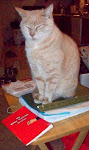
Hobo? Tramp? Or just bumming around? Email me a from_my_shelf@yahoo.com and let me know. Miss a past column? Next time you have public access just go to http://frommyshelf.blogspot .com and read your fill. Hobo, the cat used to be a tramp, but now he’s just a bookstore bum. It’s a nice gig if you can get it. Stop by and see for yourself…
Monday, May 6, 2013


Monday, April 29, 2013
He Fell From a Star

*
*
This month marks the 70th anniversary for the publication of The Little Prince, by French author, Antoine de Saint-Exupery. St-Exupery’s life, writing, and death have fascinated people for all these years: the story behind the story is just as interesting as the plots of his most well-loved works.
“St-Ex” was a little too old to be a war pilot (although this didn’t stop him) when the Nazi regime swept across Europe. Born in 1900, St-Exupery learned to fly with the generation of pilots who sought to fly longer distances, faster, across large sections of the globe. These pilots – including Charles Lindbergh and Amelia Earhart – flew more with guts and intuition than with instrumentation. St-Exupery was a pioneer of international postal flight—-the original “Aeropostale” for all you modern mall shoppers. Through the late 1920s, St-Exupery innovated and developed these mail routes connecting Europe, Africa, and South America. While participating in the Paris-to-Saigon air race in December of 1935, he and his mechanic-navigator crashed in the Saraha Desert and miraculously survived.
In the beginning of World War II in Europe, St-Exupery joined the French Air Force, but exiled himself when France surrendered to German occupation in 1940. The author-aviator-aristocrat spent the next three years in the US., encouraging Americans to enter the war, and writing some of his most famous pieces – including The Little Prince.
The Little Prince is one of the best-selling books of all time, making the list of the few titles that have sold over 100 million copies (current stats put it at about 140 million copies sold). Although there are many book series that have sold between 50 and 100 million copies, there are very few single titles that populate this esteemed list. Part of the reason for these staggering numbers of sales is that The Little Prince has been translated into more than 250 languages and dialects. Furthermore, in many countries, The Little Prince has gone through several translations – there have been six English translations, fifteen translations in Japanese, and more than fifty translations into Chinese.
Strangely enough, The Little Prince was not well-received by many of St-Exupery’s contemporary admirers. He was known for his tales of life as a pilot, in such books as Wind, Sand and Stars, for which he won the U.S.’s National Book Award. Though The Little Prince is the story of a pilot who crashes in the Saraha Desert, it was marketed as a children’s book, with its fantastical plot of the little prince from a far-away asteroid who meets the downed pilot in the desert. The strange mix of parables, talking animals, and pessimistic commentary on adult behaviors and cultural mores, didn’t appeal to the audience that St-Exupery had built. Nevertheless, it was published posthumously to growing acclaim, and, obviously, continues to charm generations around the world.
Though superior officers, friends, and concerned colleagues tried to permanently ground St-Exupery several times, citing his age, his health problems from earlier crashes, and his tendency to focus more on musing above the earth rather than on flying, St-Exupery continued flying missions for the Free French Air Force from 1943 through 1944. Adding to mystery to his legend, he took off from the southern coast of France on a reconnaissance mission in July 1944, when he was to gather information about German troop movements in the Rhone Valley, prior to a planned Ally invasion of that area. St-Exupery and his “war-weary” plane disappeared in stormy weather over the Mediterranean not long into his flight. There were no further clues to the mysterious end of an author who has himself become an icon of France until 1998, when a fisherman found a silver ID bracelet engraved with the names of St-Exupery, his wife, and his French publishing house – known to have been on his flight suit. In 2000, a diver found parts of the same make and model as St-Exupery’s, spread on the Mediterranean floor near the location of the bracelet.
I can tell you “the story behind the story”, but the question remains, why is The Little Prince so beloved? For decades, authors and publishers have wished that they could repeat the formula, that they could somehow bottle the charm, the lessons, the inspiration, that comes from less than 100 pages of a “children’s story.” Ultimately, to solve this mystery of the life and impact of Antoine St-Exupery, you will have to read The Little Prince for yourself.
Monday, April 22, 2013
Massage for Dummies
Kevin Coolidge
Have you ever had a massage? My first massage was from a girl friend. My back was stiff and sore from too much overtime and not enough sleep. She had gotten one of those how-to videos in the mail, and wanted to try some of the massage techniques. I’m not sure of the right word to use, but incredible will suffice. I could feel my stress drain away.
She wasn’t a professional massage therapist. She didn’t have a lot of training, but I felt the relief of muscle tension right away. Massage has many benefits. It increases circulation, which helps promote the healing of tissues and raises immune efficiency, reduces levels of stress, and can greatly improve your health and wellness
If you’d like to learn how soothe stress and reduce pain, you can read Massage for Dummies, written by licensed massage therapist Steve Capellini. This book has numerous step-by-step, hands-on photos and illustrations. You too can learn the basics and give and receive a therapeutic massage.
There are hundred of types of massage practiced around the world, from using wooden spoons to hit pressure points, a specialty of the Mongol hordes, to Rolfing, a form of structural bodywork that is quite intense*. These different styles of massage are called modalities, and most massage therapists today are trained in several.
There’s a chapter to help you choose the right style for you, learn some massage jargon, and how to choose a massage therapist. That’s right, one of the best ways to learn massage is to get massage. Most massage schools require students to have received a professional massage before applying.
According to the American Massage Therapy Association, only about 20% of Americans have received a professional massage. The biggest barrier for most people is that they don’t know what to expect. I didn’t. I would have found the information in this chapter very useful before I received my first professional massage.
You will find you will get more out of the massage if you know what you are hoping to achieve. People generally decide to get massage to relax, to feel better, or to improve the body’s functioning. Often, it’s a combination of all three. Letting your massage therapist know this can help you get the most out of your massage.
You can also get more out of your massage if you do a little planning. It’s best not to eat a large meal or consume alcohol before. I also don’t suggest wearing a lot of jewelry. This can eat into your massage time. An hour massage includes time before and after the massage to prepare. It usually leaves 50 minutes on the table. It’s also impossible to perform a proper effleurage** with a necklace in the way.
If you want to perform massage, Steve writes about working with massage oils, if you should invest in a massage table, or just use the floor, and attending to the comfort of your recipient. Body temperature usually drops during a massage, even the most warm-blooded cool when receiving massage, and it’s hard to relax if you’re shivering.
In chapter ten you’ll learn some of the basic massage moves and how to put them together to perform an actual massage. Massage is more a series of techniques, but a flow in which you don’t concentrate on techniques so much as focus on the feel and the movement.
Did massage change my life? I did go on to experience several professional massages, and eventually I enrolled in the Boulder School of Massage Therapy and became a trained and certified massage therapist. Massage helped get back in touch with what matters. Life matters. Health matters. People matter…
*I personally have received all ten Rolfing sessions, and exquisitely painful might be a better word choice here.
** A fancy French word meaning, “to skim” It’s a massage stroke used in Swedish massage used to prepare the muscle for deeper work.
Get rubbed the right way? Or Thanks, but I don’t knead it? Email me at from_my_shelf@yahoo.com and let me know. Miss a past column? Take a breath and relax. They are all available at http://frommyshelf.blogspot.com Hobo is a CMF. Certified Massage Feline. Stop by and he’ll train you to rub him the right way. Don’t forget the ears…
Have you ever had a massage? My first massage was from a girl friend. My back was stiff and sore from too much overtime and not enough sleep. She had gotten one of those how-to videos in the mail, and wanted to try some of the massage techniques. I’m not sure of the right word to use, but incredible will suffice. I could feel my stress drain away.
She wasn’t a professional massage therapist. She didn’t have a lot of training, but I felt the relief of muscle tension right away. Massage has many benefits. It increases circulation, which helps promote the healing of tissues and raises immune efficiency, reduces levels of stress, and can greatly improve your health and wellness
If you’d like to learn how soothe stress and reduce pain, you can read Massage for Dummies, written by licensed massage therapist Steve Capellini. This book has numerous step-by-step, hands-on photos and illustrations. You too can learn the basics and give and receive a therapeutic massage.
There are hundred of types of massage practiced around the world, from using wooden spoons to hit pressure points, a specialty of the Mongol hordes, to Rolfing, a form of structural bodywork that is quite intense*. These different styles of massage are called modalities, and most massage therapists today are trained in several.
There’s a chapter to help you choose the right style for you, learn some massage jargon, and how to choose a massage therapist. That’s right, one of the best ways to learn massage is to get massage. Most massage schools require students to have received a professional massage before applying.
According to the American Massage Therapy Association, only about 20% of Americans have received a professional massage. The biggest barrier for most people is that they don’t know what to expect. I didn’t. I would have found the information in this chapter very useful before I received my first professional massage.
You will find you will get more out of the massage if you know what you are hoping to achieve. People generally decide to get massage to relax, to feel better, or to improve the body’s functioning. Often, it’s a combination of all three. Letting your massage therapist know this can help you get the most out of your massage.
You can also get more out of your massage if you do a little planning. It’s best not to eat a large meal or consume alcohol before. I also don’t suggest wearing a lot of jewelry. This can eat into your massage time. An hour massage includes time before and after the massage to prepare. It usually leaves 50 minutes on the table. It’s also impossible to perform a proper effleurage** with a necklace in the way.
If you want to perform massage, Steve writes about working with massage oils, if you should invest in a massage table, or just use the floor, and attending to the comfort of your recipient. Body temperature usually drops during a massage, even the most warm-blooded cool when receiving massage, and it’s hard to relax if you’re shivering.
In chapter ten you’ll learn some of the basic massage moves and how to put them together to perform an actual massage. Massage is more a series of techniques, but a flow in which you don’t concentrate on techniques so much as focus on the feel and the movement.
Did massage change my life? I did go on to experience several professional massages, and eventually I enrolled in the Boulder School of Massage Therapy and became a trained and certified massage therapist. Massage helped get back in touch with what matters. Life matters. Health matters. People matter…
*I personally have received all ten Rolfing sessions, and exquisitely painful might be a better word choice here.
** A fancy French word meaning, “to skim” It’s a massage stroke used in Swedish massage used to prepare the muscle for deeper work.
Get rubbed the right way? Or Thanks, but I don’t knead it? Email me at from_my_shelf@yahoo.com and let me know. Miss a past column? Take a breath and relax. They are all available at http://frommyshelf.blogspot.com Hobo is a CMF. Certified Massage Feline. Stop by and he’ll train you to rub him the right way. Don’t forget the ears…
Monday, April 8, 2013
The Ultimate Man’s Survival Guide
Kevin Coolidge
The rite of passage, the transition from boy to man—a Spartan would be torn from his mother and forced to make his way in the wilderness. The bravest Cheyenne warriors would rouse a sleeping grizzly and then outrun the bear, or be mauled to death. Today this transition is subtler, more often marked by ages than feats.
You can smoke and gamble at eighteen. You can drink at twenty-one. Alcohol, tobacco, and playing blackjack are considered manly things, but it won’t turn a boy into a man. How do we become men when there’s no test to pass? Despite the lack of rite of passage, every male strives to be a man.
There’s more to being a man than fighting, drinking, and fornication. There’s being a father, a husband, a good friend, and a citizen. It’s keeping your own counsel and knowing when to seek advice. It’s knowing when to keep your mouth shut, but not being afraid to speak. It means standing your ground and finding your path even if there is no guide.
Luckily, there is a guide and that guide is The Ultimate Man’s Survival Guide written by Frank Minter. It’s a must-have guide on how to hunt, fish, shoot, survive in the wild, and everything else a man should know. Including the riddle that befuddles the most manly of men, “What do women want?”
Frank Sinatra, who had a Ph.D. on the subject of women, didn’t know, and the man who invented psychoanalysis, Sigmund Freud, never was able to answer it, but Minter knows. His chapter 6 titled “Romantic” is loaded with advice from women and the time-tested skills of ultimate romantics—such as Lord Byron and the Bard.
Minter divides his book into different parts labeled for modern archetypes*. In “Survivor,” there’s everything from fighting off a bear to meeting your water needs. In “Provider”, you’ll learn something about guns, shooting, and hunting, and in “Athlete,” you’ll learn how to throw the perfect pass and why a jab is better than a roundhouse.
A modern hero needs to be able to hold, feed, and change a baby, and to respond to a car accident. With this book, you can also learn how to buy and smoke a cigar. You can run with the bulls in Pamplona, Spain, and be able to live to talk about it over a properly mixed drink. A drink slowly savored and not gulped, because a drink among friends should be a bonding experience, not drunken debauchery.
According to Frank Minter every male must learn to be a man as best he can. This knowledge isn’t written in our genetic codes. Being a man is not just courage, intellect, and brawn. Training shapes a soldier, a poet, and a boxer. Knowledge instills confidence. Understanding breeds self-reliance, and The Ultimate Man’s Survival Guide packs a whole lot of assuredness between the covers of a book. Chances are you’ll learn something you didn’t know. So pick one up for yourself, your son, your nephew and your niece…
*An archetype is a universally understood symbol or pattern of behavior and is often used in myths and storytelling telling across different cultures.
Speak softly? Carry a big stick? Or Both? Email me at from_my_shelf@yahoo.com and let me know. Miss a past column? You can search them out for yourself at http://frommyshelf.blogspot.com Hobo was a kitten who grew to be a cat. His journey is the hero’s journey, but it’s cute and short and colorful, and you can read about it in “Hobo Finds A Home” Hobo—warrior, king, fool…
The rite of passage, the transition from boy to man—a Spartan would be torn from his mother and forced to make his way in the wilderness. The bravest Cheyenne warriors would rouse a sleeping grizzly and then outrun the bear, or be mauled to death. Today this transition is subtler, more often marked by ages than feats.
You can smoke and gamble at eighteen. You can drink at twenty-one. Alcohol, tobacco, and playing blackjack are considered manly things, but it won’t turn a boy into a man. How do we become men when there’s no test to pass? Despite the lack of rite of passage, every male strives to be a man.
There’s more to being a man than fighting, drinking, and fornication. There’s being a father, a husband, a good friend, and a citizen. It’s keeping your own counsel and knowing when to seek advice. It’s knowing when to keep your mouth shut, but not being afraid to speak. It means standing your ground and finding your path even if there is no guide.
Luckily, there is a guide and that guide is The Ultimate Man’s Survival Guide written by Frank Minter. It’s a must-have guide on how to hunt, fish, shoot, survive in the wild, and everything else a man should know. Including the riddle that befuddles the most manly of men, “What do women want?”
Frank Sinatra, who had a Ph.D. on the subject of women, didn’t know, and the man who invented psychoanalysis, Sigmund Freud, never was able to answer it, but Minter knows. His chapter 6 titled “Romantic” is loaded with advice from women and the time-tested skills of ultimate romantics—such as Lord Byron and the Bard.
Minter divides his book into different parts labeled for modern archetypes*. In “Survivor,” there’s everything from fighting off a bear to meeting your water needs. In “Provider”, you’ll learn something about guns, shooting, and hunting, and in “Athlete,” you’ll learn how to throw the perfect pass and why a jab is better than a roundhouse.
A modern hero needs to be able to hold, feed, and change a baby, and to respond to a car accident. With this book, you can also learn how to buy and smoke a cigar. You can run with the bulls in Pamplona, Spain, and be able to live to talk about it over a properly mixed drink. A drink slowly savored and not gulped, because a drink among friends should be a bonding experience, not drunken debauchery.
According to Frank Minter every male must learn to be a man as best he can. This knowledge isn’t written in our genetic codes. Being a man is not just courage, intellect, and brawn. Training shapes a soldier, a poet, and a boxer. Knowledge instills confidence. Understanding breeds self-reliance, and The Ultimate Man’s Survival Guide packs a whole lot of assuredness between the covers of a book. Chances are you’ll learn something you didn’t know. So pick one up for yourself, your son, your nephew and your niece…
*An archetype is a universally understood symbol or pattern of behavior and is often used in myths and storytelling telling across different cultures.
Speak softly? Carry a big stick? Or Both? Email me at from_my_shelf@yahoo.com and let me know. Miss a past column? You can search them out for yourself at http://frommyshelf.blogspot.com Hobo was a kitten who grew to be a cat. His journey is the hero’s journey, but it’s cute and short and colorful, and you can read about it in “Hobo Finds A Home” Hobo—warrior, king, fool…
Monday, March 25, 2013
The Theoretical Minimum
Kevin Coolidge
Good news--creating microscopic black holes using a particle accelerator requires even less energy than previously thought. With my very own atom smasher, I could create wormholes*, prove the existence of extra dimensions, travel through time and space and explore the multiverse**. I’ve done the math, and according to my calculations these mini black holes would probably be too small to consume any significant amount of matter—New Jersey, plus a Philly suburb or two, tops.
The problem is that I haven’t really used trigonometry since high school. Although that’s not completely true. I did just use it in a sentence, but it’s been sum time. Basically, building a cyclotron*** is a little more difficult than I thought. It does make me wish I had taken physics instead of basket weaving, but there’s still time. I just picked up a copy of The Theoretical Minimum by Leonard Susskind and George Hrabovsky.
I’m not the only one who wants to gaze upon the universe naked. As it happens, lots of people once wanted to study physics, but life got in the way. Most universities don’t allow insane villains or even responsible outsiders into classes, and for most grownups being a full-time student is not a realistic option.
This bothered George Hrabovsky. He felt there ought to be a way for people to develop their interests by interacting with active scientists, and that’s when he found out about Stanford’s Continuing Studies program. This program offers courses for people in the local nonacademic community. He thought it’d be fun to teach a course on modern physics.
Though he did enjoy it, he found that the students were not completely satisfied with a layperson’s knowledge of physics. Several had a bit of background—a little physics, rusty calculus, and experience with solving technical problems. They wanted to learn the real thing—with equations.
The result was a series of courses intended to teach students modern physics and cosmology. He did this by using the theoretical minimum, which he defines as just what you need in order to proceed to the next level. It’s not fat textbooks, but thin books that explain everything important. If you are determined to learn physics for real. The authors get directly to the important points that you are going to need to study more advanced topics. Now let’s begin with classical mechanics…
*in theory, a wormhole is a feature of spacetime that could act as a shortcut between two distant places, much like a bridge. It’d really cut down on commute time. If it didn’t eat the planet first.
**Our universe may not be the only one out there. In fact, it could be just one of an infinite number making up a “multiverse” Imagine, somewhere out there is a timeline in which the dominant mammals are otters…
***A type of particle accelerator in which charged particles accelerate outward from the center along a spiral path, theoretically cramming enough energy together at high velocity to generate a black hole and help me open the door to the multiverse.
Unfortunately, particle accelerators are also rather expensive. Please help a budding mad scientist by sending your contribution to the “Evil League of Evil,” attention Dr. Faustus. Include a self-addressed stamped envelope and I’ll send you a limited edition, foil card featuring me, with my sidekick Hobo, the crazy lab cat…
Good news--creating microscopic black holes using a particle accelerator requires even less energy than previously thought. With my very own atom smasher, I could create wormholes*, prove the existence of extra dimensions, travel through time and space and explore the multiverse**. I’ve done the math, and according to my calculations these mini black holes would probably be too small to consume any significant amount of matter—New Jersey, plus a Philly suburb or two, tops.
The problem is that I haven’t really used trigonometry since high school. Although that’s not completely true. I did just use it in a sentence, but it’s been sum time. Basically, building a cyclotron*** is a little more difficult than I thought. It does make me wish I had taken physics instead of basket weaving, but there’s still time. I just picked up a copy of The Theoretical Minimum by Leonard Susskind and George Hrabovsky.
I’m not the only one who wants to gaze upon the universe naked. As it happens, lots of people once wanted to study physics, but life got in the way. Most universities don’t allow insane villains or even responsible outsiders into classes, and for most grownups being a full-time student is not a realistic option.
This bothered George Hrabovsky. He felt there ought to be a way for people to develop their interests by interacting with active scientists, and that’s when he found out about Stanford’s Continuing Studies program. This program offers courses for people in the local nonacademic community. He thought it’d be fun to teach a course on modern physics.
Though he did enjoy it, he found that the students were not completely satisfied with a layperson’s knowledge of physics. Several had a bit of background—a little physics, rusty calculus, and experience with solving technical problems. They wanted to learn the real thing—with equations.
The result was a series of courses intended to teach students modern physics and cosmology. He did this by using the theoretical minimum, which he defines as just what you need in order to proceed to the next level. It’s not fat textbooks, but thin books that explain everything important. If you are determined to learn physics for real. The authors get directly to the important points that you are going to need to study more advanced topics. Now let’s begin with classical mechanics…
*in theory, a wormhole is a feature of spacetime that could act as a shortcut between two distant places, much like a bridge. It’d really cut down on commute time. If it didn’t eat the planet first.
**Our universe may not be the only one out there. In fact, it could be just one of an infinite number making up a “multiverse” Imagine, somewhere out there is a timeline in which the dominant mammals are otters…
***A type of particle accelerator in which charged particles accelerate outward from the center along a spiral path, theoretically cramming enough energy together at high velocity to generate a black hole and help me open the door to the multiverse.
Unfortunately, particle accelerators are also rather expensive. Please help a budding mad scientist by sending your contribution to the “Evil League of Evil,” attention Dr. Faustus. Include a self-addressed stamped envelope and I’ll send you a limited edition, foil card featuring me, with my sidekick Hobo, the crazy lab cat…
Monday, March 18, 2013
The Ten Commandments of …Comedy
Kevin Coolidge
Remember when fast food used to be fast? It’d be a whole lot faster if the cashier wouldn’t inspect my $20 so freakin’ hard. If I were talented enough to make my own money, I wouldn’t be eating here….
Surprise is so essential to comedy that if there isn’t a twist or surprise, it isn’t funny. Timing is important. You want to give the audience time to start thinking of a punch line. Drop it too soon, and they won’t be there. Drop it too late, and they’ll be gone. Pull it at the right time—surprise!
There are several techniques for generating this surprise. One device is misdirection. Lead them in one direction and then suddenly flip.
Take my wife…please
This classic one-liner at first leads the audience to believe that the comic is saying “Let’s use my wife as an example.” Then with the final word, he lets his listeners know that he is pleading for someone to actually take his wife.
Shock is another technique for creating surprise. Insults or gross language fall into this category. Some comics use obscenities because listeners are surprised, and it can get laughs, but you need to think of the commandment: “Remember the Audience.”
Every humorist needs an audience. Humor requires laughter. The audience must appreciate the humor. A funny joke is not funny if the audience doesn’t agree. Part of being a good humorist is to give them what they want to hear.
It doesn’t mean pandering to an audience. You shouldn’t change your standards to cater to an audience’s philosophy, but you want to avoid offending by excluding material that isn’t going to get any laughs.
Remember your job as a comic is to get laughs. If your material isn’t producing any, then maybe you need to learn more about your audience. You can gear material to a particular audience when working in a specific locale. Knowing what the people of the town or city are concerned with at the time can boost audience response.
There are fundamentals that control the effectiveness of comedy. Gene Perret has chosen to call them The Ten Commandments of Comedy. It’s gimmicky, but it gets your attention. You can ignore the threat from above and risk Armageddon, or you can read this book, analyze your material, and reap you reward.
Rules, regulations—you may disagree with them. They don’t apply to you, but humor is serious business. You can’t make a career as a comedy writer, performer, or a public speaker just because your friends think you’re funny.
Anything that works does so because it follows principles that make it work and comedy is no different. Comedy is a creative art, but it helps if you know the precepts that govern humor. You can add variation, creativity, and depth to your routine. Break those rules and you can keep your day job; follow Gene’s advice and you can always leave ‘em laughing…
Laugh last? Or laugh best? Email me at from_my_shelf@yahoo.com and let me know. Miss a past column? Get your stitches on at http:frommyshelf.blogspot.com Need some comedy relief? Cat like grace is for the dogs. Come see Hobo, the cat comedian—specializing in pratfalls, sword swallowing, and chain saw juggling…
Remember when fast food used to be fast? It’d be a whole lot faster if the cashier wouldn’t inspect my $20 so freakin’ hard. If I were talented enough to make my own money, I wouldn’t be eating here….
Surprise is so essential to comedy that if there isn’t a twist or surprise, it isn’t funny. Timing is important. You want to give the audience time to start thinking of a punch line. Drop it too soon, and they won’t be there. Drop it too late, and they’ll be gone. Pull it at the right time—surprise!
There are several techniques for generating this surprise. One device is misdirection. Lead them in one direction and then suddenly flip.
Take my wife…please
This classic one-liner at first leads the audience to believe that the comic is saying “Let’s use my wife as an example.” Then with the final word, he lets his listeners know that he is pleading for someone to actually take his wife.
Shock is another technique for creating surprise. Insults or gross language fall into this category. Some comics use obscenities because listeners are surprised, and it can get laughs, but you need to think of the commandment: “Remember the Audience.”
Every humorist needs an audience. Humor requires laughter. The audience must appreciate the humor. A funny joke is not funny if the audience doesn’t agree. Part of being a good humorist is to give them what they want to hear.
It doesn’t mean pandering to an audience. You shouldn’t change your standards to cater to an audience’s philosophy, but you want to avoid offending by excluding material that isn’t going to get any laughs.
Remember your job as a comic is to get laughs. If your material isn’t producing any, then maybe you need to learn more about your audience. You can gear material to a particular audience when working in a specific locale. Knowing what the people of the town or city are concerned with at the time can boost audience response.
There are fundamentals that control the effectiveness of comedy. Gene Perret has chosen to call them The Ten Commandments of Comedy. It’s gimmicky, but it gets your attention. You can ignore the threat from above and risk Armageddon, or you can read this book, analyze your material, and reap you reward.
Rules, regulations—you may disagree with them. They don’t apply to you, but humor is serious business. You can’t make a career as a comedy writer, performer, or a public speaker just because your friends think you’re funny.
Anything that works does so because it follows principles that make it work and comedy is no different. Comedy is a creative art, but it helps if you know the precepts that govern humor. You can add variation, creativity, and depth to your routine. Break those rules and you can keep your day job; follow Gene’s advice and you can always leave ‘em laughing…
Laugh last? Or laugh best? Email me at from_my_shelf@yahoo.com and let me know. Miss a past column? Get your stitches on at http:frommyshelf.blogspot.com Need some comedy relief? Cat like grace is for the dogs. Come see Hobo, the cat comedian—specializing in pratfalls, sword swallowing, and chain saw juggling…
Tuesday, March 12, 2013
The Wolf Takes the Stand
Kevin Coolidge
“Your Honor, I’d like to call Canis lupus to the stand.”
“Oh, that’s me,” said the Big Bad Wolf, loping past the court reporter. “That’s my Latin name. Just call me Wolf. Everybody does.”
“Mr. Wolf. You stand accused of the murder of Grandma, and the violation of Red Riding Hood. How do you plead?”
“I’d like to state for the record that I am not guilty.”
“Mr. Wolf, it is widely known that you are a killer.”
“I’m a apex predator, the very top of my trophic level. That refers to my position in the food chain.
“So, you are not a herbivore, Mr. Wolf?”
“No, I don’t eat plants. I’m a meat eater, a carnivore.”
“Ladies and Gentlemen of the Jury, as I stated, the wolf is designed to kill. I refer to exhibit A, the canine teeth--sharp and pointed; adapted to puncturing, slashing, and clinging. The teeth even “interlock” to grip and hang on to struggling prey. Also, Exhibit B, the back teeth, or carnassial molars, are designed to crush bones and shear meat.”
“It may sound violent,” yelped Wolf, “but I’m actually pretty docile and have an aversion to fighting. Predation is not an act of violence. It is the act of obtaining food for survival. I did state for the record that I eat meat. I prefer moose or caribou, but without a pack, these large game animals are too difficult.”
“I’ll also eat mice, rabbits, hare, squirrels, and chipmunks. I do prey on the weak, sick and young---which keeps herds healthy and strong. You humans, on the other hand, kill indiscriminately, often taking bucks and breeding females.”
“Humanity is not on trial here,” snarls the attorney. “Are there not cases of wolves killing humans?”
“No documented cases. My cousin the Gray Wolf did do time for an aggravated assault, and he wasn’t himself. He was a sick wolf. He had rabies.”
“Ha, so you admit that wolves will attack people!”
“He was cornered. Biting the hand of a shepherd is not mutton one. I mean, murder one.”
“So, wolves do kill livestock!”
“Wolves have been known to kill sheep or cattle. We can go days without eating, but we need meat. It’s not usually a pack, but one or two wolves. We have a bad rap sheet. Even though livestock are more often killed by feral dogs, we get framed for the carcass if a canine print is found nearby. You humans stink of death, but you can’t smell to save your life.”
“Where were you on the night that Grandma was brutally murdered?” howls the lawyer.
“I was traveling with my pack. Our territories can be hundreds of square miles. I wasn’t anywhere near there.”
“I suppose you have an alibi?” growls the lawyer.
“I was with my mate and pack. There are seven of us. Actually if the pack is too large, it is less efficient and there is less food per wolf.”
“It’s mankind that is harassing my kind. Pushing us into remote areas. Killing, blaming and pressuring--I’d like to submit a document in my defense. It is titled Of Wolves and Men written by Barry Holstun Lopez. It’s a wealth of observation, as well as mythology and mysticism, that surrounds our lives and shows an effort to understand the trials wolves have faced.”
“Someone must pay for this slaughter!” yowls the prosecutor, as he wildly gestures to the court room. “Are not wolves associated with danger and destruction? Does death not follow in his wake?!”
“Is it just me or is it hot in here?” the prosecutor then exclaims, ripping open his shirt, exposing a heaving chest dark with coarse hair. “Your Honor, I respectively request a recess so that I may devour the jury…”
The strength of the wolf is the pack? Or the strength of the pack is the wolf? Email me at from_my_shelf@yahoo.com and give me your verdict. Ravenous for past columns? Follow my lead and go to http://frommyshelf,blogspot,com Hobo is actually a wolf in cat’s clothing. Stop by and I’ll show you his zipper…
“Your Honor, I’d like to call Canis lupus to the stand.”
“Oh, that’s me,” said the Big Bad Wolf, loping past the court reporter. “That’s my Latin name. Just call me Wolf. Everybody does.”
“Mr. Wolf. You stand accused of the murder of Grandma, and the violation of Red Riding Hood. How do you plead?”
“I’d like to state for the record that I am not guilty.”
“Mr. Wolf, it is widely known that you are a killer.”
“I’m a apex predator, the very top of my trophic level. That refers to my position in the food chain.
“So, you are not a herbivore, Mr. Wolf?”
“No, I don’t eat plants. I’m a meat eater, a carnivore.”
“Ladies and Gentlemen of the Jury, as I stated, the wolf is designed to kill. I refer to exhibit A, the canine teeth--sharp and pointed; adapted to puncturing, slashing, and clinging. The teeth even “interlock” to grip and hang on to struggling prey. Also, Exhibit B, the back teeth, or carnassial molars, are designed to crush bones and shear meat.”
“It may sound violent,” yelped Wolf, “but I’m actually pretty docile and have an aversion to fighting. Predation is not an act of violence. It is the act of obtaining food for survival. I did state for the record that I eat meat. I prefer moose or caribou, but without a pack, these large game animals are too difficult.”
“I’ll also eat mice, rabbits, hare, squirrels, and chipmunks. I do prey on the weak, sick and young---which keeps herds healthy and strong. You humans, on the other hand, kill indiscriminately, often taking bucks and breeding females.”
“Humanity is not on trial here,” snarls the attorney. “Are there not cases of wolves killing humans?”
“No documented cases. My cousin the Gray Wolf did do time for an aggravated assault, and he wasn’t himself. He was a sick wolf. He had rabies.”
“Ha, so you admit that wolves will attack people!”
“He was cornered. Biting the hand of a shepherd is not mutton one. I mean, murder one.”
“So, wolves do kill livestock!”
“Wolves have been known to kill sheep or cattle. We can go days without eating, but we need meat. It’s not usually a pack, but one or two wolves. We have a bad rap sheet. Even though livestock are more often killed by feral dogs, we get framed for the carcass if a canine print is found nearby. You humans stink of death, but you can’t smell to save your life.”
“Where were you on the night that Grandma was brutally murdered?” howls the lawyer.
“I was traveling with my pack. Our territories can be hundreds of square miles. I wasn’t anywhere near there.”
“I suppose you have an alibi?” growls the lawyer.
“I was with my mate and pack. There are seven of us. Actually if the pack is too large, it is less efficient and there is less food per wolf.”
“It’s mankind that is harassing my kind. Pushing us into remote areas. Killing, blaming and pressuring--I’d like to submit a document in my defense. It is titled Of Wolves and Men written by Barry Holstun Lopez. It’s a wealth of observation, as well as mythology and mysticism, that surrounds our lives and shows an effort to understand the trials wolves have faced.”
“Someone must pay for this slaughter!” yowls the prosecutor, as he wildly gestures to the court room. “Are not wolves associated with danger and destruction? Does death not follow in his wake?!”
“Is it just me or is it hot in here?” the prosecutor then exclaims, ripping open his shirt, exposing a heaving chest dark with coarse hair. “Your Honor, I respectively request a recess so that I may devour the jury…”
The strength of the wolf is the pack? Or the strength of the pack is the wolf? Email me at from_my_shelf@yahoo.com and give me your verdict. Ravenous for past columns? Follow my lead and go to http://frommyshelf,blogspot,com Hobo is actually a wolf in cat’s clothing. Stop by and I’ll show you his zipper…
Monday, March 4, 2013
Grow Your Own Drugs
Kevin Coolidge
I’m hot, achy, and my head hurts—I’m not sure if it’s a cold, flu, or that those leftovers in the back of the fridge. I do know I need drugs. Lots of drugs. Drugs that I wished I could grow myself, because it’s not like I can go into a drugstore and have someone give them to me for free.
It’s a been a long winter and a tough flu season, but spring is coming. Now is a great time to prepare to grow the drugs I need myself. This is why I chose to read Grow Your Own Drugs by James Wong. It’s a provocative title, but it’s a guide to growing home remedies—legitimate remedies for a variety of ailments, ranging from sore throats, cold sores and hot flashes to hangovers, immune boosters, and beauty products.
James Wong is a trained ethnobotanist* He sees plants as more than a frivolous decoration, but rather as a living pharmacy. Traditional plant-based remedies have provided modern medicine with many of its most important drugs.
In the last few years, there’s been a surge of interest in using herbs to treat common ailments. Plant based remedies can be cheaper and less harmful than pharmaceutical drugs. This book can be a guide to help you get the most out of plants and their various properties.
It starts off explaining how to grow and harvest suitable plants in your backyard and then make them into simple, effective remedies to treat common ailments. There are over sixty recipes for teas, creams, lotions, balms, and cough syrups—all pretty easy and inexpensive.
In the second half of this book, the author gives us a wealth of information on the top 100 medicinal plants offering first-class horticultural information as well distilling the knowledge of herbal practitioners with the latest scientific findings to bring us practical and reliable information.
Most of these plants can be grown in your backyard, or windowsill, but he’s included a few exotic plants, because of their effectiveness. You might not be able to grow these yourself, but he includes where you can find these dried or in extracts.
Some home remedies can give over-the-counter medicines solid competition, but it’s important to be safe and not medicate or diagnose without seeking medical advice. This is especially important of you have an existing medical condition.
It’s always a good idea to check with a professional. It’s just as important to make sure you have identified a species correctly if you are harvesting the plants yourself. Certain plants can be quite poisonous and deadly.
Modern medicine is effective for serious conditions, but plant-based remedies can give us gentle ways to manage everyday ailments and take charge of our health and get in touch with nature. After reading this book, you’ll never look at your backyard the same way again...
*Ethnobotany: A branch of botany that studies the lore and uses of plants in folklore, religion, and healing customs of a people
Feed a fever? Or Starve a cold? Email me from_my_shelf@yahoo.com and let me know. Miss a column? Catch up on your sick days at http://frommyshelf.blogspot.com and feel better. Be sure to catch Hobo’s new book on home remedies, coming soon. He prefers chicken to fish. So you know there’s going to be some great chicken soup recipes…
I’m hot, achy, and my head hurts—I’m not sure if it’s a cold, flu, or that those leftovers in the back of the fridge. I do know I need drugs. Lots of drugs. Drugs that I wished I could grow myself, because it’s not like I can go into a drugstore and have someone give them to me for free.
It’s a been a long winter and a tough flu season, but spring is coming. Now is a great time to prepare to grow the drugs I need myself. This is why I chose to read Grow Your Own Drugs by James Wong. It’s a provocative title, but it’s a guide to growing home remedies—legitimate remedies for a variety of ailments, ranging from sore throats, cold sores and hot flashes to hangovers, immune boosters, and beauty products.
James Wong is a trained ethnobotanist* He sees plants as more than a frivolous decoration, but rather as a living pharmacy. Traditional plant-based remedies have provided modern medicine with many of its most important drugs.
In the last few years, there’s been a surge of interest in using herbs to treat common ailments. Plant based remedies can be cheaper and less harmful than pharmaceutical drugs. This book can be a guide to help you get the most out of plants and their various properties.
It starts off explaining how to grow and harvest suitable plants in your backyard and then make them into simple, effective remedies to treat common ailments. There are over sixty recipes for teas, creams, lotions, balms, and cough syrups—all pretty easy and inexpensive.
In the second half of this book, the author gives us a wealth of information on the top 100 medicinal plants offering first-class horticultural information as well distilling the knowledge of herbal practitioners with the latest scientific findings to bring us practical and reliable information.
Most of these plants can be grown in your backyard, or windowsill, but he’s included a few exotic plants, because of their effectiveness. You might not be able to grow these yourself, but he includes where you can find these dried or in extracts.
Some home remedies can give over-the-counter medicines solid competition, but it’s important to be safe and not medicate or diagnose without seeking medical advice. This is especially important of you have an existing medical condition.
It’s always a good idea to check with a professional. It’s just as important to make sure you have identified a species correctly if you are harvesting the plants yourself. Certain plants can be quite poisonous and deadly.
Modern medicine is effective for serious conditions, but plant-based remedies can give us gentle ways to manage everyday ailments and take charge of our health and get in touch with nature. After reading this book, you’ll never look at your backyard the same way again...
*Ethnobotany: A branch of botany that studies the lore and uses of plants in folklore, religion, and healing customs of a people
Feed a fever? Or Starve a cold? Email me from_my_shelf@yahoo.com and let me know. Miss a column? Catch up on your sick days at http://frommyshelf.blogspot.com and feel better. Be sure to catch Hobo’s new book on home remedies, coming soon. He prefers chicken to fish. So you know there’s going to be some great chicken soup recipes…
Monday, February 11, 2013
Tales of the Weird
Kevin Coolidge
Nothing ever happens? Things seem pretty ordinary? Take a closer look and things might start to look a little bizarre. Think about it. Your brain is the only organ aware of its own existence, and right now might be taking a power nap, without your permission. Your nose has the ability to sniff out the opposite sex. Your hair can tell scientists if you are a morning person or a night owl. Aren’t you glad your liver isn’t capable of remembering what you did last weekend? Scientists are discovering strange new things every day. Yeah, life is weird. I mean really weird.
Life always has been a little weird. Do sea monsters and saber-toothed squirrels seem weird to you? Two German paleontologists found a skull the size of a small car in Mexico. The skull belonged to a pliosaur, a type of pleisaur that had a short neck, a huge crocodile-like head, and razor-sharp teeth. This specimen would have longer than a humpback whale and had teeth the size of cucumbers. Gee, aren’t you glad the largest dinosaurs were vegetarians?
Fossils of ancient mammals are very rare because they are so small. Mammals didn’t grow to be the size of cats and dogs until the larger dinosaurs became extinct. The fossilized skull and teeth of a small fanged mammal was found in Argentina. It took a technician three years to remove the rock from around the fossil—finally revealing a saber-toothed, squirrel-like creature much like the squirrel character from the movie Ice Age.
It’s not just animals that are weird. A moss spreading throughout the Hawaiian Islands appears to be an ancient clone that has copied itself for some 50,000 years, and discovered in 2004 is a lone Norway spruce in Sweden was deemed to be the world’s oldest living plant. Although the visible portion of the 13-foot tree isn’t ancient, its root system has been growing for 9,550 years.
Discovered on an island off the coast of Madagascar in 2006 was a new species of Amorphallus*--the genus that includes the “corpse flower”. The newfound plant blooms once a year with a “really foul” stench**, according to Greg Wahlert. The flower is dormant for much of the year. If he had been visiting the islands at a different time, “I could have very easily missed it.”
Think that’s weird? You better keep on the lookout, because things just keep weirder. Tales of the Weird! Editor David Braun has chosen his favorite freaky favorites from the files of National Geographic Daily New—from “zombie ants” to one-eyed albino sharks to ancient death rituals. You can’t make this stuff up! Each story is backed by science and fueled by wonder. Read it and be surprised and delighted on just how weird the world can really be…
*Means “misshapen penis” in Greek after the phallic shape of the plants flowers. You probably didn’t need to know that, but it will really impress your teacher. Trust me.
**The smell has been described as a combination of “rotting roadkill” and a “Port-a- Potty”.
A life less ordinary? Or the straight and narrow path? Email me at from_my_shelf@yahoo.com and let me know. Miss a past column? You can visit the past at http://frommyshelf.blogspot.com and explore. Looking for a little Tioga County history? Read “Hobo Finds a Home”, a children’s book about how a stray cat from Wellsboro found a home, a friend, and a Tyrannosaurus Rex skull…
Nothing ever happens? Things seem pretty ordinary? Take a closer look and things might start to look a little bizarre. Think about it. Your brain is the only organ aware of its own existence, and right now might be taking a power nap, without your permission. Your nose has the ability to sniff out the opposite sex. Your hair can tell scientists if you are a morning person or a night owl. Aren’t you glad your liver isn’t capable of remembering what you did last weekend? Scientists are discovering strange new things every day. Yeah, life is weird. I mean really weird.
Life always has been a little weird. Do sea monsters and saber-toothed squirrels seem weird to you? Two German paleontologists found a skull the size of a small car in Mexico. The skull belonged to a pliosaur, a type of pleisaur that had a short neck, a huge crocodile-like head, and razor-sharp teeth. This specimen would have longer than a humpback whale and had teeth the size of cucumbers. Gee, aren’t you glad the largest dinosaurs were vegetarians?
Fossils of ancient mammals are very rare because they are so small. Mammals didn’t grow to be the size of cats and dogs until the larger dinosaurs became extinct. The fossilized skull and teeth of a small fanged mammal was found in Argentina. It took a technician three years to remove the rock from around the fossil—finally revealing a saber-toothed, squirrel-like creature much like the squirrel character from the movie Ice Age.
It’s not just animals that are weird. A moss spreading throughout the Hawaiian Islands appears to be an ancient clone that has copied itself for some 50,000 years, and discovered in 2004 is a lone Norway spruce in Sweden was deemed to be the world’s oldest living plant. Although the visible portion of the 13-foot tree isn’t ancient, its root system has been growing for 9,550 years.
Discovered on an island off the coast of Madagascar in 2006 was a new species of Amorphallus*--the genus that includes the “corpse flower”. The newfound plant blooms once a year with a “really foul” stench**, according to Greg Wahlert. The flower is dormant for much of the year. If he had been visiting the islands at a different time, “I could have very easily missed it.”
Think that’s weird? You better keep on the lookout, because things just keep weirder. Tales of the Weird! Editor David Braun has chosen his favorite freaky favorites from the files of National Geographic Daily New—from “zombie ants” to one-eyed albino sharks to ancient death rituals. You can’t make this stuff up! Each story is backed by science and fueled by wonder. Read it and be surprised and delighted on just how weird the world can really be…
*Means “misshapen penis” in Greek after the phallic shape of the plants flowers. You probably didn’t need to know that, but it will really impress your teacher. Trust me.
**The smell has been described as a combination of “rotting roadkill” and a “Port-a- Potty”.
A life less ordinary? Or the straight and narrow path? Email me at from_my_shelf@yahoo.com and let me know. Miss a past column? You can visit the past at http://frommyshelf.blogspot.com and explore. Looking for a little Tioga County history? Read “Hobo Finds a Home”, a children’s book about how a stray cat from Wellsboro found a home, a friend, and a Tyrannosaurus Rex skull…
Monday, February 4, 2013
The Significance of Stories
Kevin Coolidge
Family stories—those tales told at gatherings that amuse, embarrass, and help hold a family together. I remember the story my uncle told me the war? There he was stuck in a foxhole with his back teeth floating. Nowhere to empty his bladder except for his helmet. It would have been fine, except the shelling started. Was that Korea or Vietnam? Or maybe that was Grandpa and the Battle for the Bulge?
I forget. I’ve heard those stories so many times I never thought I could, but now I can’t remember them quite as well as I’d like. I wish that our family had somehow preserved more of those stories we know we heard but cannot quite recall now.
I love a good story and I bet you do too. We tend to forget that we have our own stories to tell as well. We are the ones who must be the storytellers if there is to be a tradition of family stories in years to come.
If your response is, “I have no stories to tell. Nothing ever happens to me!” then take a look at Telling Your Own Stories written by Donald Davis. Donald wrote this book for those who long for family storytelling, but live with the misconception that they have no stories to tell.
Stories are about people, places, or events. There are stories to be found. The center of every story plot is a crisis. A crisis is any event which takes a part of our life that is familiar and comfortable and makes us adjust to a world that is different than before. It can be a heart attack, a fire, a new baby, or a marriage. A simple event may have more than a simple significance.
Telling Your Own Stories is set up as a workbook. The author has included prompts to help pull stories from memory. You can read the prompts in a family setting and see who comes up with a story first. You can use the blank space to make brief notes so that you can come back and work on the story more fully later.
Be sure that when a person begins to tell their story, that others let them tell it. You may have memories about the same event, and your memories will make a different story. The human mind stores all the impressions of our lives and experiences. We just have to access them.
Scary, funny, entertaining—stories are all around us. Stories give shape to our fears and our dreams. Stories hold our history and guide our actions. Stories can define us, teach us, and give us hope. Stories are powerful. The stories we create can help us understand the deeper meaning of our lives, and impart that wisdom to others…
Short on stories? Or the never-ending taleteller? Email me at from_my_shelf@yahoo.com and let me know. Miss a past column? I could tell you all about it, or you could just visit http://frommyshelf.blogspot.com and find out for yourself. Looking for the story of how Hobo the cat came to live with me? Read “Hobo Finds a Home” a kitten’s story of how he found a home, and a friend…
Family stories—those tales told at gatherings that amuse, embarrass, and help hold a family together. I remember the story my uncle told me the war? There he was stuck in a foxhole with his back teeth floating. Nowhere to empty his bladder except for his helmet. It would have been fine, except the shelling started. Was that Korea or Vietnam? Or maybe that was Grandpa and the Battle for the Bulge?
I forget. I’ve heard those stories so many times I never thought I could, but now I can’t remember them quite as well as I’d like. I wish that our family had somehow preserved more of those stories we know we heard but cannot quite recall now.
I love a good story and I bet you do too. We tend to forget that we have our own stories to tell as well. We are the ones who must be the storytellers if there is to be a tradition of family stories in years to come.
If your response is, “I have no stories to tell. Nothing ever happens to me!” then take a look at Telling Your Own Stories written by Donald Davis. Donald wrote this book for those who long for family storytelling, but live with the misconception that they have no stories to tell.
Stories are about people, places, or events. There are stories to be found. The center of every story plot is a crisis. A crisis is any event which takes a part of our life that is familiar and comfortable and makes us adjust to a world that is different than before. It can be a heart attack, a fire, a new baby, or a marriage. A simple event may have more than a simple significance.
Telling Your Own Stories is set up as a workbook. The author has included prompts to help pull stories from memory. You can read the prompts in a family setting and see who comes up with a story first. You can use the blank space to make brief notes so that you can come back and work on the story more fully later.
Be sure that when a person begins to tell their story, that others let them tell it. You may have memories about the same event, and your memories will make a different story. The human mind stores all the impressions of our lives and experiences. We just have to access them.
Scary, funny, entertaining—stories are all around us. Stories give shape to our fears and our dreams. Stories hold our history and guide our actions. Stories can define us, teach us, and give us hope. Stories are powerful. The stories we create can help us understand the deeper meaning of our lives, and impart that wisdom to others…
Short on stories? Or the never-ending taleteller? Email me at from_my_shelf@yahoo.com and let me know. Miss a past column? I could tell you all about it, or you could just visit http://frommyshelf.blogspot.com and find out for yourself. Looking for the story of how Hobo the cat came to live with me? Read “Hobo Finds a Home” a kitten’s story of how he found a home, and a friend…
Subscribe to:
Posts (Atom)
